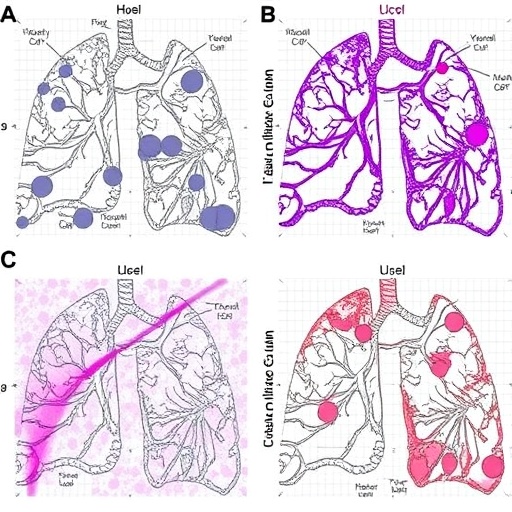
A new study in Nature Communications is bringing fresh attention to one of the most consequential—and least visible—battlegrounds in non-small cell lung cancer: the movement and transformation of immune cells between tumors and nearby lymph nodes. Researchers led by Tosello Boari, Richer and Missolo-Koussou report that follicular CD4+ T cells can share common T-cell receptor clones across these anatomical sites while also displaying remarkable cellular plasticity. The finding challenges the traditional view that immune responses are organized in isolated compartments. Instead, it suggests that lymph nodes and tumors may function as interconnected immune ecosystems, where T cells circulate, expand, specialize and potentially change their behavior in response to local signals.
Non-small cell lung cancer, or NSCLC, accounts for the majority of lung cancer diagnoses and remains difficult to control even when tumors are heavily infiltrated by immune cells. The presence of immune cells inside a tumor does not automatically mean that they are effectively attacking malignant cells. Some immune populations can support anti-tumor activity, while others may become exhausted, diverted or reprogrammed by the tumor microenvironment. Follicular CD4+ T cells are particularly important because they help organize antibody-producing responses and coordinate interactions between T cells, B cells and antigen-presenting cells. Within tumors and lymphoid tissues, related populations may contribute to the formation of specialized structures resembling germinal centers, where immune cells exchange signals and refine their responses.
The concept at the heart of the study is clonal sharing. Every T cell carries a receptor generated through genetic rearrangement, creating a molecular identity that allows researchers to distinguish one T-cell clone from another. When cells in different tissues possess highly similar or identical T-cell receptor sequences, they can be described as clonally related. Such shared clones provide evidence that cells have migrated from a common source, expanded in response to the same antigen or moved between tissues over time. In cancer research, this information is especially valuable because it can reveal whether immune cells in a tumor are locally generated, recruited from draining lymph nodes or part of a broader response distributed throughout the body.
The researchers focused on follicular CD4+ T cells, a family of immune cells that includes T follicular helper-like populations. These cells are defined not only by their CD4 marker but also by combinations of molecules involved in positioning, activation and communication. Chemokine receptors such as CXCR5 can guide cells toward B-cell-rich follicles, while transcriptional regulators including BCL6 help establish follicular programs. Once activated, these T cells can produce cytokines and surface signals that influence B-cell maturation, antibody production and the development of immune memory. In cancer, however, the same cellular machinery can be reshaped by persistent antigen exposure, inflammatory signals and suppressive molecules released by tumor and stromal cells.
The study’s emphasis on plasticity is critical. Plasticity describes the ability of a cell to alter its functional state without necessarily changing its fundamental lineage. A follicular CD4+ T cell may acquire features associated with other helper T-cell states, lose some follicular characteristics or develop a hybrid profile shaped by its surroundings. This flexibility is controlled by transcription factors, cytokine networks, metabolic conditions and antigen stimulation. A lymph node may provide signals that support proliferation and coordination with B cells, whereas a tumor may expose the same clone to hypoxia, nutrient limitation, inhibitory receptors and continuous stimulation. The resulting cells can remain clonally related while behaving differently, demonstrating that genetic identity and functional state are not the same thing.
By examining related T-cell populations across lymph nodes and tumor tissue, the work provides a framework for understanding how anti-cancer immunity is assembled. Tumor-draining lymph nodes are often described as training grounds, where dendritic cells present tumor-derived antigens and activate naïve or memory T cells. Tumors, meanwhile, are sites of intense selection, where immune cells encounter malignant cells and a complex network of suppressive signals. If follicular CD4+ T-cell clones are found in both locations, it suggests that the immune response may be distributed along a continuous pathway rather than confined to one site. It also raises the possibility that cells primed in lymph nodes can enter tumors, or that tumor-experienced cells can influence lymph-node responses.
This distinction matters for immunotherapy. Treatments such as immune-checkpoint inhibitors work partly by releasing brakes on T-cell activity, but their success depends on whether responsive T-cell populations exist, whether they can reach the tumor and whether they can maintain effective function once there. Shared clones could represent a reservoir of tumor-reactive cells that moves between supportive lymphoid environments and hostile tumor tissue. At the same time, plasticity means that the same clone might not respond identically in each compartment. A cell with helper or organizational activity in a lymph node could become dysfunctional, regulatory or otherwise altered after entering a tumor. Therapies may therefore need to influence not only the number of T cells but also the signals that determine their state.
The findings also have implications for how scientists interpret tumor biopsies. A single tissue sample captures only one location at one moment, yet immune responses are dynamic and spatially distributed. Two tumors with similar numbers of infiltrating CD4+ T cells may contain radically different clonal architectures and functional programs. High-resolution techniques such as single-cell RNA sequencing, paired T-cell receptor sequencing and spatial transcriptomics can help distinguish these possibilities. T-cell receptor sequencing identifies clonal relationships, while gene-expression analysis indicates what those cells are doing. Spatial approaches add information about where cells are positioned relative to tumor cells, blood vessels, B-cell clusters and antigen-presenting cells. Together, these methods can expose relationships that would remain invisible in conventional pathology.
The study does not reduce the immune response to a simple contest between “good” and “bad” cells. Instead, it presents follicular CD4+ T cells as adaptable participants in a changing network that spans tumors and lymph nodes. Their shared clonal identities suggest continuity, while their different states reveal environmental influence. That combination may help explain why immune responses can appear strong in one tissue but ineffective in another, and why therapies that work for one patient fail in the next. The broader message is that cancer immunity is not defined only by which cells are present. It also depends on where they have been, how they are related, what signals they receive and whether their functional identity can be redirected. By mapping these connections, the research opens a path toward more precise immunotherapies designed to mobilize entire immune circuits rather than isolated cell populations.
Subject of Research: Clonal sharing and plasticity of follicular CD4+ T cells across lymph nodes and tumors in non-small cell lung cancer
Article Title: Clonal sharing and plasticity of follicular CD4+ T cells across lymph nodes and tumors in non-small cell lung cancer
Article References: Tosello Boari, J., Richer, W., Missolo-Koussou, Y. et al. “Clonal sharing and plasticity of follicular CD4+ T cells across lymph nodes and tumors in non-small cell lung cancer.” Nature Communications (2026). https://doi.org/10.1038/s41467-026-76101-6
Image Credits: AI Generated
DOI: 10.1038/s41467-026-76101-6
Keywords: non-small cell lung cancer, follicular CD4+ T cells, T-cell receptor clonotypes, clonal sharing, immune-cell plasticity, tumor microenvironment, lymph nodes, cancer immunology, immunotherapy
Tags: follicular CD4+ T cellsimmune cell adaptation in non-small cell lung cancerimmune cell plasticity in tumorsimmune response organization in lung cancerlymph node and tumor immune interactionsnon-small cell lung cancerrole of follicular T cells in cancer immunityT cell coordination with B cells in tumorsT cell migration in cancerT cell reprogramming in tumor microenvironmentT-cell receptor sharing across lymph nodes and tumorstumor-lymph node immune ecosystem