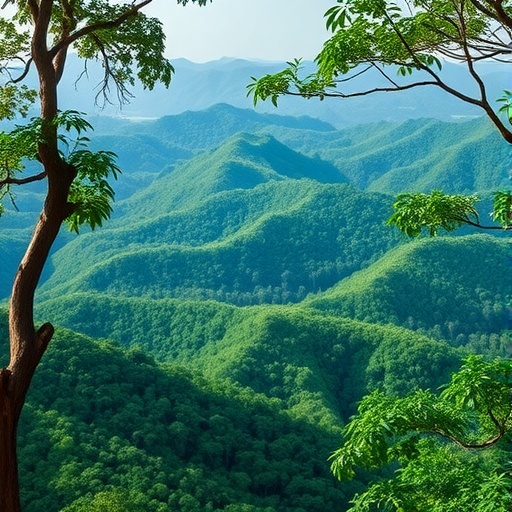
Tropical mountain forests may be hiding a major biodiversity story several meters below the canopy. A study conducted in China’s Yunkai Mountain National Nature Reserve has revealed that the plants growing beneath the forest canopy do not follow the same biodiversity patterns as the trees above them. Instead, overstory and understory communities responded to elevation in sharply different ways, challenging the assumption that tree diversity can serve as a reliable proxy for the biological richness of an entire forest. The findings suggest that conservation strategies focused primarily on canopy trees may overlook crucial plant communities—and rare species—living in the darker, more humid layer below.
Researchers established 16 sampling sites across an elevational gradient of almost 1,500 meters, allowing them to compare tropical mountain forest communities from lower slopes to higher elevations. At each site, they surveyed canopy trees and understory plants, while also recording the distribution of two nationally protected fern species, Alsophila spinulosa and Angiopteris fokiensis. The design enabled the team to examine both vertical stratification, or differences between forest layers, and elevational turnover, or changes in species composition as altitude increases. Such comparisons are especially important in mountain ecosystems, where temperature, moisture, light availability, soil conditions and human disturbance can shift rapidly over relatively short distances.
The researchers found that tree-layer alpha diversity—the number and relative distribution of species within a local community—followed a classic unimodal pattern. Tree diversity was lowest toward the lower and upper portions of the gradient and reached its highest point at middle elevations. This mid-elevation peak is common in mountain ecology and may reflect a combination of favorable climatic conditions, habitat complexity and the overlap of species originating from warmer lowlands and cooler highlands. The pattern indicates that the canopy reaches its greatest local richness in a relatively narrow portion of the landscape, but it does not describe the behavior of the vegetation beneath it.
Understory alpha diversity remained consistently higher than tree-layer diversity and displayed a striking bimodal pattern. Instead of producing one central peak, understory richness reached two separate maxima, at approximately 400–600 meters and 1,000–1,200 meters. This means that the forest floor supported particularly diverse plant assemblages in both lower and upper sections of the elevational gradient, even though the canopy itself was most diverse at middle elevations. The result highlights how vertical layers can respond independently to the same landscape. Understory plants experience environmental conditions that differ substantially from those experienced by trees, including filtered sunlight, more stable temperatures, higher humidity, leaf-litter accumulation and localized soil moisture. These microhabitats may create ecological opportunities that are invisible when biodiversity is measured only from the canopy.
The study also examined beta diversity, a measure of how much species composition changes between communities. The plant communities differed clearly among low-, middle- and high-elevation zones. Using PERMANOVA, a statistical method that tests whether groups of ecological communities differ in composition, and PERMDISP, which evaluates variation within those groups, the researchers determined that the observed separation was driven mainly by species turnover between elevational zones. In other words, the communities were not different simply because individual plots within the same zone varied widely. Rather, species were being replaced as elevation changed. This distinction matters because turnover signals a need to protect multiple environmental zones, while within-zone heterogeneity may call for a different conservation approach.
A further analysis using SIMPER showed that common dominant species, rather than rare species, accounted for most of the compositional differences between elevation zones. That finding may seem counterintuitive: rare species often attract the greatest conservation attention, yet widespread dominant plants can determine the basic structure and ecological identity of an entire community. One species stood out in particular—Cunninghamia lanceolata, the Chinese fir. Its strong contribution to differences among sites suggests that historical human afforestation may still be influencing present-day forest composition. Plantations and past management can leave long-lasting ecological signatures, altering competition, canopy structure, soil conditions and the ability of native species to recolonize. The current biodiversity map of the reserve, therefore, may reflect both natural elevation-driven processes and the legacy of earlier land use.
The two protected fern species revealed another layer of complexity. Alsophila spinulosa displayed a unimodal elevational distribution, favoring middle elevations in a pattern that broadly resembled the response of the tree community. Angiopteris fokiensis, however, followed a U-shaped distribution, occurring more frequently toward lower and higher elevations than in the middle zone. Crucially, neither fern’s occurrence was closely predicted by overall community diversity metrics. Their distributions were more strongly linked to understory microhabitat conditions, which may include moisture, shade, leaf litter, soil structure and localized shelter from temperature extremes. This decoupling demonstrates why a forest can contain important conservation targets even when broad measures of species richness suggest that the surrounding community is relatively ordinary.
The findings carry an urgent message for mountain-forest conservation as climate change and land-use pressures intensify. Protecting only the most diverse canopy zones could leave major portions of understory biodiversity exposed, particularly species whose distributions depend on small-scale environmental conditions. Effective management should maintain habitat continuity across the full elevational range and preserve the microhabitats that support ferns and other shade-adapted plants. The researchers caution that their study did not include direct, in-situ measurements of soil, light or climatic conditions, limiting the ability to separate natural environmental filtering from anthropogenic disturbance. Future investigations that combine those measurements with functional traits, long-term monitoring and broader geographic sampling could reveal why the two forest layers diverge so dramatically. For now, the study makes one point unmistakable: in tropical mountains, the biodiversity story is not written in the canopy alone.
Subject of Research: Not applicable
Article Title: Differential Elevational Diversity Between Overstory and Understory in Tropical Forests
News Publication Date: August 20, 2026
Web References: https://doi.org/10.1002/bod2.70034
References: X. Li, Z. Li, K. You, et al., “Differential Elevational Diversity Between Overstory and Understory in Tropical Forests,” Biological Diversity (2026): 1–11. DOI: 10.1002/bod2.70034
Image Credits: Biological Diversity Editorial Office
Keywords: biological diversity, biodiversity conservation, elevational gradient, tropical mountain forest, vertical stratification, understory plants, overstory trees, ferns, species turnover, community ecology
Tags: altitude-driven changes in tropical forest compositionbiodiversity assessment in Yunkai Mountain Reservecanopy and understory plant communitiesconservation strategies for tropical forestseffects of elevation on plant species distributionelevational biodiversity patternsimpact of human disturbance on forest layersimportance of understory plants for conservationprotected fern species in tropical mountain forestsTropical mountain forest biodiversityunderstory plant diversity in mountain ecosystemsvertical stratification in forests