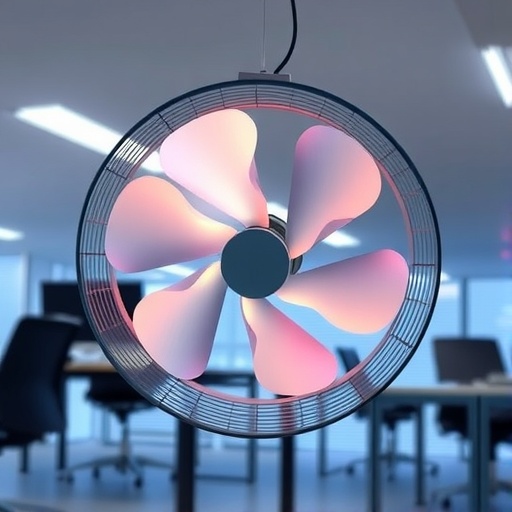
Small wearable fans that direct air at the face and neck may offer nearly the same comfort benefits as conventional desk fans while using less electricity and creating fewer unwanted drafts, according to research from Concordia University. The finding could be especially relevant as offices adjust to hybrid work, where large rooms may be occupied by only a handful of employees. Rather than cooling an entire floor to satisfy a few people, building managers could maintain a centralized heating, ventilation and air-conditioning system at a moderate setting and provide localized airflow to individuals who feel warm. The approach, researchers say, could reduce energy consumption without forcing nearby workers to tolerate a strong stream of air.
The study compared two wearable personal cooling systems—a fan aimed at the face and a fan worn around the neck—with two non-wearable devices: a bladed desk fan and a bladeless desk fan. All four systems were evaluated in a controlled office environment maintained at 25 degrees Celsius. Although wearable fans are smaller and generally operate with less power than desk models, the researchers found that their effect on whole-body thermal comfort was surprisingly strong. The face and neck represent only about 5.5 percent of the body’s total surface area, yet they are highly influential in the perception of heat because they contain temperature-sensitive regions and are frequently exposed to the surrounding air.
The researchers’ explanation is rooted in the way people experience thermal comfort rather than in the amount of body surface directly cooled. Air moving across the face and neck can increase convective heat transfer, carrying warmth away from the skin and improving the body’s ability to release heat into the environment. These areas are also densely supplied with blood vessels and sensory receptors, meaning that changes in local skin temperature can affect how warm or cool a person feels. A small cooling device positioned close to the skin can therefore produce a perceptible benefit without having to circulate air across the entire body. This principle, known as targeted or personalized cooling, is increasingly being studied as an alternative to lowering the temperature of a whole building.
Instead of recruiting office workers to sit through every test condition, the Concordia team used a sophisticated 23-segment thermal manikin. The instrument is designed to represent the human body as a series of interconnected regions, such as the head, torso, arms and legs. It can measure skin temperature and heat loss from individual segments while thermal conditions and airflow are varied. The manikin’s measurements allow researchers to estimate changes in overall thermal comfort and to compare devices under repeatable conditions. In the experiments, each fan operated at different speeds, enabling the team to examine how airflow intensity influenced cooling performance. The setup also made it possible to distinguish between localized effects, such as cooling at the face, and the broader changes that contribute to whole-body comfort.
The bladed desk fan delivered the strongest cooling overall, a result consistent with its ability to move a relatively large volume of air through the room. However, the wearable devices performed much better than their compact size might suggest. The face fan produced the greatest localized effect, increasing heat loss from the face by as much as seven watts. Both the face and neck fans generated enough cooling to move the modeled thermal sensation back into the neutral range. In practical terms, the devices did not need to cool every part of the body to reduce the sensation of overheating. By concentrating airflow on thermally sensitive areas, they could produce a comfort response comparable to that of a low-speed bladed desk fan.
The wearable fans also closely matched the performance of the bladeless desk fan. Bladeless models are often valued in offices because they have no exposed rotating blades and can provide a smoother, less conspicuous stream of air, but their cooling effect may be weaker than that of conventional fans. In the Concordia tests, the face and neck devices delivered a similar level of comfort improvement while taking up little or no desk space. Their proximity to the user is important: because the airflow is directed at the body rather than dispersed across a room, less energy may be required to achieve a noticeable cooling effect. The result is a form of personal environmental control that can operate alongside, rather than replace, a building’s central HVAC system.
The potential energy savings are particularly significant in offices where occupancy varies throughout the day. Conventional air-conditioning systems are generally designed to condition large zones, even when only a small percentage of the available workstations are being used. Lowering the temperature for the entire zone can therefore consume substantial energy to solve a comfort problem experienced by only a few people. Wearable fans could allow the wider space to remain at a less energy-intensive set point while providing additional cooling to individuals who need it. They may also reduce conflicts between coworkers, since a person seeking relief from heat would not necessarily have to aim a powerful desk fan across a shared workspace or expose others to drafts.
The researchers caution, however, that the results describe cooling performance under controlled conditions rather than every experience a person might have in a real office. A thermal manikin can measure heat transfer with high precision, but it cannot reproduce all the behavioral, psychological and physiological factors that influence human comfort. Clothing, humidity, activity level, personal preference, noise, battery life and the exact position of a wearable device could all affect how useful a fan is in practice. Even so, the findings provide a technical basis for a simple idea: cooling a small, strategically chosen region of the body can deliver much of the comfort benefit associated with cooling a much larger volume of air. The study, led by Concordia researchers and presented at the 12th International Conference on Indoor Air Quality, Ventilation & Energy Conservation in Buildings, points to wearable fans as a potentially practical tool for more flexible and energy-conscious workplaces.
Subject of Research: People
Article Title: Comparative cooling efficiency of wearable and non-wearable personal comfort systems in office settings
News Publication Date: 9-Jun-2026
Web References: https://www.concordia.ca/faculty/mohamed-ouf.html; https://iaqvec2026.org/
References: E3S Web of Conferences, DOI: 10.1051/e3sconf/202671603010
Keywords
wearable fans, personal cooling, thermal comfort, office ventilation, HVAC energy efficiency, face fan, neck fan, desk fan, indoor air quality, hybrid workplaces
Tags: bladeless vs. bladed desk fanscomparison of wearable and desk fansenergy-efficient office cooling solutionshybrid work environment cooling strategiesimpact of personal cooling devices on energy useinnovative approaches to office HVAC managementlocalized airflow technology in workplacesreducing office energy consumption with personal fansreducing unwanted drafts with wearable cooling devicessustainable office climate controlthermal comfort in office settingsWearable fans for personal cooling