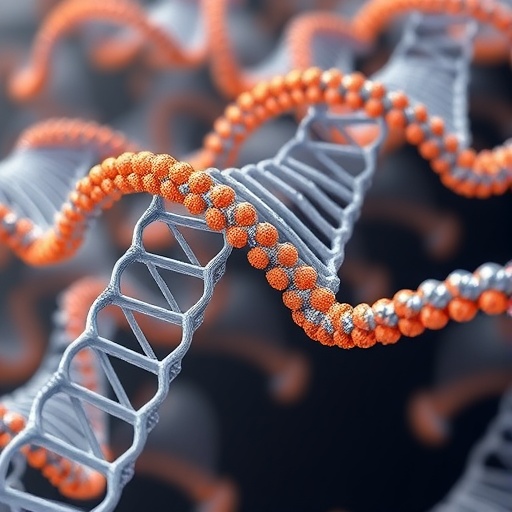
Researchers in Japan have developed a molecular construction system that uses two chemically powered biomolecular machines to build interconnected DNA networks from the bottom up. The approach combines DNA polymerase, an enzyme that synthesizes genetic material, with kinesin, a motor protein capable of converting chemical energy into mechanical motion. Together, the machines generate and organize DNA into extended, fiber-like structures, creating a synthetic material that forms through active processes rather than passive molecular diffusion. The work, led by researchers at the Institute of Science Tokyo in collaboration with Kyoto University and other institutions, offers a new strategy for producing dynamic materials whose organization resembles the coordinated construction processes found in living systems.
Biological organisms routinely create complex structures by linking several molecular operations in sequence. Enzymes synthesize molecular components, motor proteins transport them, and mechanical forces arrange them into functional architectures. These processes require a continuous input of chemical energy, usually supplied by molecules such as adenosine triphosphate, or ATP. Because the resulting structures are maintained away from thermodynamic equilibrium, they can remain dynamic, reorganize in response to their surroundings, and perform functions that passive materials cannot. Reproducing this kind of cooperation with artificial systems has been a major challenge in molecular robotics, nanotechnology, and synthetic biology. Although individual molecular machines have been engineered to move, transport, or assemble materials, coordinating different machines so that one operation feeds directly into the next has proved considerably more difficult.
The new system addresses that problem through a two-stage process that couples molecular synthesis to mechanical assembly. In the first stage, DNA polymerase carries out rolling circle amplification, a reaction in which a circular DNA template is repeatedly copied to generate a long, continuous DNA strand. Rather than producing these strands freely in solution, the researchers arranged the reaction so that the growing DNA became associated with microtubules. Microtubules are cylindrical protein filaments that serve as structural elements and transport tracks in living cells. In this experimental design, they function as mobile scaffolds carrying newly synthesized DNA. As amplification proceeds, increasingly long DNA strands develop on the microtubule surfaces, providing the material that will later be assembled into a larger network.
The second stage relies on kinesin motor proteins attached to a substrate. Kinesin is an ATP-driven molecular motor that normally transports cargo along microtubules inside cells. When ATP is present, the surface-bound kinesin proteins bind to microtubules and move them across the substrate. The microtubules, carrying their attached DNA strands, therefore become active, mobile building units. As multiple microtubules glide across the surface, they collide and bring DNA strands into close proximity. DNA molecules associated with neighboring microtubules can then connect, while continued movement supplies the mechanical forces needed to stretch, pull, and reorganize the joined strands. Over time, these local interactions produce an extended network rather than isolated DNA molecules or compact aggregates.
This mechanism is fundamentally different from conventional DNA assembly strategies that depend primarily on diffusion, thermal fluctuations, or carefully designed base-pairing interactions. In a passive system, molecules move randomly and structures tend to settle toward equilibrium configurations. Here, ATP consumption by kinesin continuously drives microtubule motion, allowing the DNA-carrying scaffolds to explore the surface and generate contacts that would be less likely through random motion alone. The motors do not simply transport pre-existing DNA; they work downstream of the polymerase reaction, physically organizing material that has just been synthesized. This sequential coupling between production and assembly is one of the central features of the study.
The researchers found that active motor operation was necessary for the formation of the network structures. When kinesin was omitted, the system did not generate comparable DNA networks. Similarly, depletion of ATP halted motor activity and prevented the characteristic assembly process. These controls indicate that the observed structures were not produced solely by DNA synthesis or by the spontaneous adhesion of microtubules. Instead, the results point to a direct role for energy-consuming mechanical motion in connecting and extending the DNA material. The team also discovered that the architecture could be influenced by adjusting experimental conditions. Higher microtubule concentrations increased the frequency of collisions, while longer DNA synthesis times provided more material for interconnection, producing networks with greater connectivity and complexity.
Computer simulations provided additional support for the proposed mechanism. In models without active forces, polymer chains representing DNA tended to collapse into compact configurations. This behavior is expected when flexible molecules are governed primarily by thermal motion and internal interactions. When motor-like propulsion was introduced, however, the simulated chains were repeatedly pulled apart and brought into contact with other chains. The resulting structures were more extended and interconnected, qualitatively resembling the networks observed experimentally. The simulations suggest that the motors influence the material at more than one level: they increase the rate at which DNA-bearing units encounter one another and also apply forces that alter the conformation of the DNA after connection.
The resulting DNA networks are not yet equivalent to living tissue or a self-sustaining organism, and the researchers emphasize that important questions remain. The current study does not provide a complete measurement of how much chemical energy is consumed or dissipated during assembly. It also does not demonstrate autonomous repair, reproduction, or adaptation. Nevertheless, the system establishes a useful experimental framework for studying how multiple molecular machines can cooperate in a nonequilibrium environment. By separating synthesis from assembly while linking the two through mobile protein scaffolds, the approach makes it possible to investigate how material properties emerge from the timing, density, and mechanical activity of nanoscale components.
The work could eventually contribute to the development of programmable soft materials, molecular robotics, and chemical information-processing systems. DNA networks are attractive construction materials because their sequences can be designed, copied, and functionalized with a high degree of molecular precision. Kinesin-driven transport could, in principle, be adapted to position different DNA components or to create structures that change when fuel concentrations vary. Future versions might incorporate multiple DNA templates, additional enzymes, or motor systems with different directions and speeds, enabling more elaborate patterns and behaviors. Such developments could lead to materials that assemble only under selected chemical conditions, reorganize in response to stimuli, or perform mechanical and computational functions at the microscale. For now, the achievement demonstrates a fundamental principle: by coupling an enzyme that makes molecular material with a motor that actively moves and stretches it, researchers can reproduce one of the defining strategies of life—the construction of order through coordinated, energy-consuming molecular activity.
Subject of Research: Not applicable
Article Title: Bottom-Up Synthesis and Active Assembly of DNA Networks by Biomolecular Nanomachines
News Publication Date: June 11, 2026
Web References: https://doi.org/10.1002/smll.202514262
References: Small, “Bottom-Up Synthesis and Active Assembly of DNA Networks by Biomolecular Nanomachines,” DOI: 10.1002/smll.202514262
Image Credits: Institute of Science Tokyo
Keywords
DNA networks, biomolecular nanomachines, DNA polymerase, kinesin, microtubules, rolling circle amplification, molecular motors, active self-assembly, nanotechnology, molecular robotics, bioengineering, synthetic materials
Tags: active DNA nanostructure constructionactive processes in DNA material engineeringATP-driven molecular machinerybiomolecular motor-based nanotechnologybiomolecular nanomachines for DNA assemblybottom-up DNA network fabricationchemically powered molecular construction systemsdynamic synthetic materials inspired by living systemsenzyme-driven DNA polymerizationHierarchical DNA material synthesiskinesin motor protein applicationssynthetic materials mimicking biological organization