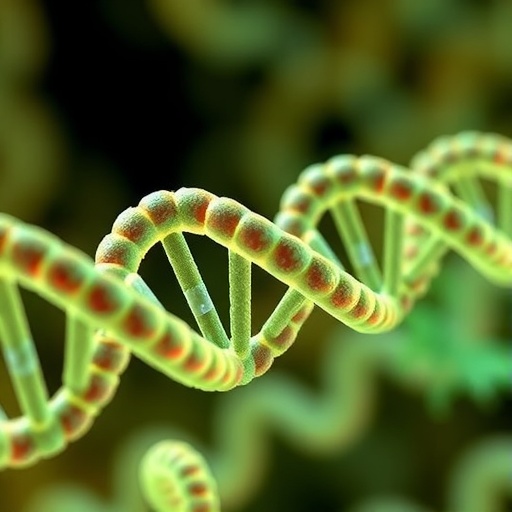
Scientists have uncovered a molecular sequence that helps cells decide when to begin copying their DNA, revealing how a dormant replication machine is converted into an active engine for genome duplication. The study, led by researchers at the MRC Laboratory of Medical Sciences and Imperial College London, shows how a phosphorylation signal releases a structural “safety catch” on the MCM2-7 helicase, how the proteins Sld3 and Sld7 detect that change, and how Sld3 delivers the essential factor Cdc45 to the site where the DNA-unwinding machinery is assembled. The findings, published in Nature Communications, provide a detailed view of one of the most tightly controlled transitions in cell biology.
Every dividing cell must duplicate its entire genome before it can produce two daughter cells. This task begins with the loading of MCM2-7, a ring-shaped complex composed of six related protein subunits: Mcm2 through Mcm7. Once positioned on DNA, the complex forms the core of a future helicase, an enzyme assembly that will eventually separate the two strands of the DNA double helix. Yet MCM2-7 is not immediately active after loading. Keeping it inactive is essential because premature or repeated DNA replication could generate incomplete, duplicated or rearranged chromosomes, threatening the stability of the genome.
The molecular events that awaken MCM2-7 have remained difficult to capture because activation involves several proteins binding and moving across the helicase in rapid succession. Previous studies established that a flexible segment of the Mcm4 subunit functions as an inhibitory element. In its inactive configuration, this segment folds over important surfaces of Mcm4, physically blocking access to regions required for activation. The new work shows that the same flexible element also masks key surfaces on the neighboring Mcm6 subunit, indicating that the safety mechanism is more extensive than previously understood. In this state, the helicase is structurally prepared for DNA replication but remains unable to recruit the factors needed to proceed.
The release mechanism begins with DDK, a kinase that adds phosphate groups to selected sites on the MCM2-7 complex. This process, known as phosphorylation, changes the chemical properties of the targeted protein regions and weakens the interactions that hold the inhibitory Mcm4 segment in place. As the safety catch moves away, surfaces on both Mcm4 and Mcm6 become exposed. These newly accessible regions are not merely passive structural features; they act as a molecular signal indicating that the helicase has received the correct activation input. The study therefore links a biochemical modification, phosphorylation, to a precise structural rearrangement that makes the replication machinery competent for the next stage.
The researchers found that Sld3 serves as a sensor for this activated state, while Sld7 helps position and stabilize Sld3 during the recognition process. In yeast, the Sld3-Sld7 pair binds to the exposed surfaces of Mcm4 and Mcm6 only after the inhibitory segment has been displaced. This arrangement gives the cell a quality-control step at the heart of replication initiation. Sld3 does not simply attach to MCM2-7 regardless of its condition; it preferentially recognizes the structural configuration created by phosphorylation. In effect, the protein complex reads the physical state of the helicase and prevents the activation sequence from advancing unless the earlier molecular switch has been correctly engaged.
Once docked, Sld3 performs a second function that is central to replication initiation. Rather than remaining fixed at its initial binding site, it acts as an adaptor that changes position across the helicase. The protein first anchors to the Mcm2 region, where it senses the activated configuration, and then reorients toward the interface between Mcm2 and Mcm5. At this second location, Sld3 binds Cdc45 and guides it onto MCM2-7. Cdc45 is a critical component of the active CMG helicase, whose name reflects its three principal components: Cdc45, the MCM2-7 motor and the GINS complex. Together, these proteins form the machine that will ultimately unwind DNA at replication forks.
The structural data also explain why the Sld3-Cdc45 connection is indispensable. When the team altered specific amino acids at the newly identified contact surface between Sld3 and Cdc45, Sld3 could still associate with the helicase, but Cdc45 was no longer efficiently recruited. This separation of functions demonstrates that simply binding MCM2-7 is not enough to initiate replication. Sld3 must establish the correct molecular bridge between the activated helicase and Cdc45. The finding also emphasizes how a small number of precisely positioned amino acids can determine whether a large multiprotein machine advances toward activation or remains stalled.
Cryogenic electron microscopy allowed the researchers to visualize several of these arrangements, including an intermediate state that had previously been difficult to observe. In this partially assembled configuration, Cdc45 is associated with the helicase but has not yet reached the fully stabilized architecture of the mature CMG complex. The observations support a stepwise model in which Cdc45 is delivered first, followed by the GINS complex, which is thought to reinforce the connection and complete the active helicase. This staged assembly may provide additional opportunities for the cell to verify that replication initiation is occurring at an authorized site and under the appropriate conditions.
Although the experiments used proteins from yeast, the mechanism may illuminate a broadly conserved principle of genome duplication. In human cells, Treslin is considered the functional counterpart of yeast Sld3, and the researchers identified structural features suggesting that Treslin could recruit Cdc45 through a related mechanism. Whether the human proteins operate in exactly the same way will require further experimental testing. Nevertheless, the conservation of the MCM2-7 helicase, Cdc45, GINS and the regulatory logic surrounding them makes the discovery relevant to higher organisms, including humans. A clearer understanding of this process could eventually help researchers interpret how replication errors arise in diseases associated with genome instability, although the study itself is fundamental rather than a direct medical treatment.
By tracing the pathway from DDK-dependent phosphorylation to safety-catch release, Sld3-Sld7 recognition, Cdc45 delivery and eventual CMG assembly, the study fills in a crucial section of the replication-initiation puzzle. It shows that cells do not rely on a single on-off switch to start copying DNA. Instead, activation is organized as a sequence of structurally linked checkpoints, with each step creating the conditions for the next. This molecular choreography ensures that a helicase is activated only after it has been correctly licensed and modified, helping cells copy billions of DNA bases with extraordinary precision each time they divide.
Subject of Research: Molecular mechanism controlling DNA replication initiation and Cdc45 loading onto the MCM2-7 helicase.
Article Title: Structural insights into Sld3-Sld7-dependent Cdc45 loading during replication initiation
News Publication Date: 14 August 2026
Web References: https://doi.org/10.1038/s41467-026-76309-6
References: Noguchi et al., Nature Communications, “Structural insights into Sld3-Sld7-dependent Cdc45 loading during replication initiation”; https://pubmed.ncbi.nlm.nih.gov/35296675/
Image Credits: DNA Replication Group, MRC Laboratory of Medical Sciences
Keywords: DNA replication, replication initiation, MCM2-7 helicase, Cdc45, Sld3, Sld7, CMG helicase, phosphorylation, cryogenic electron microscopy, genome stability
Tags: Cdc45 recruitment during DNA replicationcell cycle control of genome duplicationDNA replication initiationDNA unwinding machinery assemblygenome duplication in dividing cellsMCM2-7 helicase activationmolecular mechanisms of DNA replication initiationphosphorylation signaling in DNA replicationprevention of premature DNA replicationregulation of DNA replication timingSld3 and Sld7 roles in replicationstructural safety catch in DNA helicase activation