Tertiary amines are among the most common structural features in biologically active molecules, appearing in medicines, natural products and chemical probes that interact with receptors, enzymes and transport proteins. Their importance comes partly from their ability to switch between neutral and positively charged forms, allowing them to participate in molecular recognition while also influencing solubility, membrane permeability and binding strength. Yet a major limitation has remained hidden behind their apparent versatility: once a tertiary benzylamine has been assembled and incorporated into a complex molecule, its central carbon–nitrogen framework is usually treated as fixed. A new study now reports a catalytic strategy that could turn these apparently static structures into programmable platforms for molecular redesign.
Published in Nature, the work by J. D. Robinson, F. Richard, K. A. Ratkovich and colleagues describes a method for remodeling carbon–nitrogen connectivity directly within fully elaborated tertiary benzylamines. Rather than breaking the molecule down and rebuilding it through a lengthy synthetic sequence, the researchers developed a process that temporarily activates the amine, enables controlled cleavage of a carbon–nitrogen bond and then reconnects the molecular fragments in a new arrangement. The result is a form of skeletal editing in which modular chemical units can be inserted across an existing C–N bond.
Tertiary benzylamines contain a nitrogen atom bonded to three carbon substituents, one of which is a benzyl group: a carbon atom attached to an aromatic ring. These compounds are widely used as starting points in medicinal chemistry because they can be prepared from accessible building blocks and often display useful drug-like properties. Their nitrogen substituent can be varied, but conventional transformations generally preserve the original relationship between the nitrogen and the benzyl carbon. Changing that relationship typically requires the molecule to be dismantled or synthesized again from the beginning, an inefficient approach when the rest of the structure has already been optimized for biological activity.
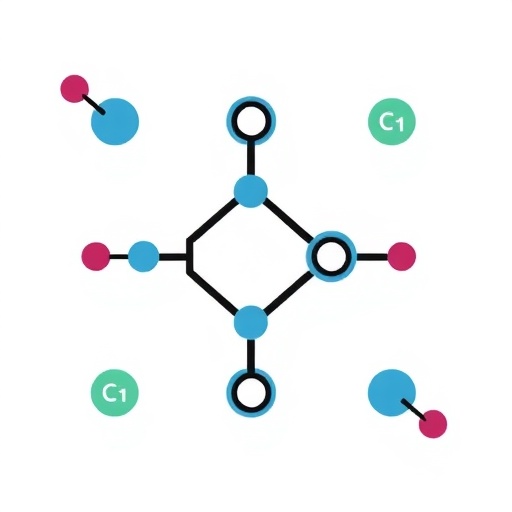
The new strategy begins with N-alkylation using a bifunctional electrophile. In this reaction, the tertiary amine attacks an electrophilic carbon and becomes a quaternary ammonium species, meaning that nitrogen now carries four carbon substituents and a formal positive charge. This temporary change is crucial because it converts an otherwise resistant C–N bond into a chemically addressable connection. The bifunctional electrophile does more than simply add an alkyl group: it installs a second reactive handle that helps organize the subsequent catalytic transformation and encodes the information needed for selective molecular reconfiguration.
The quaternary ammonium intermediate then enters a palladium-catalyzed sequence. Palladium, a transition-metal catalyst widely used in cross-coupling chemistry, can coordinate to carbon frameworks and promote selective bond cleavage and formation. In this case, the catalyst enables disassembly of the activated benzylamine and guides the fragments toward a new connectivity pattern. The process is not a random degradation of the amine. Instead, it is designed to preserve the valuable portions of the starting molecule while inserting a selected unit at the position formerly occupied by the C–N linkage.
The researchers first demonstrate the concept through one-carbon homologation. Homologation is the insertion of a single carbon atom into a molecular framework, often extending a chain or relocating the position of a functional group. Applied to tertiary benzylamines, the reaction creates a direct route to amine architectures that differ from the starting material by a precisely positioned carbon atom. This seemingly modest modification can have major consequences in drug discovery: adding or relocating one carbon may change the distance between pharmacophores, alter conformational preferences, adjust steric interactions or improve the balance between potency and physicochemical properties.
More significantly, the study presents the transformation as a general platform for inserting larger and more complex fragments. The modular units that can be introduced include hydrocarbon chains, heterocycles and aryl groups. Hydrocarbon fragments can expand molecular size and flexibility, while heterocycles can add polarity, hydrogen-bonding capacity and additional sites for tuning biological interactions. Aryl groups can alter shape, rigidity and electronic properties. By installing these units directly across the original carbon–nitrogen bond, chemists can explore structural alternatives that would be difficult to reach through ordinary functional-group interconversions.
The significance of the method lies in its treatment of a mature molecule as an editable object rather than a finished product. In conventional medicinal chemistry, a lead compound is often diversified by modifying peripheral substituents while leaving its main skeleton intact. That approach is powerful but can become limiting when the core connectivity itself is responsible for poor activity, unfavorable metabolism or suboptimal exposure. C–N bond remodeling offers a way to investigate those deeper structural variables without discarding the rest of the molecular design. A compound that has already been tuned for a particular target could, in principle, be converted into a family of connectivity isomers carrying new linkers or fragments.
This strategy also addresses a broader challenge in synthetic chemistry: the selective editing of saturated, three-dimensional molecular frameworks. Aromatic substitution and carbon–carbon cross-coupling are well-established tools, but direct manipulation of unactivated C–N bonds in complex tertiary amines is substantially more difficult. Nitrogen-containing compounds can coordinate to catalysts, undergo competing reactions or resist selective cleavage because their bonds are embedded in crowded environments. By using quaternary ammonium activation together with palladium catalysis, the researchers establish a controlled sequence that transforms this normally robust linkage into a programmable reaction site.
The ability to insert modular units could have particular value in high-throughput analogue generation and late-stage diversification. Instead of preparing every candidate through an independent multistep synthesis, researchers may be able to begin with a common tertiary benzylamine scaffold and expose it to different bifunctional electrophiles or reaction partners. Each variation could produce a distinct amine architecture while retaining much of the original molecule. Such a process would make it easier to map how changes in connectivity influence target engagement, selectivity, solubility, permeability and metabolic stability. It could also reveal productive molecular arrangements that conventional scaffold-hopping strategies overlook.
The work does not suggest that every tertiary amine can be rearranged without limitation, and the practical value of the method will depend on its compatibility with different functional groups, molecular sizes and reaction conditions. Nevertheless, the central principle is broadly important: a carbon–nitrogen bond that once marked the endpoint of a synthesis can instead serve as a programmed entry point for molecular reconstruction. By converting tertiary benzylamines into adaptable intermediates, the study expands the chemical space available from a common and biologically important class of compounds. The researchers’ approach could therefore shift amine chemistry from routine derivatization toward deliberate connectivity editing, giving medicinal chemists a new way to search for molecular architectures that were previously difficult or impossible to access.
Subject of Research: Programmable catalytic remodeling of carbon–nitrogen connectivity in tertiary benzylamines
Article Title: Programmable remodelling of carbon–nitrogen connectivity in amines
Article References: Robinson, J.D., Richard, F., Ratkovich, K.A. et al. “Programmable remodelling of carbon–nitrogen connectivity in amines.” Nature (2026). https://doi.org/10.1038/s41586-026-11009-1
Image Credits: AI Generated
DOI: 10.1038/s41586-026-11009-1
Keywords: tertiary benzylamines, amine chemistry, C–N bond remodeling, molecular diversification, palladium catalysis, quaternary ammonium intermediates, homologation, medicinal chemistry, skeletal editing, late-stage functionalization
Tags: activation and cleavage of amine bondsadvances in selective bond activation in organic chemistryapplications in drug development and natural product synthesiscatalytic strategy for molecular redesignchemical tools for molecular optimizationdirect remodeling of carbon–nitrogen connectivityflexible modification of biologically active aminesinnovative methods for amine functionalizationlong-range skeletal editing in organic synthesismolecular editing in complex moleculesprogrammable carbon–nitrogen bond rearrangement in aminesskeletal editing of tertiary benzylamines