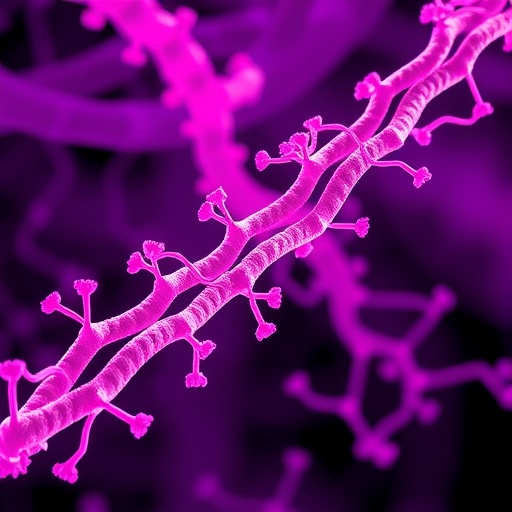
A new study has revealed that some Gram-positive bacteria may overcome one of the fundamental limitations of their cell architecture by building microscopic filaments capable of transporting quinones, the membrane-soluble molecules that carry electrons through respiratory chains. The discovery, reported by Anja Kropp, Kaveh Asadollahi, James A. Stapleton and colleagues in Nature Microbiology, shows that members of the Bacillota phylum can extend their bioenergetic machinery beyond the immediate boundaries of the cell membrane. The finding offers a new view of how bacteria generate energy in crowded communities, oxygen-poor environments and structured biofilms, where access to suitable electron acceptors can be unevenly distributed.
Respiration is, at its core, a controlled flow of electrons. Bacterial cells extract energy from nutrients by passing electrons through a series of membrane-associated protein complexes. This process creates a proton gradient across the cell membrane, which is then used by ATP synthase to produce ATP, the chemical currency that powers cellular activity. Quinones are central to this system. Embedded within the membrane, they shuttle electrons between different respiratory complexes, much like small mobile couriers moving through a densely packed transport network. In most bacteria, however, quinones remain confined to the membrane in which they operate. The study describes a mechanism that appears to let Bacillota move these electron carriers through long proteinaceous filaments, potentially linking distant regions of a cell or even neighboring cells.
The discovery is especially striking because Bacillota are generally characterized by a thick cell wall and a relatively simple envelope compared with Gram-negative bacteria. Their cell walls are dominated by a dense peptidoglycan layer, which provides mechanical strength but has often been viewed as a barrier to elaborate forms of long-distance electron transport. Yet the newly described filaments appear to transform that barrier into a platform for electrical cooperation. Rather than relying exclusively on respiratory reactions taking place directly inside a membrane, these bacteria may be able to project parts of their bioenergetic network outward. This could allow electrons, or the quinones carrying them, to reach locations where the final steps of respiration are more favorable.
The researchers identify the structures as filaments associated with quinone movement and respiratory activity. Their proposed function differs from that of ordinary flagella, which propel bacteria, and from many familiar pili, which help cells attach to surfaces or exchange genetic material. The filaments described in the study are instead linked to energy conservation. Their biological significance lies in their capacity to extend electron-transfer chemistry across a distance. If quinones can move through these structures and remain chemically active, a bacterial cell could distribute respiratory components over a larger area, bringing electron donors and acceptors into contact with a more flexible and efficient pathway.
This mechanism may be particularly valuable in biofilms, where bacteria grow as densely packed communities surrounded by extracellular polymers, mineral particles and chemical gradients. In such environments, oxygen and other electron acceptors are often consumed rapidly near the surface, while deeper layers become chemically reduced. Nutrients and electron donors may be abundant in one region, but the acceptors needed to complete respiration may be available only elsewhere. A filament-based quinone route could help bacteria bridge these microenvironments. It may also enable cells positioned at different depths to share the energetic burden of respiration, creating a distributed electrical system rather than forcing every cell to operate as an isolated metabolic unit.
The concept expands the known repertoire of microbial electron transfer. Some bacteria are already famous for producing conductive nanowires that carry electrons to minerals or electrodes. Other organisms cooperate over much larger distances through networks that redistribute reducing power across microbial communities. The Bacillota system appears to add a different strategy to this growing catalogue: instead of simply conducting electrons along a solid protein structure, the filaments may transport quinones themselves. That distinction is important because quinones are chemically versatile and can participate in reversible oxidation and reduction reactions. A mobile quinone could therefore function as both a carrier and a rechargeable component of a respiratory circuit.
The findings also raise questions about how these filaments are assembled and maintained. A functional quinone-transporting structure would require more than a hollow tube extending from the cell. It would need a molecular architecture compatible with hydrophobic quinones, which normally remain within lipid membranes, as well as a way to control their loading, movement and release. The bacterial cell would also have to coordinate filament production with the expression of respiratory enzymes and with changing environmental conditions. Determining whether the filaments contain specialized binding sites, conductive protein segments, membrane-derived components or a combination of these features will be a major goal for future structural and biochemical studies.
From an evolutionary perspective, the discovery suggests that Gram-positive bacteria may have developed sophisticated solutions to the physical constraints imposed by their cell envelopes. Energy conservation is often presented as a process locked inside the membrane, but microbial life repeatedly challenges that assumption. Bacteria can reorganize their surfaces, share metabolites, form multicellular structures and construct extracellular electron-transfer networks. Quinone-transporting filaments would represent another example of this flexibility, allowing the location of respiratory chemistry to become less tightly tied to the membrane itself. The trait could be especially advantageous for organisms living in sediments, animal-associated environments, decaying organic matter and industrial reactors, where oxygen levels and redox conditions change sharply across tiny distances.
The work could eventually influence efforts to understand and manipulate microbial communities involved in carbon cycling, waste treatment and biotechnology. Bacillota include many organisms that participate in fermentation, decomposition and anaerobic respiration, including species found in soils, sediments and engineered bioreactors. If their filament systems help regulate how electrons move through these environments, they may affect the breakdown of organic compounds and the production or consumption of gases such as hydrogen, carbon dioxide and methane. Engineered microbial materials could also one day draw inspiration from these structures, particularly if researchers learn how to produce stable biological filaments that transport redox-active molecules under mild conditions. Such applications remain speculative, but the underlying principle is powerful: microbes may be able to expand their energy-processing capacity without expanding their entire cell.
For now, the most important consequence of the study is conceptual. The bacterial membrane is no longer the only stage on which quinone-based respiration must occur. In Bacillota, energy metabolism may extend into filamentous structures that connect cellular interiors with the surrounding microbial landscape. The discovery provides a possible explanation for how Gram-positive bacteria remain metabolically competitive in environments where resources and electron acceptors are spatially separated. It also reinforces a broader lesson from microbiology: organisms that appear simple under a microscope can possess elaborate electrical and chemical infrastructures at the nanoscale. By revealing a previously unrecognized route for quinone transport, the study opens a new chapter in the biology of microbial respiration and in the search for the hidden networks that power life in oxygen-starved ecosystems.
Subject of Research: Quinone-transporting filaments and expanded bioenergetic capacity in Gram-positive Bacillota
Article Title: Quinone-transporting filaments expand bioenergetic capacity in Gram-positive Bacillota
Article References: Kropp, A., Asadollahi, K., Stapleton, J.A. et al. “Quinone-transporting filaments expand bioenergetic capacity in Gram-positive Bacillota.” Nature Microbiology (2026). https://doi.org/10.1038/s41564-026-02450-z
Image Credits: AI Generated
DOI: https://doi.org/10.1038/s41564-026-02450-z
Keywords: Bacillota, Gram-positive bacteria, quinones, microbial respiration, bioenergetics, electron transport, protein filaments, bacterial biofilms, extracellular electron transfer, bacterial metabolism
Tags: Bacillota respiratory mechanismsbacterial adaptation to oxygen-poor environmentsbacterial cell architecture innovationsbacterial electron transport chainsbacterial filamentous electron transportbacterial quinone shuttlingbioenergetics in Gram-positive bacteriaGram-positive bacteria energy metabolismmicrobial biofilm energy transfermicrobial electron flow pathwaysmicroscopic bacterial filamentsquinone-mediated electron transfer