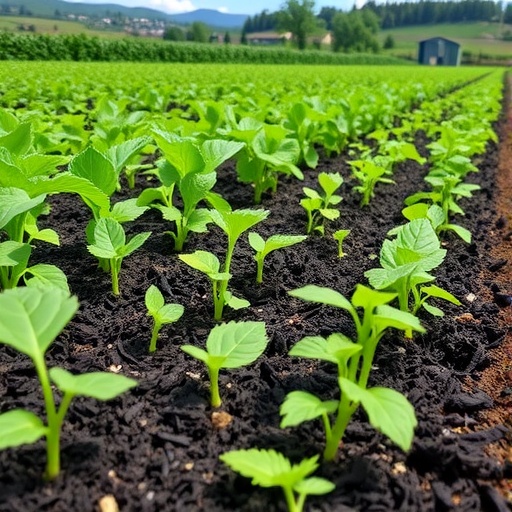
Nitrogen fertilizer has helped transform modern agriculture, allowing farmers to produce far more food from the same land. Yet a significant portion of the nitrogen applied to fields never reaches crops. Instead, it can escape into the atmosphere as ammonia, a pungent gas that contributes to fine-particle air pollution, damages ecosystems, and represents a direct economic loss for farmers. A new two-year study in China suggests that a carefully engineered combination of organic fertilizer, biochar, and dicyandiamide could offer a powerful way to keep more nitrogen where crops can use it while reducing the environmental cost of intensive farming.
The researchers found that the combined treatment reduced cumulative ammonia volatilization by 27.1 percent compared with conventional urea fertilization during a complete rice-wheat rotation. The result is particularly notable because the amended organic fertilizer was applied with a 30 percent reduction in mineral nitrogen input, yet crop productivity was largely maintained. The findings point toward a potential strategy for making fertilizer use more efficient without simply asking farmers to apply less and accept lower yields. Instead, the approach aims to control what happens to nitrogen after it enters the soil.
“Reducing fertilizer input is only useful if farmers can maintain crop production at the same time,” said corresponding author Haijun Sun. “Our results suggest that combining biochar with dicyandiamide in organic fertilizer can help balance these goals by retaining nitrogen, limiting ammonia losses, and supporting crop growth.” That balance is central to the global fertilizer challenge. Nitrogen is indispensable for plant proteins, chlorophyll, and growth, but when it is converted into gaseous ammonia and lost from farmland, farmers may need to spend more on replacement fertilizer while nearby communities and ecosystems absorb the pollution.
The experiment covered two complete rice and wheat rotations from 2022 to 2024 in greenhouse soil columns. The researchers compared conventional urea fertilization with three treatments that used lower amounts of mineral nitrogen: conventional organic fertilizer, organic fertilizer amended with biochar, and organic fertilizer containing both biochar and dicyandiamide. The soil-column design allowed the team to monitor nitrogen movement and ammonia emissions under controlled conditions over successive crop seasons. Unlike a short laboratory test, the two-year rotation captured repeated changes in soil chemistry, crop uptake, and fertilizer behavior across both flooded rice and relatively dry wheat production.
Among the treatments, the combination of biochar and dicyandiamide produced the most consistent result. Across the full rotation, it was the only organic fertilizer treatment that significantly reduced cumulative ammonia emissions compared with conventional urea. Biochar alone reduced cumulative ammonia volatilization by 5.9 percent compared with conventional organic fertilizer, while adding both biochar and dicyandiamide achieved a much larger 33.6 percent reduction relative to that treatment. These results suggest that the two amendments may work through complementary mechanisms rather than simply adding the same effect twice.
Biochar is a carbon-rich material produced by heating biomass under oxygen-limited conditions. Its porous structure can alter soil water retention, nutrient adsorption, and the chemical environment surrounding fertilizer particles. In this study, the researchers linked biochar application to better regulation of ammonium concentrations and pH in the soil and the floodwater covering rice. This matters because ammonia volatilization is strongly influenced by the balance between ammonium ions and dissolved ammonia. Higher pH shifts more ammonium toward gaseous ammonia, making it easier for nitrogen to escape. By moderating this chemical environment, biochar may help keep nitrogen in a less volatile form for longer.
Dicyandiamide, commonly known as DCD, is a nitrification inhibitor that slows the microbial conversion of ammonium into nitrite and nitrate. That process can be beneficial under some conditions because plants can absorb nitrate, but rapid nitrification can also increase the risk of nitrogen leaching and nitrous oxide production. By delaying the transformation, DCD may extend the period during which ammonium remains available for plant uptake or retention in the soil. The researchers observed altered nitrogen transformation patterns in the amended treatment, indicating that the inhibitor helped reshape the timing and pathways of nitrogen cycling rather than merely reducing one isolated emission.
The study also examined soil bacteria and found that biochar-containing fertilizers reduced the abundance of Nitrospirota, a bacterial group associated with nitrite oxidation, one of the key steps in nitrification. The shift suggests that the amendments may change the microbial niches involved in nitrogen conversion by modifying factors such as pH, moisture, carbon availability, and nutrient distribution. However, the researchers emphasize that their microbial analysis was based on taxonomic profiling. Detecting changes in the abundance of a bacterial group does not directly prove that a particular organism performed a specific biochemical function, so future work using functional genes, enzyme measurements, and isotope tracing will be needed to confirm the mechanisms.
The environmental gains did not appear to come at the expense of another major greenhouse gas. Cumulative nitrous oxide emissions showed no significant differences among the fertilizer treatments, an important finding because strategies that suppress ammonia can sometimes redirect nitrogen losses into other pathways. The combined treatment also maintained rice yields at levels comparable with conventional fertilization, while conventional organic fertilizer and biochar-only organic fertilizer reduced rice grain yields. The researchers estimated through Monte Carlo simulations that the combined treatment could generate potential benefits of approximately 36,600 Chinese yuan per hectare per year under the experimental conditions, reflecting fertilizer savings and reduced nitrogen-related environmental and health costs.
The result is promising, but it is not yet a universal prescription for farmers. The experiment was conducted in controlled soil columns rather than commercial fields, where rainfall, temperature swings, soil types, irrigation practices, fertilizer placement, and management decisions can vary dramatically. The economic estimate also depends on local fertilizer prices, crop yields, pollution costs, and the availability and quality of biochar and dicyandiamide. Field-scale trials will be essential to determine whether the ammonia reductions persist under real farming conditions and whether the treatment remains affordable and practical across different rice-wheat systems. Even with those limitations, the study offers a striking example of how combining carbon-based soil amendments with targeted nitrogen management could help turn fertilizer from a major source of pollution into a more efficient tool for feeding a growing population.
Subject of Research: Nitrogen fertilizer efficiency, ammonia volatilization, biochar, dicyandiamide, soil nitrogen cycling, and rice-wheat crop production
Article Title: Ammonia mitigation and economic gains from dicyandiamide and biochar-amended organic fertilizer: a 2-year rice-wheat rotation study
News Publication Date: 22-Jun-2026
Web References: https://doi.org/10.48130/aee-0026-0016; Agricultural Ecology and Environment
References: Huang W, Wang L, Gong X, Bian R, Lu X, et al. 2026. “Ammonia mitigation and economic gains from dicyandiamide and biochar-amended organic fertilizer: a 2-year rice-wheat rotation study.” Agricultural Ecology and Environment 2: e019. DOI: 10.48130/aee-0026-0016
Image Credits: Wang Huang, Lisha Wang, Xueliu Gong, Rongjun Bian, Xinyue Lu, Yuanqing Bu, Yunyi Liang, Haijun Sun, Yanfang Feng, Changlei Xia, Jiang Jiang, and Lihong Xue
Keywords: ammonia volatilization, biochar, dicyandiamide, organic fertilizer, nitrogen fertilizer, nitrogen cycling, rice-wheat rotation, soil microbiome, nitrification inhibition, sustainable agriculture, crop productivity, agricultural pollution
Tags: Biochar and nitrification inhibitors for ammonia loss reductiondicyandiamide as nitrification inhibitoreco-friendly farming practicesenvironmental impact of ammonia volatilizationimpact of biochar on crop productivitynitrogen loss mitigation strategiesnitrogen use efficiency in agricultureorganic fertilizer and biochar combinationreducing nitrogen fertilizer application without yield lossrice-wheat crop nitrogen managementsoil nitrogen retention techniquessustainable fertilizer management