• HOME
  • NEWS
  • EXPLORE
    • CAREER
      • Companies
      • Jobs
    • EVENTS
    • iGEM
      • News
      • Team
    • PHOTOS
    • VIDEO
    • WIKI
  • BLOG
  • COMMUNITY
    • FACEBOOK
    • INSTAGRAM
    • TWITTER
Saturday, February 7, 2026
BIOENGINEER.ORG
No Result
View All Result
  • Login
  • HOME
  • NEWS
  • EXPLORE
    • CAREER
      • Companies
      • Jobs
        • Lecturer
        • PhD Studentship
        • Postdoc
        • Research Assistant
    • EVENTS
    • iGEM
      • News
      • Team
    • PHOTOS
    • VIDEO
    • WIKI
  • BLOG
  • COMMUNITY
    • FACEBOOK
    • INSTAGRAM
    • TWITTER
  • HOME
  • NEWS
  • EXPLORE
    • CAREER
      • Companies
      • Jobs
        • Lecturer
        • PhD Studentship
        • Postdoc
        • Research Assistant
    • EVENTS
    • iGEM
      • News
      • Team
    • PHOTOS
    • VIDEO
    • WIKI
  • BLOG
  • COMMUNITY
    • FACEBOOK
    • INSTAGRAM
    • TWITTER
No Result
View All Result
Bioengineer.org
No Result
View All Result
Home NEWS Science News Biology

E. coli bacteria’s defense secret revealed

Bioengineer by Bioengineer
June 13, 2017
in Biology
Reading Time: 2 mins read
0
Share on FacebookShare on TwitterShare on LinkedinShare on RedditShare on Telegram
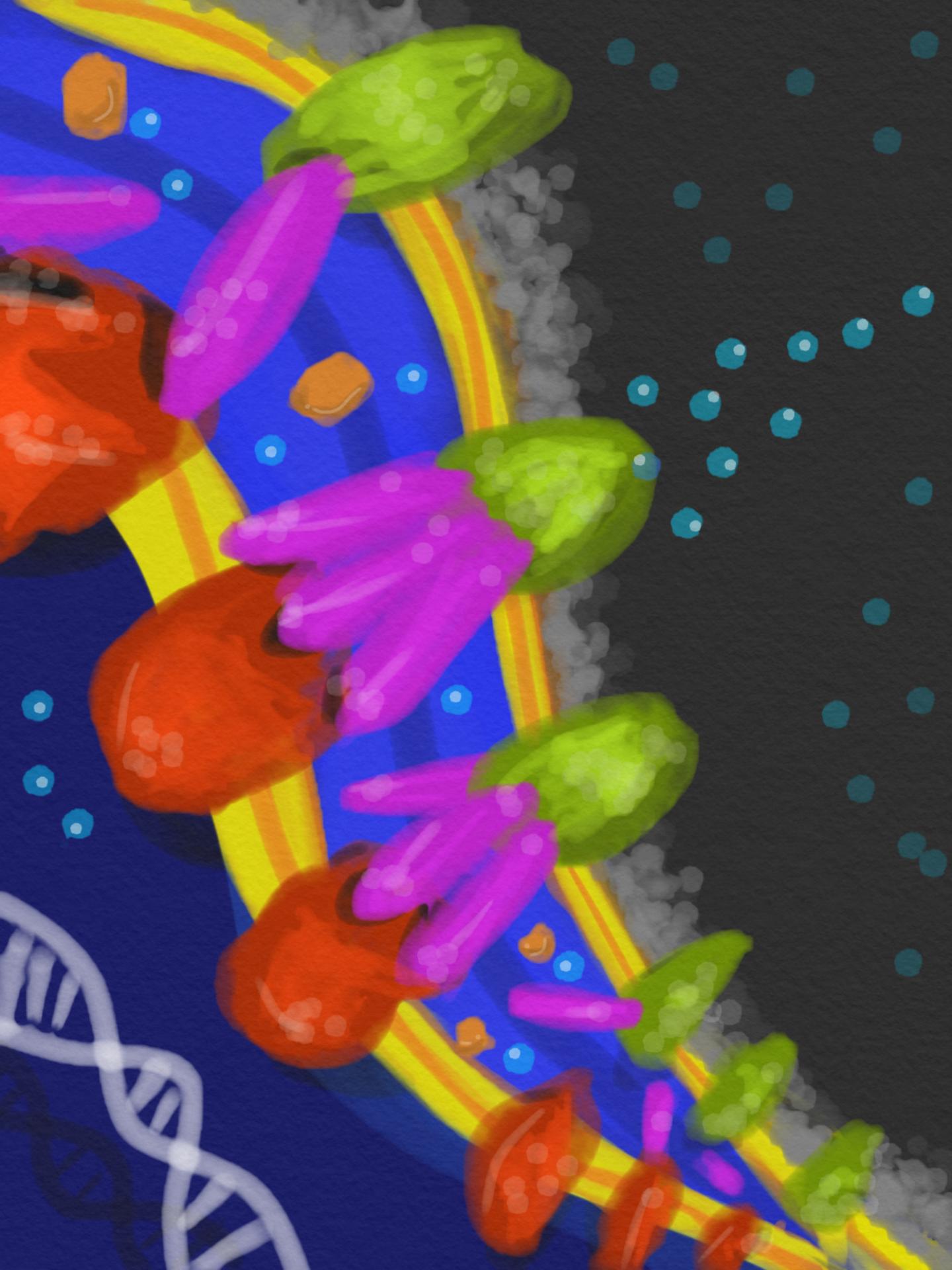
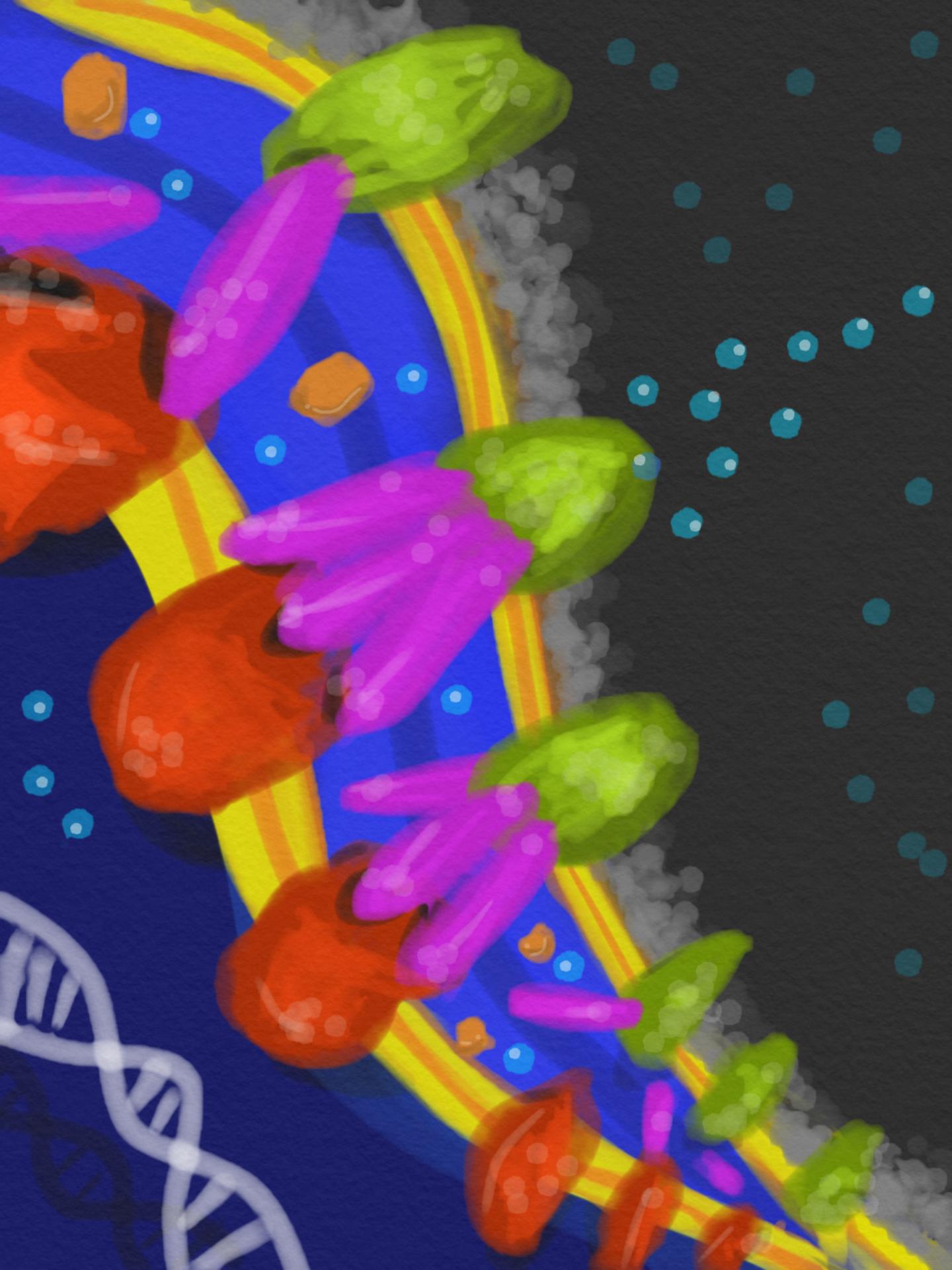
IMAGE

Credit: Ace George Santiago, Cornell University

By tagging a cell's proteins with fluorescent beacons, Cornell researchers have found out how E. coli bacteria defend themselves against antibiotics and other poisons. Probably not good news for the bacteria.

When undesirable molecules show up, the bacterial cell opens a tunnel though its cell wall and "effluxes," or pumps out, the intruders.

"Dynamic assembly of these tunnels has long been hypothesized," said Peng Chen, professor of chemistry and chemical biology. "Now we see them."

The findings could lead to ways to combat antibiotic-resistant bacteria with a "cocktail" of drugs, he suggests: "One is to inhibit the assembly of the tunnel, the next is to kill the bacteria."

To study bacteria's defensive process, Chen and colleagues at Cornell selected a strain of E. coli known to pump out copper atoms that would otherwise poison the bacteria. The researchers genetically engineered it, adding to the DNA that codes for a defensive protein an additional DNA sequence that codes for a fluorescent molecule.

Under a powerful microscope, they exposed a bacterial cell to an environment containing copper atoms and periodically zapped the cell with an infrared laser to induce fluorescence. Following the blinking lights, they had a "movie" showing where the tagged protein traveled in the cell. They further genetically engineered the various proteins to turn their metal-binding capability on and off, and observed the effects.

Their research was reported in the Early Online edition of the Proceedings of the National Academy of Sciences the week of June 12. The Cornell researchers also collaborated with scientists at the University of Houston, the University of Arizona and the University of California, Los Angeles.

The key protein, known as CusB, resides in the periplasm, the space between the inner and outer membranes that make up the bacteria's cell wall. When CusB binds to an intruder – in this experiment, a copper atom – that has passed through the porous outer membrane, it changes its shape so that it will attach itself between two related proteins in the inner and outer membranes to form a complex known as CusCBA that acts as a tunnel through the cell wall. The inner protein has a mechanism to grab the intruder and push it through.

The tunnel locks the inner and outer membranes together, making the periplasm less flexible and interfering with its normal functions. The ability to assemble the tunnel only when needed, rather than having it permanently in place, gives the cell an advantage, the researchers point out.

This mechanism for defending against toxic metals may also explain how bacteria develop resistance to antibiotics, by mutating their defensive proteins to recognize them. Similar mechanisms may be found in other species of bacteria, the researchers suggested.

###

The work was supported by the Army Research Office and the National Institutes of Health.

Media Contact

Daryl Lovell
[email protected]
607-592-3925
@cornell

http://pressoffice.cornell.edu

Original Source

http://news.cornell.edu/stories/2017/06/e-coli-bacterias-defense-secret-revealed

############

Story Source: Materials provided by Scienmag

Share12Tweet8Share2ShareShareShare2

Related Posts

Florida Cane Toad: Complex Spread and Selective Evolution

Florida Cane Toad: Complex Spread and Selective Evolution

February 7, 2026
New Study Uncovers Mechanism Behind Burn Pit Particulate Matter–Induced Lung Inflammation

New Study Uncovers Mechanism Behind Burn Pit Particulate Matter–Induced Lung Inflammation

February 6, 2026

DeepBlastoid: Advancing Automated and Efficient Evaluation of Human Blastoids with Deep Learning

February 6, 2026

Navigating the Gut: The Role of Formic Acid in the Microbiome

February 6, 2026
Please login to join discussion

POPULAR NEWS

  • Robotic Ureteral Reconstruction: A Novel Approach

    Robotic Ureteral Reconstruction: A Novel Approach

    82 shares
    Share 33 Tweet 21
  • Digital Privacy: Health Data Control in Incarceration

    63 shares
    Share 25 Tweet 16
  • Study Reveals Lipid Accumulation in ME/CFS Cells

    57 shares
    Share 23 Tweet 14
  • Breakthrough in RNA Research Accelerates Medical Innovations Timeline

    53 shares
    Share 21 Tweet 13

About

We bring you the latest biotechnology news from best research centers and universities around the world. Check our website.

Follow us

Recent News

Barriers and Boosters of Seniors’ Physical Activity in Karachi

Evaluating Pediatric Emergency Care Quality in Ethiopia

TPMT Expression Predictions Linked to Azathioprine Side Effects

Subscribe to Blog via Email

Enter your email address to subscribe to this blog and receive notifications of new posts by email.

Join 73 other subscribers
  • Contact Us

Bioengineer.org © Copyright 2023 All Rights Reserved.

Welcome Back!

Login to your account below

Forgotten Password?

Retrieve your password

Please enter your username or email address to reset your password.

Log In
No Result
View All Result
  • Homepages
    • Home Page 1
    • Home Page 2
  • News
  • National
  • Business
  • Health
  • Lifestyle
  • Science

Bioengineer.org © Copyright 2023 All Rights Reserved.