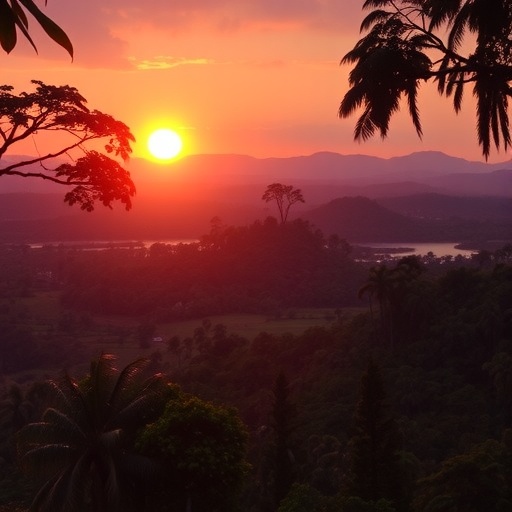
Tropical forests are often treated as a single planetary machine for absorbing carbon, but a new satellite-based analysis suggests that the world’s great rainforest regions are governed by strikingly different ecological rules. By examining 16 million measurements collected in 2020 by NASA’s Global Ecosystem Dynamics Investigation, or GEDI, researchers found that temperature, aridity, soil nutrients and terrain influence forest biomass in sharply contrasting ways across the Amazon, the Congo Basin and Southeast Asia. The findings, published in Nature, indicate that there is no universal climate formula for predicting how much carbon a tropical forest stores—or how it will respond to a changing climate.
The study focused on aboveground biomass, the carbon held in trunks, branches, leaves and other vegetation above the soil. Forest biomass is a critical measure in climate science because it provides an estimate of how much carbon ecosystems have removed from the atmosphere and locked into living tissue. Yet measuring it across millions of square kilometers has historically been difficult. Conventional satellite imagery can reveal the color, density and seasonal behavior of vegetation, but it does not directly show the height and three-dimensional structure of a forest. GEDI addressed that limitation by using lidar, a remote-sensing technology that sends laser pulses toward Earth and measures the time required for reflected light to return.
Mounted on the International Space Station, GEDI uses multiple laser beams to create detailed vertical profiles of forests and other ecosystems. Each pulse can reveal the arrangement of foliage, branches and trunks from the canopy top to the ground. By combining these structural measurements with environmental information—including climate, soil properties and topography—researchers were able to investigate why some forests accumulate enormous quantities of biomass while others under similar broad climatic conditions do not. The analysis, led by Matheus Nunes of the University of Maryland and NASA’s GEDI mission, represents one of the largest efforts to connect satellite-derived forest structure with the environmental forces shaping tropical ecosystems.
The broad pattern was clear: sites with higher temperatures generally contained less aboveground biomass, but the strength of that relationship varied dramatically from continent to continent. Forests in Africa’s Congo Basin were particularly sensitive to temperature. Amazonian forests showed a moderate response, while forests in Southeast Asia were comparatively insensitive. That contrast challenges the assumption that warming should produce a similar reduction in forest carbon everywhere. Instead, the impact of temperature appears to depend on the ecological history of each region, including the climates its species experienced over evolutionary time and the environmental pressures that shaped its forests.
Water availability told a different story. Southeast Asian forests were the most strongly affected by aridity, with biomass falling substantially in drier locations. Amazonian forests reached their highest biomass at intermediate levels of aridity, suggesting that the wettest sites are not automatically the most productive or carbon-rich. African forests, meanwhile, were relatively insensitive to aridity in the analysis. These regional differences may reflect variations in rainfall history, soil drainage, species composition and the ability of trees to tolerate drought. They also show why a single global model can obscure important ecological signals when it averages together forests that developed under very different conditions.
The researchers found that climate effects were further modified by soils and landscape features. Nutrient availability can influence how much carbon trees are able to build into wood, while steep terrain, elevation and drainage can determine whether water remains available to roots or rapidly moves away. Forests growing on flat, fertile ground may therefore respond differently to heat or drought than forests on nutrient-poor soils or mountainous terrain. The study also highlights the importance of disturbance. In the tallest forests, where trees can exceed 70 meters, storms may be among the most important forces reducing biomass. Lightning strikes and windthrow can kill or topple large trees, releasing carbon and opening gaps that change the structure of the forest for decades.
The results help explain why previous studies of tropical forest biomass have sometimes reached apparently conflicting conclusions. Differences in satellite instruments, field measurements and statistical methods have often been blamed for disagreements. The new analysis suggests that at least part of the inconsistency may be real biology rather than measurement error. Tropical forests on different continents are not simply variations of the same ecosystem. Their species, soils, disturbance regimes and responses to climate have been shaped by distinct geological and evolutionary histories. A relationship that appears strong in the Congo Basin may be weak in the Amazon, while a pattern detected in Southeast Asia may not apply elsewhere.
Helene Muller-Landau, a staff scientist at the Smithsonian Tropical Research Institute and a co-author of the study, said the findings are consistent with the idea that ancient climate conditions continue to influence modern forests. Africa, Southeast Asia and the Americas have experienced different long-term histories of drying, wetting, geological change and biological diversification. Those legacies helped determine which species survived, where they spread and how they respond to heat and water stress today. Carlos Jaramillo, a paleobiologist and staff scientist at the Smithsonian Tropical Research Institute, emphasized that events unfolding over geological time have helped shape the tropical rainforests now visible from space.
The implications extend beyond forest ecology. Tropical forests are central to international efforts to estimate carbon emissions, protect biodiversity and predict the effects of global warming. If climate controls biomass differently in each region, carbon forecasts must account for local ecological context rather than relying exclusively on global averages. The researchers argue that satellite observations should be combined with detailed field studies and expertise from scientists who know individual landscapes. Networks such as GEO-TREES, which use consistent methods to measure forest carbon at sites around the world, could provide the ground-based evidence needed to test and refine satellite estimates. As GEDI and future spaceborne instruments continue mapping Earth’s forests in three dimensions, the emerging picture is becoming more complex—but also more useful. Tropical forests do not respond to climate as one unified system, and understanding their differences may be essential to predicting how much carbon they can store in the future.
Subject of Research: Tropical forest biomass, climate controls and carbon storage
Article Title: Heterogeneous climatic controls on tropical-forest biomass
References: Nunes, M.H., Muller-Landau, H.C., Görgens, E.B., Pascual, A., and Dubaya. “Heterogeneous climatic controls on tropical-forest biomass.” Nature.
Image Credits: GEDI Ecosystem LIDAR
Keywords
Tropical forests, forest biomass, carbon storage, Amazon Basin, Congo Basin, Southeast Asia, NASA GEDI, lidar, satellite remote sensing, climate change, aridity, forest ecology, biodiversity, carbon cycle, Nature study
Tags: climate influence on tropical forest ecosystemsecological differences in Amazon Congo Southeast Asiaglobal carbon sequestration in rainforestsimpact of temperature aridity soil nutrients on forestsimplications for climate modeling and conservationinternational collaboration on ecological researchmeasuring aboveground biomass with lidarNASA GEDI satellite lidar technologyremote sensing for forest structure measurementsatellite-based tropical forest studyTropical forest biomass analysistropical rainforest responses to climate change