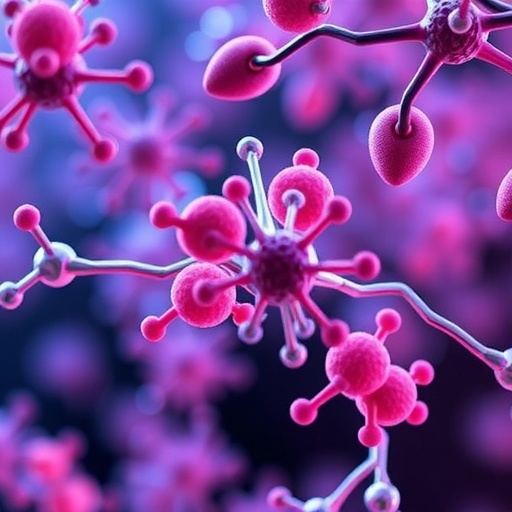

image: Degradation of NUDT5 (Artistic representation, © Tuan-Anh Nguyen / Wolfgang Däuble)
view more
Credit: © Tuan-Anh Nguyen / Wolfgang Däuble
(Vienna, 12 August 2026) For more than 70 years, the drug 6-thioguanine (6-TG) has been used to treat leukemia. Although its clinical effects have been studied extensively, scientists are still uncovering the molecular mechanisms that determine whether cells succumb to the drug or survive its attack.
Now, researchers at the CeMM Research Center for Molecular Medicine of the Austrian Academy of Sciences, together with collaborators at the University of Oxford, the Weizmann Institute of Science and the University of Dundee, have identified an unexpected player in this process: the protein NUDT5.
The discovery builds directly on a recent breakthrough from the Kubicek and Huber laboratories (Science, 2025). In that work, researchers showed that NUDT5 performs a critical cellular function independently of its enzymatic activity. Instead of acting primarily as a catalyst, NUDT5 was found to serve as a molecular scaffold that helps organize cellular metabolism. This unusual behavior has direct consequences for the action of the important cancer drug.
“We initially expected that NUDT5 would influence 6-TG through its enzymatic activity,” says co-first author Tuan-Anh Nguyen from CeMM. “Instead, we found that inhibiting the enzyme had little effect. What mattered was whether the protein itself was present.”
When inhibition is not enough
Most drugs that target enzymes work by blocking their catalytic activity. To investigate whether this was also true for NUDT5, the researchers turned to an emerging technology known as targeted protein degradation. Rather than inhibiting a protein, this approach removes it entirely from the cell.
“We developed a cell-based platform to accelerate the discovery of NUDT5 degraders. This platform helped guide the medicinal chemistry efforts that ultimately produced dNUDT5, our most active degrader.”, said Anne-Sophie Marques, a first author of the paper whose work at Oxford contributed to the findings.
In a dedicated medicinal chemistry effort led by the Huber laboratory at the University of Oxford, the team designed, synthesised and optimised a NUDT5 degrader toolkit: highly selective molecules that remove NUDT5 from cells, together with matched control compounds that bind NUDT5 but do not trigger its degradation, and compared their effects with conventional NUDT5 inhibitors. The outcome was striking: while inhibition of NUDT5 failed to alter cellular responses to 6-TG, degradation of the protein itself protected cells from the drug’s toxic effects. Genetic experiments produced the same result.
“Chemical degraders give us a way to separate what a protein does as an enzyme from what it does as a physical presence in the cell,” says Professor Kilian Huber, Centre for Medicines Discovery at the University of Oxford and co-corresponding author of the study. “In this case, that distinction was decisive: removing NUDT5 revealed biology that conventional inhibitors missed.”
These findings revealed that NUDT5 influences thiopurine sensitivity through a non-enzymatic mechanism – one that cannot be detected by studying catalytic activity alone.
“As the results came in, it became immediately clear that the dNUDT5 was protecting cells from 6-thioguanine toxicity in a dose-dependent manner. That was an incredibly exciting moment.” said Ludwig Bauer, a first author of the paper.
An unexpected counterpart
The work also uncovered a surprising relationship between NUDT5 and NUDT15, another protein already known to influence patient responses to thiopurine drugs.
Whereas loss of NUDT15 increases sensitivity to 6-TG, depletion of NUDT5 has the opposite effect, making cells more resistant to treatment. The results suggest that the two proteins operate through distinct and, in some respects, opposing mechanisms.
“Our results show that proteins can have important biological functions that are completely independent of their enzymatic activity,” says corresponding author Stefan Kubicek, Principal Investigator at CeMM. “By removing NUDT5 rather than simply inhibiting it, we were able to uncover a hidden layer of biology that helps determine how cells respond to a clinically important drug.”
Although the findings do not immediately point to a new therapy, they reveal an unexpected mechanism that influences the activity of a widely used leukemia drug. By showing that NUDT5 affects 6-TG response through a non-catalytic function, the study opens new avenues for understanding why patients respond differently to thiopurine treatment and demonstrates the unique power of targeted protein degradation to uncover hidden biological functions.
###
The Study “Targeted Protein Degradation of NUDT5 Dissociates Catalytic Inhibition from Protein Loss in 6-Thioguanine Response” was published as a pre-print in Nature Communications on 30 June 2026, the final peer-reviewed version was published on 12 August, 2026. DOI: 10.1038/s41467-026-74489-9
Authors: Anne-Sophie M. C. Marques, Ludwig G. Bauer, Tuan-Anh Nguyen, Alejandro Gonzalez Orta, Jan-Lennart Venne, Carol Cheng, Esra Balıkçı, Yusi Liu, Barr Tivon, Alena Kroupova, Alessio Ciulli, Nir London, Stefan Kubicek & Kilian V. M. Huber.
Funding: This work was supported by the European Research Council (ERC) under the European Union’s Horizon 2020 research and innovation programme, the Austrian Science Fund (FWF), the Vienna Science and Technology Fund (WWTF), the Marie Skłodowska-Curie Actions Postdoctoral Fellowships programme, the Innovative Medicines Initiative 2 Joint Undertaking (IMI2 JU), the Wellcome Trust, Merck Sharp & Dohme Corp. and Janssen Pharmaceutica NV.
###
The CeMM Research Center for Molecular Medicine of the Austrian Academy of Sciences is an international, independent and interdisciplinary research institution for molecular medicine under the scientific direction of Maria Rescigno. CeMM is oriented towards medical needs and integrates basic research and clinical expertise to develop innovative diagnostic and therapeutic approaches for precision medicine. Research focuses on cancer, inflammation, metabolic and immune disorders, rare diseases and aging. The institute’s research building is located on the campus of the Medical University and the Vienna General Hospital.
www.cemm.at
We use artificial intelligence (AI) tools for proofreading and translation purposes. All AI-generated output is reviewed and edited by humans before publication.
For further information please contact:
Wolfgang Däuble
Media Relations Manager / Science Writer
Phone +43-1/40160-70092
[email protected]
CeMM
Research Center for Molecular Medicine
of the Austrian Academy of Sciences
Lazarettgasse 14, AKH BT 25.3
1090 Vienna, Austria
www.cemm.at
Journal
Nature Communications
DOI
10.1038/s41467-026-74489-9
Article Title
Targeted Protein Degradation of NUDT5 Dissociates Catalytic Inhibition from Protein Loss in 6-Thioguanine Response
Article Publication Date
30-Jun-2026
Media Contact
Anna Wolfschwenger
CeMM Research Center for Molecular Medicine of the Austrian Academy of Sciences
Office: 14016070074
Journal
Nature Communications
DOI
10.1038/s41467-026-74489-9
Journal
Nature Communications
DOI
10.1038/s41467-026-74489-9
Article Title
Targeted Protein Degradation of NUDT5 Dissociates Catalytic Inhibition from Protein Loss in 6-Thioguanine Response
Article Publication Date
30-Jun-2026
Tags
/Health and medicine/Diseases and disorders/Cancer/Leukemia
/Health and medicine/Clinical medicine/Medical treatments/Cancer treatments
Tags: 6-thioguanine drugcancer cell resistanceCeMM Research Center leukemia studiesleukemia treatment mechanismslong-term leukemia drug effectsmolecular mechanisms of leukemia therapymolecular medicine leukemianovel leukemia drug control strategiesNUDT5 enzyme degradationOxford University cancer researchtargeted cancer therapy developmentWeizmann Institute cancer mechanisms