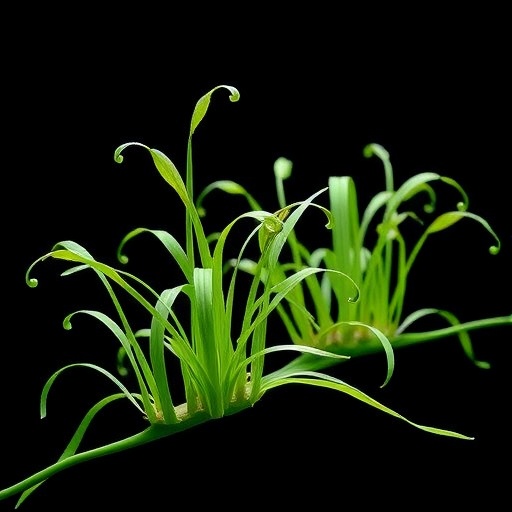
A new wearable sensor designed to monitor the movement of water inside fragile, grass-like plants is turning a subtle biological process into a visible stream of digital data. Reported by Zou, Chai, Sa and colleagues in npj Flexible Electronics, the device combines magnetic sensing with kirigami-inspired mechanical design, creating a lightweight platform that can conform to delicate stems without crushing or seriously disturbing them. The research addresses a persistent challenge in plant science: measuring sap flow continuously while leaving the plant’s natural transport system as undisturbed as possible.
Sap flow is one of the clearest indicators of how plants respond to their surroundings. As water evaporates from microscopic pores in leaves, known as stomata, it creates tension that pulls water upward through the plant’s xylem. This stream carries water and dissolved minerals from the roots toward the leaves, linking plant hydration to light, temperature, humidity and soil conditions. Conventional approaches for measuring sap movement can be bulky, rigid or difficult to attach to narrow stems, especially in grasses and other plants whose tissues are thin, flexible and easily damaged.
The newly described system is based on two design concepts that are increasingly important in soft wearable electronics. The first is magnetic sensing, which can detect changes in the position or separation of magnetic components without requiring a rigid electronic structure to press directly against the plant. The second is kirigami, an engineering strategy that uses carefully arranged cuts in a thin material to make it stretch, bend and expand. Unlike origami, which relies primarily on folds, kirigami introduces cuts that allow a structure to accommodate complex shapes and mechanical motion.
For a plant-mounted sensor, that flexibility is more than a visual feature. A stem can bend in the wind, change diameter as it grows and respond dynamically to water availability. A rigid device may restrict these movements or lose contact with the plant, producing unreliable readings. A kirigami-based structure can distribute strain across its patterned surface, reducing localized pressure while maintaining a functional connection between the sensing elements. The magnetic configuration then translates mechanical changes associated with sap flow into measurable signals.
The central innovation is the attempt to sense a physiological process indirectly, through the tiny mechanical effects generated as water travels within the plant. Sap flow is not simply a visible stream that can be tapped like fluid in a pipe. It is influenced by pressure gradients, tissue elasticity and the plant’s changing water status. By placing a compliant wearable structure around or alongside a fragile stem, the researchers seek to capture these changes without cutting the plant open or inserting probes into its vascular tissue. This non-invasive approach could make long-term observations more practical.
The choice of grass-like plants is particularly significant. Their slender stems and leaves are common in agriculture, ecology and environmental monitoring, yet their small dimensions make them difficult targets for standard instrumentation. A sensor that is too heavy can alter posture and wind response; one that is too stiff can interfere with growth; and one that requires invasive installation may damage the very transport pathway under investigation. A conformable magnetic kirigami device offers a route toward measurements that follow the plant’s movement rather than forcing the plant to adapt to the instrument.
Continuous sap-flow monitoring could provide information well beyond whether a plant is “hydrated” or “dry.” Changes in the signal may reveal how plants respond to drought, heat, shade, sudden changes in humidity or restricted water uptake. In controlled experiments, such data could help researchers compare plant varieties and study the timing of stress responses. In agricultural settings, distributed sensors might eventually support irrigation strategies that respond to plant demand rather than relying only on soil moisture or fixed schedules. Such applications remain dependent on calibration, durability and field validation, but the underlying concept moves plant monitoring toward a more intimate form of wearable technology.
The work also reflects a broader shift in electronics, from rigid devices built around conventional mechanical assumptions to soft systems designed for living surfaces. Human wearable sensors have already demonstrated the value of flexible materials that move with skin, muscles and organs. Plants present a different set of engineering problems: their surfaces can be waxy, their stems grow, their tissues transport fluid internally, and their movements are driven by wind, light and water balance rather than muscles. Magnetic kirigami sensing adapts ideas from flexible electronics to this biological environment, illustrating how device architecture can be shaped by the mechanics of the organism being measured.
The most compelling promise of the technology is its potential to make plant water transport continuously observable without turning the plant into a laboratory specimen. If refined for large-scale use, networks of miniature sensors could generate real-time maps of plant stress across greenhouses, fields or ecological sites. Those measurements could complement imaging, weather data and soil sensing, helping scientists connect invisible vascular activity with visible growth and survival. For now, the study presents a striking demonstration of how a patterned, flexible structure and a magnetic sensing principle can open a new window into fragile plants—one in which the instrument bends, stretches and listens while the plant continues to grow.
Subject of Research: Magnetic kirigami-based wearable sensing of sap flow in fragile grass-like plants
Article Title: Magnetic kirigami-based wearable plant sap flow sensor for fragile grass-like plants
Article References: Zou, Y., Chai, Y., Sa, H. et al. “Magnetic kirigami-based wearable plant sap flow sensor for fragile grass-like plants.” npj Flexible Electronics (2026). https://doi.org/10.1038/s41528-026-00630-9
Image Credits: AI Generated
DOI: 10.1038/s41528-026-00630-9
Keywords: plant sap flow, wearable sensor, magnetic sensing, kirigami, flexible electronics, grass-like plants, plant physiology, non-invasive monitoring, smart agriculture, plant water transport
Tags: continuous plant hydration trackingdelicate plant stem monitoringdigital data collection in plant sciencegrass-like plant water movement detectioninnovative plant physiological measurementkirigami-inspired flexible electronicsmagnetic sensing in agricultureminimally invasive plant sensorsnon-invasive sap flow measurementplant water transport monitoringsoft wearable biosensorswearable plant sensors