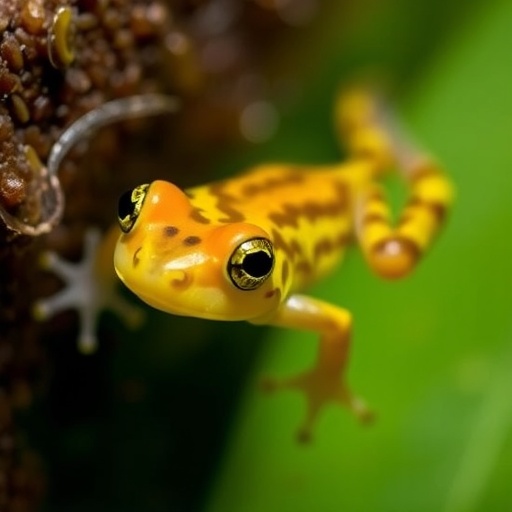
Fever is widely recognized as a powerful defense against infection. Across the animal kingdom, many species raise their body temperature to slow pathogens or improve immune performance. For ectothermic animals such as amphibians, fish and reptiles, however, temperature regulation depends largely on behavior rather than internal heat production. A new study indicates that this response can work in the opposite direction when the pathogen benefits from warmth: virus-infected agile frog tadpoles actively seek cooler environments, apparently using behavioral cooling to limit viral replication.
Researchers from ELTE Eötvös Loránd University and the HUN-REN Hungarian Research Network studied the temperature preferences of agile frog tadpoles (Rana dalmatina) infected with ranaviruses. These pathogens are among the most damaging infectious agents affecting amphibians and have been associated with severe disease outbreaks and mass mortality in susceptible populations around the world. Ranaviruses belong to the family Iridoviridae and can infect multiple amphibian species, with infection often affecting internal organs and causing widespread physiological damage.
The study focused on whether infected tadpoles could alter their preferred body temperature in response to the virus. In ectotherms, body temperature is closely linked to the surrounding environment, meaning that movement between warmer and cooler areas can influence metabolism, immune function and pathogen growth. The researchers created an artificial thermal gradient that allowed tadpoles to select their preferred temperature freely. They then compared the behavior of infected animals with that of healthy tadpoles over five consecutive days. A second group of tadpoles was kept under constant cool conditions, preventing them from choosing among different temperatures.
The behavioral differences became increasingly clear as the experiment progressed. Tadpoles exposed to ranavirus gradually selected cooler water than their uninfected counterparts. The relationship between infection intensity and temperature preference was particularly notable: individuals carrying higher viral loads preferred lower temperatures. This pattern suggests that the shift was not simply a general consequence of illness or reduced activity, but a regulated response associated with the severity of infection.
The infected tadpoles also became more precise in their temperature selection. Over time, they restricted themselves to progressively narrower temperature ranges, indicating that they were not merely moving randomly through the thermal gradient. Instead, their behavior appeared to reflect active thermoregulatory control. By selecting a specific, cooler range, the tadpoles may have been balancing two competing pressures: reducing the temperature-dependent growth of the virus while avoiding the harmful effects of excessive cooling on their own development and physiology.
Measurements of viral load provided additional support for this interpretation. Tadpoles that were held continuously under cool conditions contained significantly less virus in their tissues at the end of the experiment than animals that could regulate their temperature within the gradient. The result is consistent with the biology of the ranavirus used in the study, which replicates more rapidly at higher temperatures. In this context, cooling could slow the expansion of the infection and give the host a better chance of surviving or limiting disease progression.
“ Our results suggest that infected tadpoles fine-tune their body temperature to slow viral replication while avoiding the detrimental physiological consequences of excessively low temperatures,” says Dr Dávid Herczeg, a research fellow at the HUN-REN–ELTE–MTM Integrative Ecology Research Group and first author of the study. Low temperatures can slow tadpole growth and development and may also reduce the performance of the immune system, meaning that cooling is unlikely to be beneficial without limits. The narrowing of the selected temperature range may therefore represent a compromise between antiviral protection and the physiological costs of cold exposure.
Behavioral cooling has been documented only rarely in animals. Previous examples have primarily involved arthropods infected with bacterial or viral pathogens, as well as rats infected with bacteria. The new findings extend this phenomenon to an ectothermic vertebrate and suggest that temperature-related disease behavior may be more diverse than the traditional concept of behavioral fever implies. Whether other amphibians and ectothermic species use similar strategies against viruses remains unknown, but the researchers say the response could have broader evolutionary significance.
The discovery also has implications for amphibian conservation. Ranaviruses threaten amphibian populations in many regions, while climate change is altering the temperature and structure of freshwater habitats. Warmer conditions could increase viral replication in some environments, potentially intensifying outbreaks. At the same time, the availability of cooler refuges may allow infected animals to regulate their body temperature and slow disease progression. “Our study provides the first direct experimental evidence that ectothermic vertebrates can employ behavioral cooling in response to pathogens,” says Dr Attila Hettyey, head of the Department of Evolutionary Ecology at the HUN-REN Centre for Agricultural Research.
Protecting wetlands with a diversity of thermal conditions could therefore become an important part of disease management for amphibians. Shaded pools, deeper water, groundwater inputs and other cool microhabitats may provide infected tadpoles with opportunities to reduce viral growth without forcing them into uniformly cold conditions. The study does not establish that behavioral cooling alone can prevent mortality in natural populations, and field research will be needed to determine how the response operates under fluctuating temperatures, predators and competition. Nevertheless, the findings reveal a previously underappreciated form of antiviral behavior and highlight how host animals can use the physical environment as part of their defense against infection.
Subject of Research: Behavioral cooling in ranavirus-infected agile frog tadpoles, an ectothermic vertebrate
Article Title: Experimental evidence for behavioural cooling as a response to virus infection in an ectothermic vertebrate
News Publication Date: 2-Jul-2026
Web References: https://link.springer.com/article/10.1186/s12915-026-02669-6
References: BMC Biology; DOI: 10.1186/s12915-026-02669-6
Image Credits: copyright Sos Tibor
Keywords: ranavirus, viral infections, amphibians, frog tadpoles, behavioral cooling, thermoregulation, ectothermic vertebrates, evolutionary ecology, amphibian conservation, viral replication
Tags: adaptive behaviors in infected amphibiansamphibian immune responsesamphibian mass mortality caused by ranaviruseseffects of viral pathogens on tadpole physiologyenvironmental strategies to limit viral infectionsimpact of temperature on viral replicationinfected tadpoles behavioral coolingranavirus infection in amphibiansrole of behavior in disease resistancetemperature preference changes in infected animalstemperature regulation in ectothermstemperature-dependent disease dynamics