


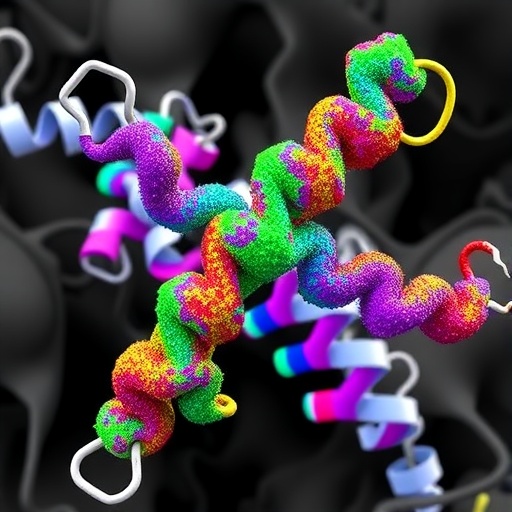
Proteins are often portrayed as elegant molecular machines with a single, well-defined structure. In reality, many proteins constantly shift among several conformations, flickering between shapes that can determine whether they bind a ligand, catalyze a reaction, transmit a signal, or remain inactive. These structural interconversions can occur on microsecond-to-millisecond timescales, fast enough to be invisible to many conventional experiments but slow enough to influence biological function. A new study suggests that one of the most important clues to these hidden motions may be found not in what appears in a protein spectrum, but in what is missing.
The work, reported in Nature, draws on a large-scale analysis of Nuclear Magnetic Resonance, or NMR, data. NMR spectroscopy is one of the principal methods used to study protein structure and motion at atomic resolution. In a typical protein NMR experiment, researchers assign signals to individual atoms or residues, creating a chemical shift dataset that acts like a molecular map. When a residue undergoes conformational exchange on the microsecond-to-millisecond timescale, however, its NMR signal can become broadened, weakened, or entirely undetectable. The residue may then be absent from the final list of assignments.
The researchers made a deliberately bold assumption: that many unassigned residues are missing because their signals have been erased by conformational exchange rather than because of technical errors, incomplete analysis, or poor sample quality. They curated more than 100 NMR relaxation datasets and examined chemical shift assignments from approximately 10,000 proteins deposited in the Biological Magnetic Resonance Data Bank, or BMRB. This allowed them to treat missing assignments as a potential indirect measurement of protein dynamics across a much larger collection of molecules than would normally be accessible through specialized relaxation experiments.
NMR relaxation experiments provide detailed information about molecular motion, but they are labor-intensive and are not available for most deposited protein structures. These experiments measure how nuclear magnetization returns toward equilibrium after being disturbed. Specific relaxation behaviors, including changes in transverse relaxation rates and chemical exchange contributions, can reveal conformational fluctuations occurring on microsecond-to-millisecond timescales. The new study asked whether machine-learning systems trained on the pattern of assigned and unassigned residues could recover the same information.
The answer was unexpectedly strong. The researchers trained several deep-learning models to predict which residues would be missing from NMR assignment datasets. Although the models were not directly instructed to predict conformational exchange, their predictions also correlated with exchange measured in independent NMR relaxation experiments. In other words, a model trained to recognize what was absent from a spectrum learned to identify where a protein was moving. The result suggests that missing data, when interpreted carefully, can contain a biological signal rather than merely representing an inconvenience.
The most successful model was named Dyna-1. It uses an intermediate representation from ESM-3, a multimodal protein language model designed to learn relationships among protein sequences, structures, and other molecular information. Rather than relying only on the local sequence around a residue, Dyna-1 can draw on broader patterns learned from large protein datasets. This gives the model a way to connect a residue’s position and chemical environment with the likelihood that it participates in dynamic exchange.
That capability matters because protein motions are rarely random noise. Conformational flexibility can be central to how enzymes lower activation barriers, how receptors recognize signaling molecules, and how binding sites open and close around drugs or natural ligands. The study found that Dyna-1 was particularly effective at predicting dynamics associated with biological function, including enzyme catalysis and ligand binding. These are precisely the kinds of motions that have often been difficult to survey systematically, because they may be transient, localized, and invisible to standard structural snapshots.
The researchers also observed a relationship between microsecond-to-millisecond exchange and evolutionary conservation. Residues experiencing exchange were more likely to be conserved across related proteins, suggesting that functionally important motions may leave a detectable imprint in evolution. A conserved residue is not necessarily rigid; it may be preserved because its ability to move in a particular way is essential. This finding challenges the common tendency to interpret conservation mainly as evidence for a static structural role and instead highlights dynamics as another property that evolution can protect.
The approach does not mean that every missing NMR assignment is proof of biologically meaningful motion. Signals can disappear for many reasons, including experimental limitations, sample aggregation, overlap with other resonances, or difficulties in assigning crowded spectra. The model’s success therefore depends on large datasets, careful curation, and comparisons with direct relaxation measurements. Still, by identifying a reproducible statistical connection between missing assignments and exchange, the work points toward a new way of extracting value from existing scientific archives.
Dyna-1 and the accompanying datasets could ultimately make protein dynamics easier to study on a scale that conventional NMR experiments cannot match. Instead of requiring a dedicated relaxation study for every protein, researchers may be able to use existing chemical shift information to prioritize residues and proteins most likely to contain functionally important motions. The broader implication is that biological data do not always speak through explicit measurements; sometimes, the pattern of omissions is itself informative. By turning absent signals into predictions of molecular movement, the study offers a potentially powerful route toward a more unified understanding of how protein dynamics gives rise to biological function.
Subject of Research: Protein microsecond-to-millisecond dynamics predicted from missing NMR assignments using deep learning.
Article Title: Learning millisecond protein dynamics from what is missing in NMR spectra
Article References: Wayment-Steele, H.K., El Nesr, G., Hettiarachchi, R. et al. Learning millisecond protein dynamics from what is missing in NMR spectra. Nature (2026). https://doi.org/10.1038/s41586-026-10989-4
Image Credits: AI Generated
DOI: 10.1038/s41586-026-10989-4
Keywords: Protein dynamics, NMR spectroscopy, microsecond-to-millisecond motions, conformational exchange, deep learning, Dyna-1, ESM-3, enzyme catalysis, ligand binding, BMRB
Tags: advanced techniques for studying protein motionanalyzing NMR signal broadening and absenceatomic resolution of protein dynamicsbiological implications of protein conformational flexibilitydetection of transient protein states via NMRhidden protein conformational exchangeinnovative methods to detect invisible protein stateslarge-scale NMR data analysis for protein dynamicsmicrosecond-to-millisecond protein motionsNMR spectroscopy in protein structure analysisprotein conformational dynamics inference from missing NMR signalssignificance of missing signals in NMR spectra


