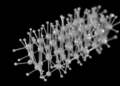
Skyrmions—tiny magnetic vortices that can be moved by electric currents—have taken a major step toward becoming practical components in future computers and data-storage systems. Researchers at Johannes Gutenberg University Mainz (JGU) have directly observed how antiferromagnetic skyrmions move and interact, revealing behavior that could make these nanoscale structures far more reliable than their ferromagnetic counterparts. Using time-resolved X-ray microscopy, the team showed that antiferromagnetic skyrmions travel in straight paths aligned with the driving current, without the sideways deflection that has complicated skyrmion-based technologies for years.
The findings address one of the central obstacles in magnetic spintronics, a field that aims to use the spin of electrons rather than—or alongside—their electrical charge to process and store information. Skyrmions are stable arrangements of spins that form vortex-like patterns within magnetic materials. Because they can be extremely small, resistant to certain forms of disturbance, and manipulated with electrical currents, they have attracted intense interest as potential carriers of information. Proposed applications include racetrack memory, magnetic logic circuits, neuromorphic systems, and unconventional computers designed to perform calculations using the collective behavior of many magnetic structures.
In conventional ferromagnetic materials, however, moving a skyrmion with an electric current often causes it to veer away from the intended direction. This phenomenon, known as the skyrmion Hall effect, arises because the skyrmion experiences transverse forces as it moves through the material. Depending on the material and operating conditions, the resulting deflection can reach angles of approximately 30 degrees. For a device containing thousands or millions of skyrmions, even a small sideways drift could cause the magnetic vortices to collide with boundaries, interfere with one another, or leave their assigned tracks.
Antiferromagnetic skyrmions were theoretically predicted to avoid this problem. In an antiferromagnet, neighboring magnetic moments point in opposite directions, causing their transverse responses to cancel one another. The net result should be motion directly along the direction of the applied current. The Mainz researchers have now confirmed this prediction experimentally by observing an interacting lattice of antiferromagnetic skyrmions in motion. “We have demonstrated—reproducibly and within the experimental uncertainty—that skyrmions in antiferromagnetic systems move along the current direction,” said Mona Bhukta, a member of Professor Mathias Kläui’s research group at the JGU Institute of Physics.
The experiment began with the creation of a dense skyrmion lattice, in which many skyrmions were close enough to interact. Rather than moving independently, the skyrmions maintained their relative positions as the entire lattice moved coherently. The researchers applied short pulses of electric current and tracked the response. Every skyrmion followed a straight trajectory that matched the current direction, providing direct evidence that the skyrmion Hall effect was absent under the conditions studied.
Capturing this motion required an imaging technique capable of resolving both extremely short timescales and nanoscale magnetic structures. The team used time-resolved X-ray microscopy at the BESSY II facility operated by the Helmholtz-Zentrum Berlin. In a second series of experiments, the researchers applied very short current pulses at lower current density and repeatedly recorded what happened as the skyrmions moved. Because the same pulse sequence could be repeated billions of times, the measurements were combined into a movie showing skyrmion dynamics with nanosecond time resolution.
The most revealing part of the movie appeared after the current was switched off. Some skyrmions continued moving briefly toward neighboring skyrmions that had become pinned by material imperfections, defects, or grain boundaries. Once the electrical force disappeared, the mobile skyrmions recoiled from their pinned neighbors. Bhukta compared the process to a crowded arrangement of soft balls in which some are anchored in place: when the moving balls are pushed against them, they deform or compress, then bounce back when the pressure is released.
That recoil allowed the researchers to measure the repulsive interaction between neighboring skyrmions in real time and real space. Skyrmions are not particles in the conventional sense, but their collective magnetic textures generate forces that influence their positions and motion. By analyzing the measured trajectories, the team determined how the effective interaction weakens as the distance between skyrmions increases. Kilian Leutner, a Ph.D. student in Kläui’s group, developed and refined the physical model used to interpret the data, fitted it to the observed trajectories, and carried out micromagnetic simulations to test the results.
Understanding this interaction is essential if antiferromagnetic skyrmions are ever to operate in large-scale devices. Engineers must know how closely the skyrmions can be packed, how rapidly they respond to electrical pulses, and when the repulsive interaction becomes strong enough to affect information transfer. The new measurements provide a quantitative framework for answering those questions. They also suggest that antiferromagnetic skyrmion lattices could transport information with greater positional stability and fewer corrective mechanisms than systems based on ferromagnetic skyrmions. The researchers’ results, published in Nature Physics, bring the prospect of densely integrated skyrmion-based technologies closer to reality by showing not only that these magnetic vortices can move in the right direction, but also how they behave when surrounded by many others.
Subject of Research: Not applicable
Article Title: Time-resolved imaging of antiferromagnetic skyrmion interactions
Web References: https://doi.org/10.1038/s41567-026-03383-4
References: Nature Physics, DOI: 10.1038/s41567-026-03383-4
Image Credits: Mona Bhukta
Keywords
Antiferromagnetic skyrmions, skyrmion Hall effect, spintronics, magnetic vortices, nanotechnology, X-ray microscopy, antiferromagnetism, racetrack memory, magnetic computing, skyrmion interactions
Tags: antiferromagnetic skyrmionscurrent-induced skyrmion manipulationferromagnetic vs antiferromagnetic skyrmionsmagnetic logic circuitsmagnetic vorticesnanoscale magnetic structuresneuromorphic computingracetrack memory technologyskyrmion motion dynamicsskyrmion stability and reliabilityspintronics and data storagetime-resolved X-ray microscopy