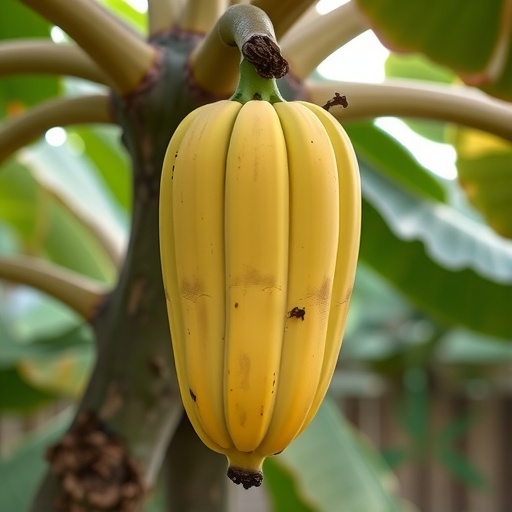
Bananas may soon become easier to manage from harvest to supermarket shelf, thanks to a newly identified genetic switch that controls how quickly their stored starch is converted into sugar. Researchers at Fujian Agriculture and Forestry University have identified the transcription factor MaLBD50 as a key positive regulator of banana ripening. Their findings show that MaLBD50 directly activates MaBMY1, a gene encoding a β-amylase enzyme that breaks down starch in the fruit’s pulp. The discovery provides a detailed molecular explanation for one of the most important changes bananas undergo during ripening: the transformation of firm, relatively bland starch reserves into soluble sugars that produce sweetness and characteristic flavor.
Bananas are climacteric fruits, meaning that their ripening is driven by a burst of respiration and ethylene signaling after harvest. During this process, starch accumulated during fruit development is progressively hydrolyzed into sugars, while the pulp softens and its aroma and color change. Although several transcription factors have been linked to these processes, the regulatory network governing starch degradation in bananas remains incomplete. Lateral organ boundaries domain, or LBD, proteins are a large family of plant transcription factors known to influence development, metabolism, and stress responses. Their contribution to banana fruit ripening, however, has been largely unexplored.
In the study, published in Tropical Plants on 17 June 2026, Zhuo Chen’s team first conducted a genome-wide analysis of Musa acuminata, one of the principal ancestral species contributing to cultivated bananas. The researchers identified 77 MaLBD transcription factor genes distributed across all 11 banana chromosomes. Comparative phylogenetic and synteny analyses showed that the banana LBD family shares stronger evolutionary conservation with rice than with Arabidopsis thaliana, offering clues about how these regulatory proteins developed in monocot crops.
The team next combined RNA sequencing with DNase I hypersensitive-site sequencing, a technique that identifies regions of chromatin where DNA is accessible to regulatory proteins. The analysis compared four developmental and ripening stages. Nine MaLBD genes became more highly expressed in fully ripe fruit, but four—MaLBD4, MaLBD23, MaLBD24, and MaLBD50—also showed accessible promoter regions. These features suggested that the genes could be active regulators rather than merely responding passively to the ripening process. MaLBD50 was selected for detailed functional testing because its expression pattern and chromatin accessibility were particularly consistent with a role in ripening control.
To test that possibility, the researchers used Agrobacterium-mediated transient transformation to increase or suppress MaLBD50 activity in banana tissues. Fruit tissue engineered to overexpress MaLBD50 ripened faster, whereas RNA interference-mediated silencing delayed ripening. In the overexpression treatment, MaLBD50 transcript levels increased by approximately 3.3-fold, and starch content declined by 32.6 percent compared with control tissue. By contrast, pulp in which MaLBD50 was silenced retained 9.9 percent more starch. These results indicate that the transcription factor is closely associated with the rate of starch hydrolysis and is not simply a molecular marker of ripening.
The researchers then investigated how MaLBD50 exerts its effect. They integrated data from DNA affinity purification sequencing, DNase sequencing, and RNA sequencing to map potential MaLBD50 binding sites and downstream genes. The combined analysis identified 7,813 high-confidence candidate targets. Approximately 28.39 percent of the binding peaks occurred in promoter regions, where transcription factors can directly influence gene activity. Among the candidate targets were MaAMY3, which is associated with starch degradation; MaEXPA8, linked to cell-wall loosening; and MaINV1, which participates in sugar metabolism.
One gene stood out as a direct connection between MaLBD50 activity and starch conversion: MaBMY1, which encodes a β-amylase. β-amylases cleave starch molecules to release maltose and related soluble carbohydrates, helping transform the fruit’s stored energy reserves into sugars that contribute to sweetness. DNA affinity purification followed by quantitative PCR confirmed that MaLBD50 was enriched at an accessible region of the MaBMY1 promoter. Yeast one-hybrid experiments further demonstrated direct binding between MaLBD50 and the promoter, while dual-luciferase assays in tobacco leaves showed that MaLBD50 strongly activated MaBMY1 transcription.
Together, the experiments establish a MaLBD50–MaBMY1 regulatory module that links a specific transcription factor to the biochemical breakdown of starch during banana ripening. The findings also suggest that MaLBD50 may influence several ripening characteristics at once, because its broader target network includes genes involved in cell-wall remodeling and sugar metabolism. That broader activity could be useful for crop improvement, but it also means that manipulating the gene may produce effects beyond starch content, including changes in softening, flavor development, aroma, or ripening synchrony.
The discovery could eventually support new strategies for extending banana shelf life and reducing postharvest losses. Fine-tuning MaLBD50 activity through promoter editing, tissue-specific gene regulation, or naturally occurring genetic variants might delay starch conversion during transport and storage without completely blocking normal ripening. Conversely, increasing its activity could help fruit reach desirable sweetness more quickly before sale. Such applications remain experimental, and field-scale studies will be needed to determine how the pathway behaves across cultivars and growing conditions. For now, the study provides a mechanistic framework for understanding how bananas turn starch into sugar and identifies MaLBD50 as a promising molecular target for developing fruit with more controllable ripening rates.
Subject of Research: Banana fruit ripening and starch degradation
Article Title: MaLBD50 directly activates MaBMY1 to promote starch degradation during banana fruit ripening
News Publication Date: 17 June 2026
Web References: https://www.maxapress.com/tp
References: DOI: 10.48130/tp-0026-0026
Image Credits: Tropical Plants
Keywords: banana ripening, MaLBD50, MaBMY1, β-amylase, starch degradation, transcription factors, fruit quality, postharvest shelf life, plant genomics, tropical crops
Tags: banana ripening genetic regulationbanana starch-to-sugar conversionethylene signaling in climacteric fruitsgene editing for banana ripening controlgenetic control of banana ripeningMaLBD50 transcription factormolecular mechanisms of fruit ripeningplant stress response and fruit maturationplant transcription factors and fruit developmentregulation of banana flavor and aromastarch hydrolysis in bananasβ-amylase enzyme in bananas