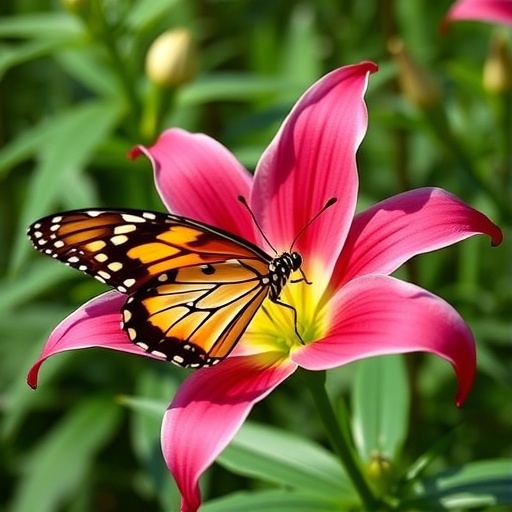
A genetic switch that determines whether butterfly lily flowers develop as mirror-image left- or right-handed forms has been identified for the first time, solving a botanical mystery that dates back more than a century. The discovery, published in Science, reveals how a small cluster of linked genes redirects the development of flowers in two South African plant lineages. The findings also show that gravity acts as an environmental cue, helping developing flowers establish their final orientation.
Butterfly lilies in the genus Wachendorfia produce flowers with a striking form of asymmetry. On each plant, every flower develops with its female reproductive structure, known as the style, pointing either to the left or to the right. The central male structure, the stamen, bends in the opposite direction. A plant therefore carries flowers with a consistent “handedness,” creating mirror-image forms that resemble the left and right versions of a glove.
This unusual arrangement has important consequences for reproduction. Because the style and stamen point in opposite directions, pollen is less likely to be transferred directly from a flower’s anthers to its own stigma. Instead, pollinators moving between plants with opposite floral orientations are more likely to pick up pollen from one form and deposit it on the corresponding reproductive structure of the other. The arrangement therefore reduces self-pollination and encourages pollen exchange between genetically distinct individuals.
The evolutionary puzzle attracted the attention of Charles Darwin late in his life. In a letter written just nine days before his death, Darwin discussed the curious left-right differences observed in flowers. More than a century later, an international team involving researchers from the University of Cape Town, the University of Potsdam and Wageningen University has traced the phenomenon to a genetic region that functions as a developmental control system.
The researchers compared DNA from hundreds of left- and right-oriented plants representing four Wachendorfia species and the related species Barberetta aurea. Their analysis identified a segment of DNA present only in plants that develop right-oriented flowers. The region contains two closely linked genes, YUC-R and miR156, which together act as a supergene-like switch. A supergene is a group of neighboring genes inherited together because genetic recombination between them is suppressed or limited, allowing several coordinated traits to evolve as a single functional unit.
The two genes influence different aspects of floral development. YUC-R belongs to the YUCCA family of genes, which participate in the production of auxin, a plant hormone that regulates cell expansion, tissue growth and directional development. Changes in auxin distribution can cause one side of a developing organ to grow faster than the other, producing curvature. In butterfly lilies, the activity of YUC-R helps establish the bending direction of the central stamen.
The second gene, miR156, produces a small regulatory RNA molecule rather than a conventional protein. MicroRNAs control gene activity by binding to messenger RNAs and preventing them from being translated into proteins or promoting their degradation. The butterfly lily version of miR156 was shown by University of Cape Town honours students Oliver Marketos and Anand Shankar to perform a regulatory role comparable to that of the gene in the laboratory plant Arabidopsis thaliana. In the flower, its activity helps determine the direction taken by the style.
Natural mutants provided an especially powerful test of the genetic model. During a search across the Western Cape, the team located plants carrying naturally occurring defects in the two genes. When YUC-R was disrupted, the stamen bent in the opposite direction from normal. When miR156 was defective, the style switched orientation. These contrasting effects demonstrated that the genes control separate but coordinated components of the flower’s mirror-image architecture.
The work also revealed that genes are not acting alone. While observing developing flower buds, Professor Nicola Illing accidentally positioned one bud upside down. MSc student Caroline Robertson noticed that the flower did not simply continue its original developmental trajectory. Instead, its style and stamen reversed orientation. Further observations indicated that gravity provides a directional signal during the brief developmental window when the flower establishes its handedness. The result suggests that the genetic switch determines how the plant responds to its surroundings, while gravity helps define the direction in which the response unfolds.
Obtaining the genetic evidence required overcoming a practical obstacle. Butterfly lily tissues contain high concentrations of sticky carbohydrates that interfere with the purification of DNA and RNA, making molecular analysis difficult. During her MSc research, Kelly Shepherd developed a method for extracting high-quality genetic material from young flower buds. That protocol enabled the team to sequence and compare the genomes and gene activity patterns needed to identify the handedness region. The combined genetic, developmental and ecological evidence now provides a detailed explanation for how these plants break left-right symmetry.
The discovery extends beyond butterfly lilies. Left-right asymmetry is a fundamental problem in developmental biology, appearing in organisms ranging from humans to flowering plants. In animals, internal organs can be positioned asymmetrically even when the external body plan is broadly symmetrical. In plants, asymmetry may arise through unequal growth, hormone transport, cell division or environmental sensing. The butterfly lily system offers an unusually clear example in which a small genetic region, hormone-linked growth, microRNA regulation and gravity interact to produce a visible evolutionary trait.
The findings may also help explain how mirror-image flowers evolve and persist in natural populations. Wachendorfia species are found in South Africa’s Western and Eastern Cape, while Barberetta aurea occurs in KwaZulu-Natal and the Eastern Cape. The marsh butterfly lily, Wachendorfia thyrsiflora, grows near streams and is cultivated in botanical gardens worldwide. Other species, including W. brachyandra, W. multiflora and W. paniculata, flower across the Western Cape from the Cederberg to Cape Agulhas, generally between August and November. As these plants enter bloom, their apparently delicate mirror-image flowers will display the outcome of a precisely coordinated genetic and environmental decision made early in development.
Subject of Research: Plant developmental biology and evolutionary biology
Article Title: Supergene control of chiral development in mirror-image flowers
News Publication Date: 30-Jul-2026
Web References: Science article; Charles Darwin letter; University of Cape Town Department of Molecular and Cell Biology
References: Science. DOI: 10.1126/science.aeb1157
Image Credits: Nicola Illing
Keywords: butterfly lilies, Wachendorfia, Barberetta aurea, floral asymmetry, left-right symmetry, flower development, supergene, YUC-R, miR156, auxin, microRNA, gravity, plant evolution, developmental biology
Tags: botanical mystery of flower handednessButterfly lily flower asymmetryenvironmental cues in flower orientationevolutionary significance of floral asymmetrygenetic basis of flower symmetrygenetic mechanisms of floral handednessgravity’s role in plant morphogenesismirror-image flower formationplant developmental geneticsplant reproductive structure orientationpollination strategies in asymmetric flowersWachendorfia flower morphology