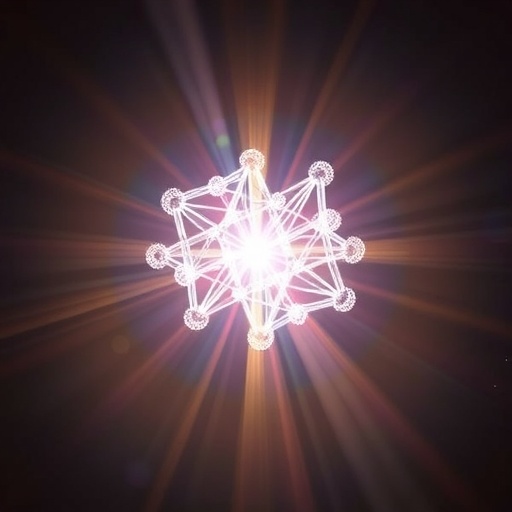
A new experiment has shown that sunlight, rather than a power-hungry laser, can generate entangled photons—particles of light whose properties remain mysteriously linked even when the photons travel apart. The result could reshape how quantum technologies are powered, offering a route toward systems that use the abundant natural light available on Earth and in space. The researchers say the demonstration may eventually help satellites produce secure encryption keys without carrying complex laser equipment.
Quantum entanglement is one of the most important resources in modern quantum science. It allows two particles to share a joint state so strongly correlated that measuring one immediately provides information about the other, even across large distances. These correlations support proposed technologies including quantum communication, precision sensing and quantum computing. Yet most experiments that create entangled photons depend on lasers, which require electrical power, thermal management and supporting optical hardware. As quantum systems grow, those energy demands could become a significant limitation.
The new work, led by researchers from the University of Ottawa and the Max Planck Institute for the Science of Light, challenges the assumption that entanglement requires highly orderly light. Lasers produce coherent radiation, meaning their waves maintain a predictable relationship in space and time. Sunlight is very different: it contains a broad spectrum of colors, arrives from many directions and has low spatial and temporal coherence. Despite this apparent disorder, the researchers found that sunlight can still produce high-quality entanglement when the quantum information is encoded in photon polarization.
The experiment relies on spontaneous parametric down-conversion, or SPDC, a widely used nonlinear optical process. In SPDC, a pump photon enters a nonlinear crystal and interacts with the material, occasionally producing a pair of lower-energy photons. Under carefully controlled conditions, the two resulting photons can become entangled. Traditionally, the pump beam is supplied by a laser, whose narrow bandwidth and strong coherence make it easier to focus and control. In this experiment, polarized sunlight replaced the laser while the researchers designed the system to prevent its color and directional variation from disturbing the polarization correlations.
“Quantum entanglement is crucial for applications such as secure communication, ultra-precise sensing and high-performance computation,” said Cheng Li, a recent University of Ottawa graduate and first author of the study. The key theoretical insight was that polarization entanglement does not necessarily depend on every aspect of the pump light being coherent. If the relevant order exists in the direction of the light’s electric-field oscillation, the photons’ polarization can remain strongly correlated even while the light is disordered in other properties.
Turning that idea into an experiment required solving a difficult engineering problem: sunlight must be concentrated onto a nonlinear crystal only a few millimeters in size. The researchers used a window-sized Fresnel lens to collect and focus sunlight. A specially developed, all-glass, cone-shaped solar concentrator then compressed the concentrated light into an optical fiber roughly the width of a human hair. This arrangement directed enough sunlight onto the crystal to drive the SPDC process, despite the source’s relatively weak brightness compared with a laboratory laser.
The outdoor test was conducted at the Max Planck Institute for the Science of Light. After generating the photon pairs, the team used quantum state tomography to reconstruct their joint quantum state. The measurements indicated that the sunlight-generated state was approximately 94 percent similar to a perfectly entangled state. The researchers also observed correlations that violated Bell’s inequality, a crucial test used to distinguish quantum entanglement from patterns that could be explained by classical physics. The result showed that the observed correlations could not be reproduced by a conventional local classical model.
The performance was comparable to laser-based approaches after accounting for the different bandwidth of the input light. Sunlight contains a much wider range of frequencies than the narrow output of a typical laser, so direct comparisons can be misleading. The researchers emphasize that the experiment is a proof of principle rather than a ready-to-deploy quantum communications system. The present source still needs improvements in brightness, stability and entanglement quality before it can support practical applications.
One of the most striking possibilities is space-based quantum communication. Satellites already receive intense, uninterrupted sunlight, and a sunlight-driven entanglement source could reduce the need for onboard lasers and their associated power supplies, cooling systems and control electronics. In principle, entangled photons could help satellites establish quantum encryption keys with ground stations or with one another. The same strategy could also benefit future quantum processors and sensors by reducing the energy burden associated with producing specialized quantum light.
The researchers say the concept may extend beyond SPDC to other nonlinear optical processes, including four-wave mixing. Their broader message is that quantum resources may be available in light sources previously dismissed as too disordered for sophisticated quantum experiments. As the team works toward a field-deployable device, the experiment offers a vivid demonstration that sunlight is not merely a source of energy. Under the right optical conditions, it can also become a source of distinctly quantum information.
Subject of Research: Quantum mechanics and applied optics
Article Title: Sunlight Generates Entangled Photons Using a Solar Concentrator
News Publication Date: 6-Aug-2026
Web References: University of Ottawa: https://www.uottawa.ca/en ; Max Planck Institute for the Science of Light: https://mpl.mpg.de/ ; Optica Publishing Group: https://opg.optica.org/
References: DOI: 10.1364/OPTICA.601797
Image Credits: Florian Sterl
Keywords
Quantum entanglement, sunlight, entangled photons, quantum optics, solar concentrator, spontaneous parametric down-conversion, nonlinear optics, quantum communication, satellite technology, applied optics
Tags: advances in quantum photonics with sunlightenergy-efficient quantum technologies utilizing natural illuminationenvironmental benefits of sunlight-powered quantum experimentsimpact of sunlight on quantum sensing devicesnatural light for quantum communicationquantum entanglement generation using sunlightsolar-powered quantum entanglementspace-based quantum communication without laserssunlight as a resource for quantum computingsunlight-based photon entanglement experimentssunlight-driven quantum encryption technologysustainable quantum systems with natural light