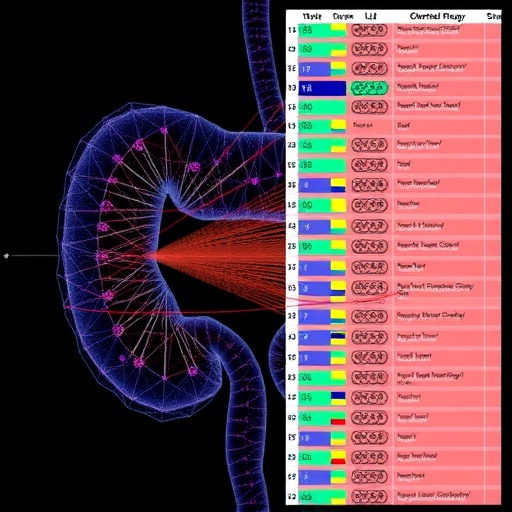
A healing colon does not simply switch genes on and off. Its cells appear to follow a complex daily timetable, with different populations activating distinct genetic programs at different times. A new study by V. Carmona-Alcocer, C. Gobet, J. MacDonald and colleagues introduces a “chrono-atlas” designed to chart these cell-type-specific rhythms during colon regeneration, offering a detailed view of how biological time may influence tissue repair.
Published in Nature Communications, the work focuses on the regenerating colon, an organ that must rapidly rebuild its protective lining after injury. The colon contains a diverse cellular ecosystem, including stem and progenitor cells, absorptive cells, mucus-producing goblet cells, hormone-secreting enteroendocrine cells, immune populations and supporting stromal cells. Each group performs a different job, and the study examines whether each also operates according to its own daily gene-expression schedule.
Gene expression is the process through which DNA instructions are used to produce RNA and, ultimately, proteins. When gene activity rises and falls over approximately 24 hours, the pattern is known as a circadian rhythm. These oscillations are coordinated by molecular clock machinery, including transcriptional regulators such as CLOCK and BMAL1, which control networks of downstream genes. However, a tissue is not governed by one uniform clock. Individual cell types can interpret time differently, responding to feeding, hormones, metabolism, inflammation and signals from neighboring cells.
That cellular diversity is central to the new atlas. Rather than treating the colon as a single synchronized organ, the research frames it as a collection of interacting biological clocks. A gene involved in metabolism may peak in one cell population while a gene controlling cell division, barrier maintenance or immune signaling reaches its maximum in another. Mapping these differences can reveal when particular cellular tasks are most active and how those schedules change after injury.
Regeneration makes the timing question especially important. When the intestinal lining is damaged, stem and progenitor cells increase their activity, producing new cells that migrate, mature and rebuild the epithelial barrier. This emergency response must be carefully balanced: too little proliferation can delay healing, while excessive or poorly controlled growth may disturb tissue architecture. Daily rhythms could help coordinate this process by aligning DNA replication, cell differentiation, mucus production and barrier repair with predictable environmental cues.
The chrono-atlas approach provides a framework for identifying those temporal patterns at cellular resolution. By comparing gene-expression programs across cell types and time points, researchers can distinguish genes that are consistently active from genes whose activity oscillates. This distinction matters because a gene may appear only moderately active in a whole-tissue sample while undergoing powerful daily swings in a specific population. Bulk measurements can blur such behavior; cell-resolved analysis can expose it.
The study also highlights why regeneration cannot be understood solely by counting cells or measuring the average level of a protein. Two tissues might contain similar numbers of stem cells, immune cells and mature epithelial cells, yet behave differently because those populations are operating at different phases of their molecular cycles. A temporal map may therefore help explain why the outcome of injury, infection or treatment can depend on when the event occurs.
For medicine, the implications extend toward chronobiology and chronotherapy. If certain regenerative pathways are naturally more active at particular times, therapies designed to stimulate repair might work more effectively when administered during those windows. Conversely, treatments that interfere with proliferation or inflammation could potentially be scheduled to limit disruption of normal tissue rhythms. Such applications remain prospective, and translating a gene-expression atlas into clinical guidance would require extensive validation, but the map offers a foundation for testing these ideas.
The findings may also help connect circadian disruption with intestinal disease. Shift work, irregular eating schedules, jet lag and altered sleep patterns have been associated with changes in metabolism and immune function. The colon is exposed directly to food-derived signals and microbial activity, making it especially sensitive to changes in daily routines. If injury-induced regeneration depends on coordinated cellular timing, persistent disruption of those rhythms could affect barrier integrity or recovery, although the precise consequences will need to be established experimentally.
By organizing the daily molecular behavior of regenerating colon cells, Carmona-Alcocer, Gobet, MacDonald and their colleagues present a resource for researchers studying tissue repair, intestinal biology and biological clocks. The central message is both technically precise and broadly striking: regeneration is not only a question of which cells are present or which genes are active, but also of when those genes rise and fall. The colon’s recovery may be governed by a hidden timetable, and the new chrono-atlas brings that timetable into view.
Subject of Research: Cell-type-specific daily gene-expression rhythms during colon regeneration.
Article Title: Chrono-atlas of cell-type specific daily gene expression rhythms in the regenerating colon
Article References: Carmona-Alcocer, V., Gobet, C., MacDonald, J. et al. “Chrono-atlas of cell-type specific daily gene expression rhythms in the regenerating colon.” Nature Communications (2026). https://doi.org/10.1038/s41467-026-76318-5
Image Credits: AI Generated
DOI: 10.1038/s41467-026-76318-5
Keywords: circadian rhythms, chrono-atlas, colon regeneration, gene expression, cell-type specificity, intestinal biology, tissue repair, chronobiology, stem cells, biological clocks
Tags: cell-specific circadian gene expression in colon regenerationcell-type-specific gene regulation during colon regenerationchronobiology of immune and stromal cell populations in colon healingcircadian rhythms in stem and progenitor cells during tissue regenerationdevelopment of chrono-atlas for tissue-specific gene activitygene expression oscillations in goblet and enteroendocrine cellsimpact of circmolecular clock mechanisms in intestinal cellsrole of CLOCK and BMAL1 in colon tissue repairtissue repair and biological timing