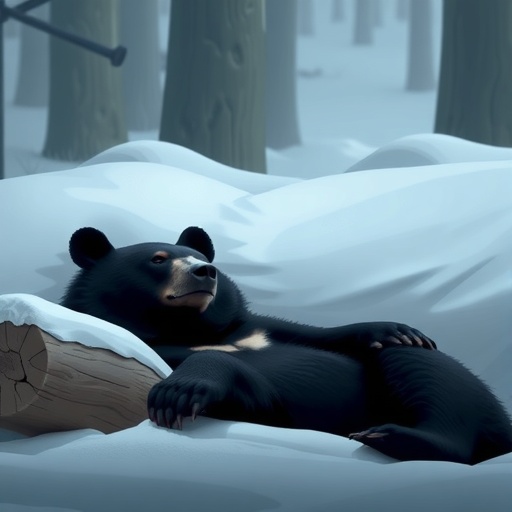
American black bears may spend far more time asleep during hibernation than previously appreciated, according to a machine-learning analysis of long-term physiological recordings from captive animals. The study, published in PLOS One, found that bears slept approximately twice as much during their winter hibernation period as they did during summer. During hibernation, the animals were awake for only about one-third of the time, revealing a dramatic seasonal reorganization of sleep and wakefulness.
The research, titled “Automated sleep scoring in hibernating and non-hibernating American black bears,” examined data collected from captive American black bears over five years. Rather than relying exclusively on manual inspection of recordings, the investigators used automated software to classify periods of sleep and wakefulness. This approach allowed them to analyze a large and complex dataset while applying the same criteria consistently across different seasons and animals.
Sleep scoring is the process of dividing physiological recordings into behavioral states, such as wakefulness and different stages of sleep. In humans and many laboratory animals, researchers commonly use signals from the brain, eyes, muscles, and heart to identify these states. Hibernation presents a more difficult analytical challenge because body temperature, heart rate, movement, and brain activity can change substantially as an animal enters and maintains a hypometabolic condition. Conventional scoring methods developed for humans or non-hibernating animals may therefore be less reliable when applied to bears.
The machine-learning system used in the study was designed to recognize patterns in recorded physiological signals and distinguish sleep from wakefulness during both hibernating and active periods. Automated classification can detect subtle changes that may be difficult to identify consistently by visual inspection alone. It also makes it possible to examine uninterrupted recordings over long periods, providing a more detailed picture of how sleep is distributed across an entire season rather than focusing only on short observation windows.
The results suggest that hibernation is not simply a prolonged state of unconsciousness. Even while conserving energy, bears cycle between periods that can be identified as sleep and shorter intervals of wakefulness. The analysis showed that hibernating bears slept about twice as much as they did in summer, but the animals still spent a measurable portion of the hibernation period awake. This finding supports the view that hibernation is a highly regulated physiological state involving repeated changes in metabolism and behavior, rather than a single uniform condition.
For bears, seasonal changes in sleep are closely connected to the demands of survival. During hibernation, animals reduce energy expenditure and may remain in dens for extended periods without feeding. In summer, by contrast, black bears are active foraging animals that must search for food, navigate their environment, and respond to social and ecological conditions. The difference in sleep duration between the two seasons reflects the opposing biological priorities of energy conservation in winter and activity in warmer months.
The study may also provide a useful framework for investigating the biology of hibernation in other species. Hibernating mammals have attracted interest because their natural ability to suppress metabolism, tolerate prolonged inactivity, and recover without the muscle and bone loss commonly associated with immobility could inform medical research. Understanding how sleep is organized during hibernation may eventually contribute to studies of critical illness, long-term immobilization, spaceflight, or other conditions in which human physiology is forced into abnormal metabolic states. Such applications remain prospective, but reliable methods for measuring sleep are an essential first step.
The long-term dataset is particularly valuable because sleep and hibernation can vary among individuals and from year to year. A five-year record allows researchers to look beyond isolated episodes and assess recurring seasonal patterns. At the same time, the findings should be interpreted within the study’s limits. The animals were captive bears, and their sleep may not perfectly match that of wild black bears exposed to natural denning conditions, food availability, temperature fluctuations, and environmental disturbance. Further research will be needed to determine how broadly the results apply across populations and habitats.
The work involved researchers from the United States, the United Kingdom, and Australia. Funding came entirely from U.S. federal sources, including the National Institutes of Health, the U.S. Army Medical Research and Materiel Command, and the National Science Foundation. The researchers also disclosed that one author has a financial interest in Somnivore Pty Ltd, which provided free access to its sleep-analysis software but no direct financial support for the study. The authors state that the company did not participate in data collection or the decision to publish.
Subject of Research: Seasonal sleep and hibernation physiology in captive American black bears, analyzed using machine-learning-based sleep scoring.
Article Title: Automated sleep scoring in hibernating and non-hibernating American black bears
Web References: https://doi.org/10.1371/journal.pone.0352640
References: PLOS One article, DOI: 10.1371/journal.pone.0352640
Image Credits: Ali Kazal, Unsplash, CC0
Keywords: American black bears, hibernation, sleep, machine learning, animal physiology, seasonal biology, sleep scoring, PLOS One, mammalian metabolism
Tags: automated sleep scoringblack bearscaptive black bear studieshibernation sleep durationimpact of hibernation on sleep architecturelong-term animal behavior analysismachine learning in wildlife researchphysiological monitoring of hibernating animalsseasonal reorganization of sleep and wakefulnessseasonal sleep patterns in bearssleep-wake cycle during hibernationtechnological advances in animal physiology