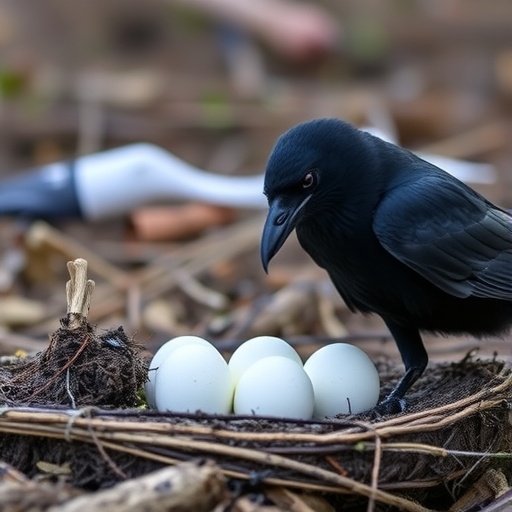
Common ravens are thriving in landscapes reshaped by people—and that success may be putting vulnerable birds at greater risk. New research published in The Journal of Wildlife Management reports that treating raven nests with a thin layer of non-toxic mineral oil can reduce raven reproduction, lower local raven abundance, and improve the survival and population growth of greater sage-grouse. The findings suggest that a targeted intervention may provide temporary protection for one of North America’s most imperiled grassland birds, although scientists caution that it cannot replace broader efforts to address the human activities fueling raven populations.
Ravens are highly intelligent, adaptable omnivores that have benefited from modern food and nesting opportunities. Landfills, agricultural operations, roadkill, livestock facilities, and other human-associated food sources can provide reliable calories, while transmission towers, utility structures, buildings, and other artificial features offer additional nesting sites. These advantages allow ravens to survive and reproduce at unusually high densities in some sagebrush ecosystems. As raven numbers rise, so does pressure on species that evolved with lower levels of predation, including greater sage-grouse.
Greater sage-grouse depend on expansive sagebrush habitat, where females build nests on the ground and incubate their eggs for several weeks. Their nests and chicks are vulnerable to a wide range of predators, but ravens are particularly effective hunters. They can search large areas, remember productive locations, and exploit small openings in vegetation to locate eggs and young. Nest predation is one of several factors contributing to long-term sage-grouse declines, alongside habitat loss, invasive plants, wildfire, disease, and changes in land use.
The study examined whether reducing raven reproduction could create a localized “predator release” for sage-grouse without directly killing adult ravens. Researchers treated developing raven eggs with mineral oil, a technique known as egg oiling. The oil forms a coating over the eggshell’s microscopic pores. Those pores normally allow oxygen to enter and carbon dioxide and water vapor to leave during embryonic development. By interfering with that gas exchange, the treatment prevents the embryo from surviving while leaving the egg itself intact.
Egg oiling is intended to act during a narrow window, when raven nests can be located and eggs can be treated before embryos develop too far. The approach has been used in some wildlife management programs because it does not require removing eggs or using toxic substances. It also avoids the immediate loss of adult birds, which may occur with lethal population-control methods. However, the technique requires repeated monitoring, access to nests, trained personnel, and careful consideration of animal-welfare and regulatory standards.
According to the researchers, treating raven nests produced measurable ecological effects beyond the nests themselves. Sage-grouse nest survival more than doubled in areas where raven nests were treated compared with control populations. Relative sage-grouse abundance increased by 44 percent in the treated areas, indicating that the intervention may influence not only individual nests but also local population performance. By reducing the number of young ravens entering the population, the treatment may lower future predation pressure during a critical period for sage-grouse recovery.
The results are significant because they connect a direct management action on a predator with demographic outcomes in its prey. A small change in raven recruitment can potentially alter the local balance between predators and nesting birds, especially where raven densities have been artificially elevated. The study does not suggest that ravens are inherently harmful or that they should be eliminated. Instead, it highlights how human-caused changes to food availability and nesting habitat can produce ecological consequences that extend across species and reshape predator-prey relationships.
Steven Mathews-Sanchez, the study’s lead author, said that egg oiling offered nesting sage-grouse “some reprieve from nest predation.” He also emphasized that the method is most effective at a local scale and does not solve the underlying causes of raven population growth. As long as human landscapes continue to provide abundant food and nesting structures, raven numbers may recover after treatment ends. The technique therefore functions as a targeted conservation tool rather than a permanent solution.
The researchers stress that long-term sage-grouse conservation will require protection and restoration of healthy sagebrush habitat, reduction of artificial food sources, and management of infrastructure that supports raven nesting. Egg oiling may be most useful when combined with those broader measures, particularly in locations where sage-grouse populations are small and each successful nest can influence recovery. The study demonstrates how a carefully targeted, non-toxic intervention can produce rapid benefits, while also underscoring a larger lesson in conservation: protecting vulnerable species often requires changing the human conditions that have intensified the threats they face.
Subject of Research: Effects of common raven nest treatment on raven populations and greater sage-grouse survival and abundance in sagebrush ecosystems.
Article Title: Effects of Oiling Common Raven Nests on Ravens and Greater Sage-Grouse in Sagebrush Ecosystems
News Publication Date: 5-Aug-2026
Web References: The Journal of Wildlife Management, https://wildlife.onlinelibrary.wiley.com/journal/19372817; DOI: https://doi.org/10.1002/jwmg.70247
References: Mathews-Sanchez, S. et al., “Effects of Oiling Common Raven Nests on Ravens and Greater Sage-Grouse in Sagebrush Ecosystems,” The Journal of Wildlife Management, DOI: 10.1002/jwmg.70247.
Keywords
Common ravens, greater sage-grouse, egg oiling, nest predation, wildlife management, sagebrush ecosystems, conservation ecology, predator control, bird conservation, habitat management
Tags: artificial nesting sites for ravensbalancing predator control and habitat protectionconservation efforts for greater sage-grouseeffects of landfills on bird predatorshuman influence on raven populationsimpact of raven predation on sage-grouseinfluence of human food sources on predator populationsnon-toxic mineral oil for bird conservationraven nest managementrole of ravens in North American ecosystemsstrategies to reduce raven reproductiontargeted interventions for imperiled grassland birds