


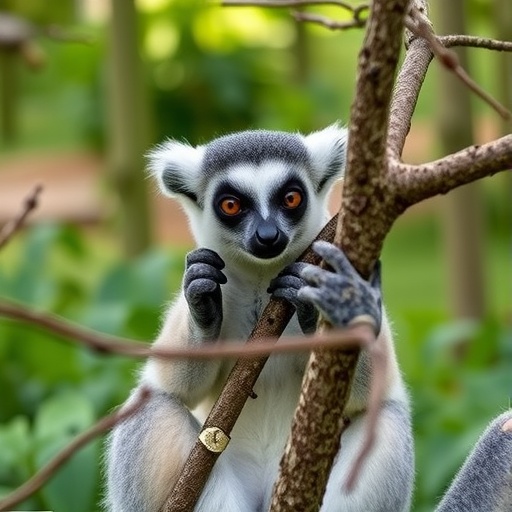
A virus that usually causes little more than an uncomfortable cold sore in people has been linked to the deaths of four privately owned lemurs, according to a new case study led by researchers at the University of Florida. The report provides the first molecular confirmation of human alphaherpesvirus 1, or HuAHV1, in lemurs and highlights the severe consequences that human-associated pathogens can have when they cross into evolutionarily distant hosts.
Published in the Journal of Zoo and Wildlife Medicine, the study describes infections in two ring-tailed lemurs (Lemur catta), one black-and-white ruffed lemur (Varecia variegata) and one hybrid lemur produced from a black-and-white ruffed lemur and a red ruffed lemur (Varecia variegata × Varecia rubra). All four animals were privately owned and died after developing disease consistent with herpesvirus-associated neurological damage.
In humans, HuAHV1—more commonly known as herpes simplex virus type 1, or HSV-1—is widespread. Many infections remain asymptomatic, while others produce recurrent oral lesions. In susceptible nonhuman primates, however, the virus can behave very differently. Once it reaches the nervous system, it may cause encephalitis, an inflammation of the brain that can progress rapidly and is frequently fatal.
The researchers used molecular testing to identify the virus in tissues collected from the affected lemurs. Such testing can detect viral genetic material and distinguish the pathogen from other infectious agents that may cause similar neurological signs. The confirmation is significant because previous reports of herpesvirus disease in lemurs have been limited, and laboratory evidence specifically identifying human alphaherpesvirus 1 in these animals has been lacking.
“Herpes, as viruses, have amazing host fidelity,” said Jim Wellehan, D.V.M., M.S., Ph.D., senior author of the study and a professor at the University of Florida’s College of Veterinary Medicine. Herpesviruses typically remain adapted to a particular host species or a closely related group of hosts. Their long-term survival depends on a finely balanced relationship with the immune system of that host. When a virus enters an unfamiliar species, that balance may be lost, allowing uncontrolled replication and severe tissue damage.
The biological danger of a host jump is especially pronounced in alphaherpesviruses because these viruses can establish lifelong infections in nerve cells. After an initial infection, the virus may move along sensory neurons and persist in a latent state within nerve ganglia. Periodically, it can reactivate and travel back toward the skin or mucous membranes. In a new host, however, viral replication may spread beyond its normal sites of persistence, reaching the central nervous system and producing fatal inflammation.
The cases also raise concerns about the way privately owned exotic animals interact with people. Wellehan noted that one of the lemurs had reportedly been present at a yoga class, where people exercised in close proximity to the animal. Such contact can create opportunities for respiratory droplets, saliva, contaminated hands or direct contact with active lesions to transmit human pathogens. The study does not establish the precise route of infection in any individual lemur, but the circumstances illustrate how unusual human-animal environments can increase exposure risk.
No cases of this herpesvirus have been reported in a lemur treated at an accredited zoo during the past two decades, according to the researchers. Accredited facilities generally enforce strict procedures designed not only to protect staff and visitors from animal pathogens, but also to protect animals from human infections. Veterinary personnel may wear masks, limit direct contact, follow hand-hygiene protocols and screen staff members who are ill. In primate medicine, these precautions are often intended primarily to prevent people from transmitting infections to the animals.
Lemurs are particularly vulnerable because they have no vaccine specifically designed to protect them against human alphaherpesvirus 1. Unlike dogs and cats, which have lived alongside humans long enough for veterinary medicine to develop vaccines and established disease-control practices for numerous infections, lemurs have had far less exposure to human pathogens under managed conditions. The deaths therefore underscore the importance of preventive measures, veterinary surveillance and careful regulation of human contact with privately kept primates.
The researchers place the findings within the broader evolutionary role of infectious disease. Although a pathogen can devastate a population when it enters a new host, disease also acts as a powerful selective force over longer periods. Host populations may evolve immune responses that reduce mortality, while pathogens may become less damaging as both sides adapt. A herpesvirus associated with rock pigeons, for example, can be highly lethal to some birds of prey, potentially influencing predator-prey relationships. For the affected lemurs, however, the immediate outcome was far more severe: a familiar human virus became a lethal neurological disease after crossing the boundary between species.
Subject of Research: Animals
Article Title: Human alphaherpesvirus 1 in two ring-tailed lemurs (Lemur catta), one black-and-white ruffed lemur (Varecia variegata), and one Varecia hybrid lemur (Varecia variegata × Varecia rubra)
Web References: https://bioone.org/journals/journal-of-zoo-and-wildlife-medicine/volume-57/issue-3/2025-0008/Human-alphaherpesvirus-1-in-two-ring-tailed-lemurs-Lemur-catta/10.1638/2025-0008.full ; https://www.vetmed.ufl.edu/ ; https://www.ufl.edu/
References: Journal of Zoo and Wildlife Medicine, DOI: 10.1638/2025-0008
Keywords: human alphaherpesvirus 1, HSV-1, herpesvirus, lemurs, zoonotic disease, viral encephalitis, molecular diagnosis, wildlife medicine, primate health, host jumping
Tags: conservationherpes simplex virus type 1 in nonhuman primatesHerpesvirus cross-species transmission in lemursherpesvirus-induced neurological disease in captive primateshuman herpesvirus 1 infection in wildlifeimpact of zoonotic herpesviruses on primate conservationmolecular confirmation of HuAHV1 in exotic animalsneurotropic herpesvirus causing encephalitis in lemursthreats to wild lemur populations from human pathogenszoonotic disease risk in pet and private animal collections


