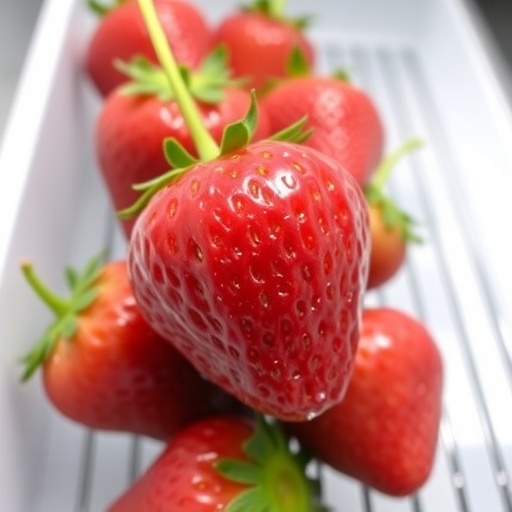
University of British Columbia researchers have developed an edible coating made from seaweed-derived agar that kept strawberries fresh for at least four days at room temperature—longer than comparable uncoated berries stored in a refrigerator. The transparent coating reduced water loss, slowed mould growth and helped preserve the fruit’s firmness, vitamin C and antioxidant content, offering a potentially low-energy way to extend the shelf life of fresh produce.
The technology targets one of the food system’s most persistent problems. Fruits and vegetables begin deteriorating soon after harvest as they lose moisture, soften and become vulnerable to bacteria and fungi. In Canada, nearly half of all food produced is estimated to be lost or wasted, representing an annual economic cost of about $58 billion. Because refrigeration is used throughout harvesting, transport, storage and retail, spoilage prevention also carries a substantial energy and infrastructure burden.
The new material is based on agar, a polysaccharide extracted from red seaweed and widely used as a food thickener and vegan alternative to gelatin. Agar normally forms a relatively thick gel when hydrated. In the UBC researchers’ formulation, however, agar is combined with zinc ions and tannic acid, a plant-derived polyphenol found naturally in foods such as grapes, tea and some fruits. These components interact through coordination and hydrogen bonding, causing the ingredients to self-assemble into microscopic particles.
Those particles form a thin, continuous film across the surface of the produce. The resulting structure acts as a semi-permeable barrier: it limits the movement of water vapour out of the fruit while still allowing controlled exchange of gases involved in respiration. By slowing dehydration and modifying the microenvironment around the fruit, the coating can delay the softening and surface damage that create opportunities for microbial growth. Unlike many visible waxes or opaque films, the agar-based layer dries clear and is designed to be edible.
In laboratory tests, strawberries dipped in the coating solution lost less than half as much water as untreated berries during four days at room temperature. They remained noticeably firmer and retained higher levels of vitamin C and antioxidant compounds. Untreated strawberries stored at room temperature began developing mould after about two days, while most uncoated berries kept in a refrigerator began to deteriorate by the fourth day. Coated strawberries remained mould-free for at least four days without refrigeration and for at least six days when refrigerated.
The coating also showed promise beyond strawberries. Treated grapes maintained quality improvements for as long as 14 days, while coated apple slices benefited for approximately 24 hours. The different results reflect the distinct physiology of each produce type, including differences in skin structure, respiration rate, water content and susceptibility to browning. The formulation’s antibacterial activity may further reduce the growth of microorganisms on damaged or cut surfaces, although larger-scale testing will be needed to determine how it performs under commercial conditions.
Safety tests using human intestinal cells found no signs of toxicity under the conditions examined. Consumers who do not want to eat the coating can remove most of it by rinsing the fruit under tap water for approximately two minutes. The use of zinc is also significant because it is an essential nutrient, although the amount present in the final coating and its potential dietary contribution will require careful regulatory assessment before commercial adoption.
The researchers also conducted a life-cycle assessment comparing the coating with conventional refrigeration. Their analysis indicated that the coating could produce a 14 per cent lower carbon footprint and reduce freshwater ecotoxicity by about 85 per cent, largely because less electricity and fewer refrigerants would be needed to maintain low temperatures. These figures describe the assessed production and preservation system rather than a universal guarantee; real-world benefits will depend on manufacturing scale, application methods, packaging, transport distances and the amount of food waste avoided.
To test whether the approach could move beyond tightly controlled laboratory conditions, the team replaced laboratory-grade agar with commercially available food-grade agar. The treated strawberries continued to show reduced moisture loss and spoilage while maintaining their quality, suggesting that the material may be compatible with ingredients already used in the food industry. The coating can be applied by dipping, a relatively simple process that could potentially be adapted for packing facilities, although throughput, drying time, cost and regulatory approval remain important challenges.
The study, led by doctoral student Ivy Chiu and senior author Tianxi Yang of UBC’s Faculty of Land and Food Systems, represents an early step toward replacing some cold-storage requirements with biodegradable surface protection. The team is now evaluating additional fruits and vegetables and investigating how the self-assembled microparticle system could be scaled for commercial food chains. If the performance can be reproduced during long-distance transport and retail storage, an invisible seaweed-based film could become a practical tool for keeping produce fresh longer while reducing food waste and the energy demands of refrigeration.
Subject of Research: Fresh produce preservation using an edible agar-based coating
Article Title: Self-Assembled Metal–Phenolic–Agar Microparticle-Derived Coatings Enable Scalable and Sustainable Fresh Produce Preservation
News Publication Date: 3-Aug-2026
Web References: Journal of Agricultural and Food Chemistry; https://doi.org/10.1021/acs.jafc.6c06531
References: Chiu, I., Yang, T. et al., “Self-Assembled Metal–Phenolic–Agar Microparticle-Derived Coatings Enable Scalable and Sustainable Fresh Produce Preservation,” Journal of Agricultural and Food Chemistry, DOI: 10.1021/acs.jafc.6c06531.
Image Credits: Clare Kiernan/UBC
Keywords
Edible coating, agar, seaweed, strawberries, food preservation, fresh produce, food waste, sustainable technology, zinc, tannic acid, microparticles, refrigeration, food science, antimicrobial coating
Tags: agar-derived food coatingbio-based food packaging innovationslow-energy fruit storage solutionsmicrobial growth inhibition on fruitsnatural antioxidants for fruit preservationplant-based fruit preservationreduction of food waste through edible filmsSeaweed-based edible coatingshelf life extension of fresh producestrawberry preservation technologysustainable methods for extending fruit freshnesszinc and tannic acid in food preservation