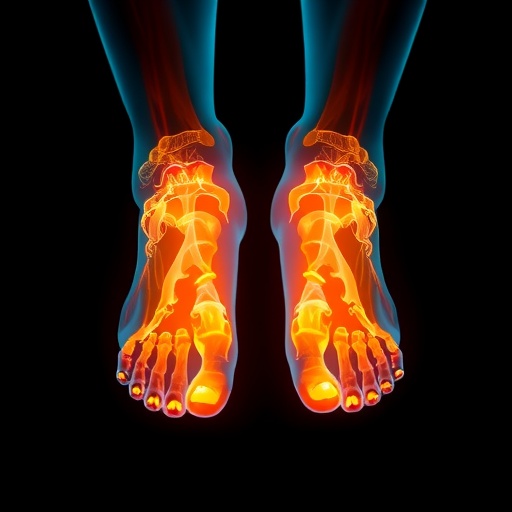
Plantar pressure mapping, a technology used to reveal how forces move across the underside of the foot, could soon become cheaper, smaller and more accessible through artificial intelligence. Researchers at The University of Queensland, working with iOrthotics and Healthia Limited, have developed a deep-learning system that reconstructs detailed pressure maps from a person’s foot shape and a surprisingly small number of anatomical measurement points. The advance may help bring sophisticated foot-health monitoring to rural and remote communities where conventional equipment is expensive, difficult to transport or unavailable.
Plantar pressure analysis is widely used to investigate foot function, balance, gait mechanics and musculoskeletal health. It can also guide the design of orthotics intended to reduce the risk or progression of foot-related conditions. Conventional systems typically rely on pressure-sensitive platforms or instrumented insoles containing many sensors. Although these technologies can capture highly detailed information, they are often costly and may require specialist facilities, limiting their use outside hospitals, research laboratories and urban clinics.
The new approach uses artificial intelligence to infer the pressure distribution between measured points. Rather than sensing every region of the foot directly, the system combines plantar geometry—information describing the shape and structure of the foot—with sparse anatomical landmarks recorded on the sole. This multimodal input is processed by an artificial neural network designed to estimate a dense, high-resolution pressure image. In principle, the method could reduce the number of physical sensors needed while preserving much of the information generated by a conventional pressure-mapping system.
The research team used anatomical foot information and plantar-pressure measurements collected from 35 participants. These data were used to train and evaluate a multimodal deep-learning framework known as a Feature-Level Fusion CBAM U-Net. U-Net architectures are widely used for image reconstruction and segmentation because they can combine broad contextual information with fine spatial detail. In this model, a convolutional block attention mechanism, or CBAM, helps the network focus on the most informative features within the input data, potentially improving its ability to identify pressure patterns across different regions of the foot.
The model performed best when it received information from 16 anatomical landmarks located on the plantar surface. According to the researchers, it produced pressure maps with a high level of accuracy under those conditions. The system also delivered a comparable reconstruction result using only two landmarks, suggesting that useful pressure information may be recoverable even when sensing is extremely limited. The finding does not mean that two sensors can replace every clinical pressure-measurement system in all circumstances, but it indicates that AI may compensate for missing measurements when supported by accurate information about foot geometry.
Applied mechanics engineer Emeritus Professor Martin Veidt said the technology could address important limitations in existing measurement methods. Traditional systems can be difficult to deploy in isolated communities, where access to specialist equipment and trained personnel may be restricted. A smaller sensing arrangement, combined with automated reconstruction, could allow data to be collected in more locations and transmitted for analysis. This could support remote consultations, repeated monitoring and earlier identification of changes in foot function.
The potential public-health significance is especially relevant to people at risk of diabetic foot complications. Abnormal loading patterns can contribute to tissue damage, ulcers and, in severe cases, amputation. Healthia group chief education and research officer Associate Professor Kerrie Evans said the broader research program aims to develop practical and affordable technologies that help clinicians understand foot function and identify possible problems sooner. A portable system capable of monitoring pressure over time could eventually complement clinical assessments, although it would need to be validated extensively in people with diabetes and other foot-health conditions.
The project formed part of a wider collaboration involving UQ, iOrthotics, Healthia and researchers from Queensland University of Technology. The work was initiated through a 2.2-million-dollar Australian Government Cooperative Research Centres Projects grant focused on smarter orthotic technology for rural and remote populations. In-shoe monitoring systems are attractive because they allow pressure to be recorded during movement and across extended periods, but large sensor arrays can increase cost, electronic complexity and power consumption. AI-based reconstruction could reduce those demands, making wearable systems more practical.
The researchers stress that the results are an early demonstration rather than a finished clinical product. The study involved only 35 participants and focused on static plantar-pressure prediction, so performance may vary across different ages, body types, footwear conditions, walking patterns and clinical populations. Future studies will need to test the model in larger and more diverse groups, examine dynamic gait measurements and determine how accurately it performs in real-world environments. Even with those limitations, the research points toward a striking possibility: a small amount of carefully collected data, combined with knowledge of foot shape, could allow artificial intelligence to recreate a detailed picture of forces that were never directly measured.
Subject of Research: People
Article Title: Multimodal Feature-Level Fusion CBAM U-Net for Static Plantar Pressure Prediction Using Plantar Geometry and Sparse Anatomical Landmarks
Web References: https://www.mdpi.com/1424-8220/26/13/4143 ; https://doi.org/10.3390/s26134143
References: Sensors, DOI: 10.3390/s26134143
Image Credits: Healthia Ltd
Keywords
Artificial intelligence, plantar pressure, foot health, smart insoles, wearable technology, deep learning, orthotics, diabetic foot, biomedical engineering, rural healthcare
Tags: accessible musculoskeletal health toolsaffordable orthotic designAI-powered foot health technologydeep learning for biomechanicsfootfoot shape and pressure reconstructiongait and balance assessmentplantar pressure mappingportable plantar pressure analysisremote foot health monitoringrural healthcare foot diagnosticssensorless plantar pressure estimation