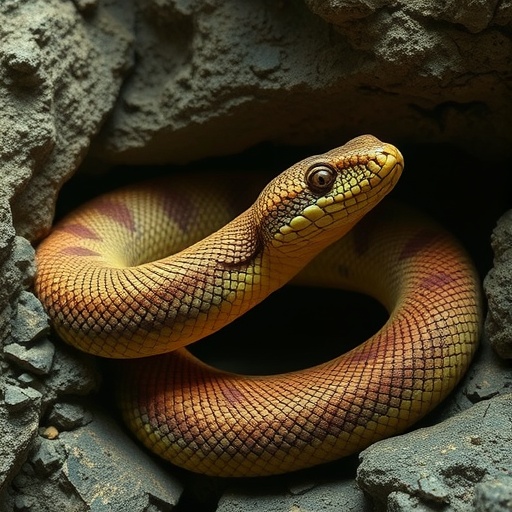
Snakes may be among nature’s most successful evolutionary experiments, but their origin has never followed a simple script. Today, more than 4,000 living species occupy deserts, forests, oceans and underground tunnels, yet scientists have long debated how their distinctive limbless bodies first evolved. One influential idea proposed that early snakes became elongated and legless primarily for burrowing, while another suggested that the transformation was driven by life in water. A new study published in Nature challenges both explanations by showing that the earliest snakes were already exploring several environments and sensory strategies at least 80 million years ago.
The study introduces Tametara mirim, a previously unknown snake from Late Cretaceous rocks in southeastern Brazil. Preserved in the Adamantina Formation, the fossil represents one of the most complete and informative early snake skeletons ever discovered. Its unusually detailed anatomy includes portions of the skull and vertebral column, allowing researchers to investigate not only how the animal moved, but also how it perceived the world. The specimen reveals that early snakes were not primitive versions of a single modern lifestyle. Instead, different lineages appear to have evolved specialized adaptations for burrowing, living on land and inhabiting marine environments relatively early in their history.
The fossil was examined using computed tomography, a technique that generates thin virtual slices through a specimen without physically damaging it. These scans enabled the team to digitally separate fossilized bones from the surrounding rock and reconstruct the skull in three dimensions. The researchers also produced a brain endocast, a model of the space once occupied by the brain. Although an endocast does not preserve the brain itself, the shape of the cavity can provide valuable information about the size and arrangement of major brain regions, sensory systems and neural pathways. In extinct animals, these internal anatomical clues can reveal ecological adaptations that are invisible in the skeleton alone.
At the center of the discovery is the shape of Tametara’s braincase and endocast. Its anatomy indicates an animal adapted to moving through soil or loose sediment, where vision would have been less important than chemical and tactile information. Burrowing animals often evolve compact, reinforced skulls and sensory systems suited to detecting prey, obstacles and environmental changes in confined spaces. The fossil’s brain shape and bone microstructure independently point toward this subterranean lifestyle, strengthening the interpretation that Tametara was not simply a generalized early snake, but a specialized burrower.
The researchers compared Tametara mirim with another important fossil, Dinilysia patagonica, which lived in what is now Argentina. Despite both animals belonging to the early history of snakes, their reconstructed brains were strikingly different from one another and from those of most modern snakes examined in the study. Dinilysia appears to have been adapted primarily to life on the ground rather than underground. The contrast suggests that early snake evolution was not a steady march toward one body design or one ecological niche. Instead, separate lineages were experimenting with distinct combinations of skull architecture, sensory biology and locomotion.
This conclusion is also consistent with evidence from other fossil snakes found in marine sediments. Together, the fossils indicate multiple transitions between burrowing, terrestrial and aquatic habitats during the early evolution of the group. The findings weaken the idea that snakes first evolved their elongated, limbless bodies in response to a single environmental pressure. Limblessness may have opened opportunities in several habitats, allowing different snake lineages to exploit narrow underground spaces, move efficiently across land or navigate water. The evolutionary history of snakes therefore resembles a branching laboratory of experiments rather than a single road leading toward modern diversity.
“Our findings show that early snakes had already achieved remarkable ecological and morphological diversity by the Late Cretaceous,” said lead author Tiago Simões, an assistant professor at Princeton University. The timing is significant: around 80 million years ago, dinosaurs still dominated terrestrial ecosystems, while early birds and other reptiles occupied the same landscapes. The reconstruction of Tametara places a specialized burrowing snake within this complex Cretaceous world, demonstrating that snake diversification was already well underway before the end-Cretaceous extinction reshaped life on Earth.
The research was led by Simões with senior authors Nicolas Di-Poï of the University of Helsinki and Annie Hsiou of the University of São Paulo. Postdoctoral researcher Simone Macrì and Di-Poï directed the brain reconstruction and comparative analysis at the University of Helsinki’s HiLIFE institute. By combining fossil anatomy, digital imaging, brain endocasts and data from living snakes, the team connected internal anatomy to behavior and habitat. Macrì said the brain tells a richer story than the skeleton alone because it can reveal sensory and ecological differences that external bones may fail to capture.
The study offers a broader lesson about evolution: major anatomical transformations do not necessarily arise through one universal pathway. Early snakes were already testing different solutions to the challenges of movement, feeding and perception in contrasting environments. Tametara mirim shows that underground specialization emerged deep in snake history, while Dinilysia and marine fossils demonstrate that terrestrial and aquatic experiments occurred alongside it. Rather than representing an incomplete stage on the way to modern snakes, these ancient animals were successful evolutionary forms in their own right—and their hidden brains preserve the evidence of how dramatically diverse the first chapters of snake evolution really were.
Subject of Research: Animals
Article Title: Exceptional brain and ecological diversity in the earliest snakes
News Publication Date: 22-Jul-2026
Web References: https://www.nature.com/articles/s41586-026-10809-9; https://doi.org/10.1038/s41586-026-10809-9
References: Tiago R. Simões et al., “Exceptional brain and ecological diversity in the earliest snakes,” Nature.
Image Credits: Gabriel Ugueto
Keywords: early snakes, Tametara mirim, snake evolution, fossil reptiles, Late Cretaceous, burrowing animals, brain endocasts, computed tomography, paleontology, evolutionary biology
Tags: Ancient snake evolutionCretaceous snake diversificationearly snake fossil discoveriesfossil record of early snakeslimbless snake originsmarine snake evolutionprehistoric snake habitat adaptationssnake adaptations to underground environmentssnake evolutionary hypothesessnake sensory and locomotion strategiesTametara mirim fossil significanceterrestrial snake evolution