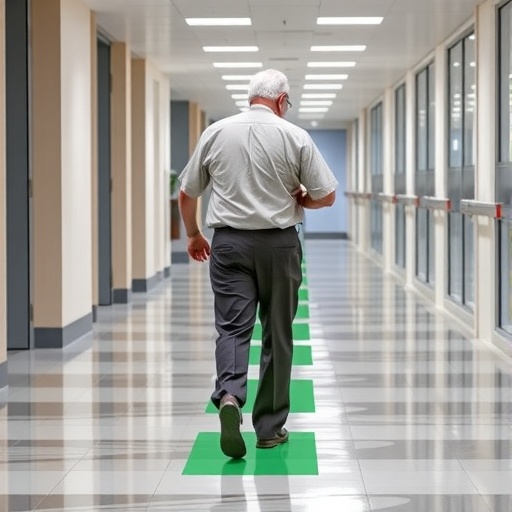
Falls among older adults often begin with changes too subtle to be noticed during an ordinary walk. A person may still appear steady while moving through a familiar environment, yet struggle when asked to divide attention between walking and another task. A new study by researchers Dong, Hu, Guo and colleagues examines whether machine-learning techniques can identify this hidden vulnerability in community-dwelling older adults by analyzing how gait changes during dual-task walking. Published in BMC Geriatrics in 2026, the research focuses on a potentially powerful combination of digital movement measurement and artificial intelligence: spatiotemporal gait parameters recorded while people walk and perform a second mental or motor activity.
Walking is not a single, automatic action. It requires continuous coordination between the brain, muscles, sensory systems and balance mechanisms. When a person walks while counting backward, answering questions or carrying an object, the nervous system must distribute attention between locomotion and the competing task. This is known as dual-task walking. Older adults who have limited cognitive or physical reserve may respond by slowing down, shortening their steps, widening their base of support or becoming more irregular in their timing. These adaptations can provide clues about fall susceptibility that may remain invisible during conventional clinical walking tests.
The study’s central idea is that gait should be evaluated under realistic cognitive pressure rather than only in ideal, distraction-free conditions. Spatiotemporal gait parameters describe measurable features of movement across time and space, including walking speed, stride length, step time, cadence, stance duration and the variability between consecutive steps. In a dual-task setting, researchers can also examine the degree to which these variables change compared with normal walking. This difference, often called dual-task cost, can reveal how much a person’s mobility is affected when attention is divided. A larger cost may indicate reduced ability to manage competing demands while remaining stable.
Machine learning offers a way to analyze these patterns simultaneously. Traditional clinical assessment may focus on one or two measurements, such as walking speed or the number of previous falls. A machine-learning model can process many variables at once and search for combinations associated with elevated risk. Depending on the model design, the system may learn from labeled examples, in which participants’ gait data are linked to fall-related outcomes, and then estimate risk for new individuals. Algorithms can detect nonlinear relationships that are difficult to capture with conventional statistical methods, although their usefulness depends heavily on the quality, size and representativeness of the data used for training.
The community setting is especially important. Many studies of balance and falls are conducted in hospitals or specialist laboratories, where participants may be healthier, more closely supervised or less representative of the broader older population. Community-dwelling adults live independently and encounter the complex conditions that make falls more likely: distractions, uneven surfaces, hurried movement, household obstacles and the need to perform several tasks at once. By focusing on this group, the research addresses a practical question for preventive medicine: can accessible gait testing identify people who appear independent but may require additional support before a serious fall occurs?
A potential advantage of this approach is its ability to move fall-risk assessment toward objective, repeatable measurement. Gait sensors, pressure-sensitive walkways, wearable devices or camera-based systems can convert movement into numerical data. Those data may be more sensitive than a brief visual observation, particularly when they capture step-to-step variability and changes induced by a secondary task. In the future, similar measurements could potentially be collected in clinics, rehabilitation centers or even at home. However, a prediction tool would need to be tested across different ages, health conditions, walking environments and technology platforms before it could be trusted for widespread use.
The research also highlights the technical challenges behind apparently simple predictions. Falls are influenced by numerous factors, including muscle strength, vision, medication use, reaction time, fear of falling, neurological disease and environmental hazards. Gait features alone cannot explain every incident. A machine-learning model may also perform impressively on the data used to develop it but less reliably on people from another population, a problem known as limited generalizability or overfitting. For clinical adoption, researchers must therefore evaluate calibration, sensitivity and specificity, test the model on independent datasets and make its decisions understandable to health professionals and patients.
Although the citation identifies the study’s objective and methodology, it does not provide detailed numerical findings such as sample size, predictive accuracy or the specific algorithm used. Those results will determine how close this technology is to practical deployment. Even so, the study reflects a broader shift in geriatric care: fall prevention is increasingly being treated as a problem of measurable, dynamic performance rather than a simple checklist of past incidents. By combining dual-task gait analysis with machine learning, the researchers are investigating whether the body’s response to distraction can serve as an early warning signal—one that could eventually help clinicians intervene before a dangerous fall changes an older person’s independence.
Subject of Research: Fall-risk prediction in community-dwelling older adults using machine learning and dual-task spatiotemporal gait parameters.
Article Title: Machine learning-based fall risk prediction in community-dwelling older adults using dual-task spatiotemporal gait parameters.
Article References: Dong, G., Hu, H., Guo, Y. et al. “Machine learning-based fall risk prediction in community-dwelling older adults using dual-task spatiotemporal gait parameters.” BMC Geriatrics (2026). https://doi.org/10.1186/s12877-026-07998-3
Image Credits: AI Generated
DOI: 10.1186/s12877-026-07998-3
Keywords: machine learning, fall risk prediction, older adults, community-dwelling older adults, dual-task walking, gait analysis, spatiotemporal gait parameters, geriatric medicine, balance, mobility.
Tags: AI-based fall risk assessmentbalance and coordination in agingcognitive-motor interference during walkingcommunity-dwelling older adults fall riskdigital movement measurement in elderlydual-task gait analysisearly detection of fall vulnerabilityfall risk prediction in older adultsgait parameters during dual-task walkingmachine learning for fall preventionspatiotemporal gait analysissubtle gait changes in seniors