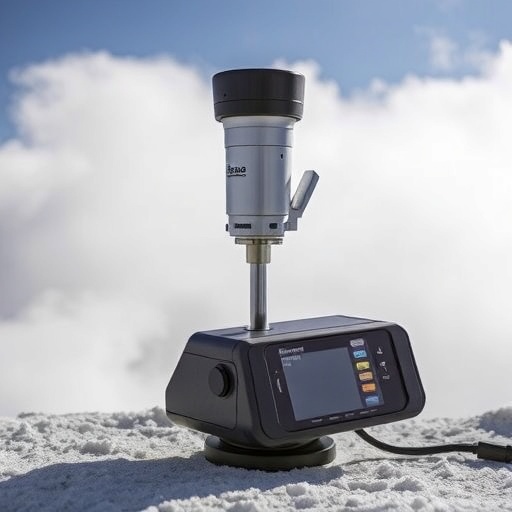
Researchers have demonstrated an infrared spectroscopy system that can detect chemical aerosols from a distance by using light reflected from ordinary surfaces, including traffic signs, tree trunks, painted walls and vehicle panels. The approach could transform the way hazardous chemical releases are monitored, replacing specialized reflective targets with objects already present in the environment. In laboratory tests, the system identified aerosol and vapor signatures at distances of up to 11 meters, offering a potential new tool for industrial safety, emergency response, security and environmental monitoring.
Chemical aerosols are made of tiny liquid droplets or solid particles suspended in air. They can be produced by industrial accidents, chemical spills, combustion processes or deliberate releases, and some may pose serious risks before they become visible or reach a densely populated area. Infrared spectroscopy provides a way to identify these substances because molecules absorb specific wavelengths of infrared light according to their chemical structure. The resulting pattern, known as a spectral signature, can act like a molecular fingerprint.
Conventional remote infrared detection systems often use a mirror or another highly reflective target to send laser light back toward a detector. Although this configuration can produce a strong signal, it is difficult to deploy in real-world environments. A mirror must be positioned accurately, kept aligned with the instrument and protected from scratches, dust and weather. Installing such a target may also be impossible in crowded public spaces, industrial facilities or locations where rapid monitoring is required.
The new system avoids these limitations by directing an infrared laser toward common surfaces and analyzing the weak reflection that returns through the atmosphere. Surfaces such as painted materials, siding and traffic signs are not as reflective as optical mirrors, but the researchers found that many can still provide enough signal for chemical detection. The team compensated for the lower reflectivity with high-power infrared lasers and data-processing software designed to separate useful spectral information from background noise.
A central part of the technology is an infrared laser and telescope assembly that can automatically adjust the outgoing beam as the distance to the target changes. The optical system also collects returning light efficiently, increasing the amount of information delivered to the detector. When an aerosol plume crosses the laser’s path, the particles interact with the infrared radiation and modify its spectrum. By examining those changes, the instrument can determine whether an aerosol is present and identify aspects of its chemical composition.
Before testing aerosols, the researchers measured the reflectivity of nearly 50 everyday materials. Their survey included siding, wallboard, traffic signs, tree bark and automobile panels. The results showed that reflectance varied substantially between materials, with some types of siding and traffic signs producing particularly strong signals. This characterization is important because the performance of the system depends not only on the chemical plume but also on the optical properties, texture and condition of the surface used as the return target.
The team then constructed a controlled aerosol chamber to evaluate the method under repeatable conditions. The chamber allowed them to generate particles with known sizes and chemical compositions, including mixtures, while directing the infrared beam across the aerosol cloud toward selected reflective surfaces. The researchers tested diethyl sebacate, a compound used as a stand-in for hazardous chemicals, as well as calcium carbonate, a substance found in chalk and mineral limestone. In both cases, the system detected and distinguished the aerosols despite differences in their chemistry and in the reflectivity of the target surfaces.
The findings suggest that remote chemical sensing may no longer require a carefully installed mirror at every monitoring location. A traffic sign, building wall or other nearby surface could potentially serve as the optical return path, allowing an instrument to scan an area without placing equipment inside a hazardous zone. Such a capability could support perimeter monitoring at industrial sites, help emergency teams investigate suspected releases and provide an additional layer of protection at large public gatherings. At concerts or sporting events, for example, early detection could help identify an accidental or intentional chemical release before it spreads through a crowd.
The researchers caution that more work is needed before the system can be deployed in complex outdoor environments. Future experiments will use aerosols with broader particle-size distributions and more complicated chemical mixtures, which create overlapping and harder-to-interpret infrared signatures. Weather, atmospheric turbulence, changing illumination and irregular surfaces could also affect the signal. The team expects artificial intelligence and machine-learning methods to help classify complex spectra and improve detection reliability. The work, carried out through the Intelligence Advanced Research Projects Activity’s PICARD program, establishes a practical foundation for rapid chemical-aerosol sensing using the ordinary surfaces already found in the world around us.
Subject of Research: Not applicable
Article Title: Spectroscopy system detects aerosols using everyday surfaces
News Publication Date: 30-Jul-2026
Web References: Pacific Northwest National Laboratory, https://www.pnnl.gov/; Optica Publishing Group, https://opg.optica.org/
References: T. Johnson et al., “Aerosol and Vapor Detection via Infrared Laser Reflectance from Common Surfaces: All That Shimmers is Not Gold,” Applied Optics, DOI: 10.1364/AO.604722
Image Credits: Timothy Johnson, Pacific Northwest National Laboratory
Keywords
Infrared spectroscopy, chemical aerosols, remote detection, aerosol sensing, applied optics, laser detection, chemical safety, spectroscopy, environmental monitoring, machine learning
Tags: Aerosol detection using infrared spectroscopy from common surfacesambient surface reflectance spectroscopyemergency response aerosol monitoringenvironmental monitoring with existing objectshazard detection through reflected lightinnovative atmospheric chemical analysis techniquesnon-contact industrial safety toolsremote chemical vapor sensingremote sensing of airborne particlessecurity applications for chemical threat detectionspectral fingerprinting of hazardous substancesspectroscopic identification of chemical aerosols