For more than a century, the South African butterfly lilies of the genus Wachendorfia have challenged botanists with a striking question: how do these plants reliably produce flowers whose reproductive organs bend either to the left or to the right? A new study has now identified the genetic and developmental mechanism behind this mirror-image arrangement, revealing how a tightly linked set of genes coordinates floral architecture, gravity and pollination. The findings, published in Science, show that a plant “supergene” controls the orientation of both styles and stamens, creating two distinct floral forms that promote cross-pollination.
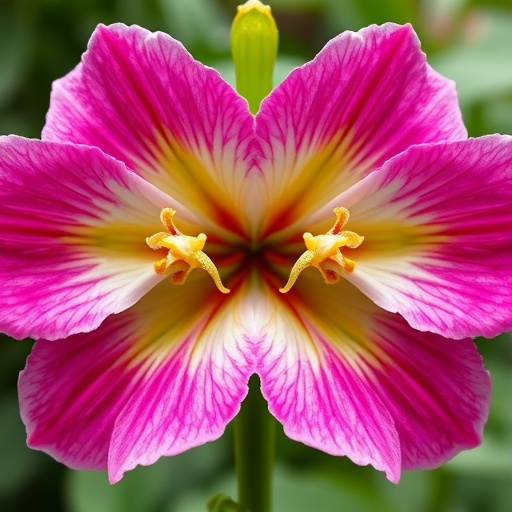
The flowers of Wachendorfia are not simply irregular in appearance. Their reproductive structures are arranged in precise, opposing configurations. In one floral form, the styles curve toward one side while the stamens occupy the complementary position; in the mirror-image form, the arrangement is reversed. This left-right difference, known as floral chirality, determines where pollen is deposited on visiting pollinators. When an insect or bird moves between the two forms, pollen placed on its body by one flower can be transferred efficiently to the corresponding stigmas of another.
An international research team led by the University of Potsdam discovered that this coordination is controlled by a supergene—a cluster of closely linked genetic factors that are inherited together and influence several related traits. In Wachendorfia, the supergene contains two major factors that independently regulate the orientation of the stamens and styles. Because these genetic elements remain tightly linked, the organs develop in a coordinated pattern rather than becoming misaligned. The result is a highly reliable floral design in which the position of pollen-producing and pollen-receiving structures is matched with extraordinary precision.
“This supergene couples the orientation of style and stamen so tightly that the plants remain reliably dependent on cross pollination,” says first author Haoran Xue, a bioinformatician at the University of Potsdam. That dependence is central to the evolutionary significance of the system. By directing pollen between complementary floral forms, the plants reduce the likelihood of self-pollination and increase genetic exchange between individuals. In turn, this can help maintain genetic diversity and may contribute to the formation of reproductive barriers between populations.
The researchers also investigated how the genetic instructions are translated into physical movement during flower development. Their experiments show that the styles first rotate and then continue growing asymmetrically under the influence of gravity. Depending on the plant’s genetic form, this growth proceeds toward the left or the right side of the floral midline. The process is therefore not caused by a single bend occurring at one moment. Instead, it combines an initial rotation with continued, directionally biased growth as the flower develops.
Biomechanical modelling and cultivation experiments demonstrated that both stages are necessary to produce the pronounced asymmetry seen in mature flowers. A rotation alone would not create the final position of the styles, while gravity-guided growth without the initial rotation would also be insufficient. Together, the two processes amplify a small developmental difference into a conspicuous left-right arrangement. This provides a rare example of gravity acting as a decisive external reference for the development of plant form.
“What is particularly exciting is that left and right here are not defined relative to internal body axes, as in many animals, but relative to an external cue—gravity,” Xue explains. In animals, asymmetry is often described in relation to anatomical features such as the head, tail or spine. In these lilies, however, the orientation of a floral organ is determined through its interaction with the physical environment. The finding adds a new dimension to scientists’ understanding of how plants sense and respond to gravity while constructing complex reproductive structures.
For the cellular and developmental work, the team studied living specimens of Wachendorfia thyrsiflora cultivated in the Botanical Garden of the University of Potsdam. The plants allowed researchers to follow organ development under controlled conditions and to examine the microscopic changes associated with rotation and asymmetric growth. Researchers from the University of Cape Town contributed fieldwork and molecular analyses of South African populations, while scientists at Wageningen University developed mathematical and biomechanical models describing the movements of the floral organs.
The study emerged from a long-term collaboration that combined genomics, plant cell biology, field research and theoretical modelling. Senior author Michael Lenhard of the University of Potsdam says that bringing these approaches together was essential to solving the longstanding puzzle of mirror-image flowers. Rather than treating floral form as the product of a single gene or isolated developmental event, the researchers reconstructed a chain of events linking inherited genetic variation to organ movement, gravity response and pollinator placement.
The discovery also highlights why supergenes are important in evolution. Whenever several traits must remain coordinated, tightly linked genetic factors can preserve the combination that natural selection favours. In Wachendorfia, the relevant traits are the orientation of the styles and stamens, but the consequences extend to pollinator behaviour, mating patterns and possibly speciation. The flowers effectively use their geometry to guide pollen transport, turning pollinators into precise biological delivery systems. By revealing the genetic architecture behind this system, the new work shows how plants can combine molecular control with environmental information to produce one of nature’s most elegant reproductive strategies.
Subject of Research: The genetic and developmental control of left-right asymmetry, or chirality, in the flowers of South African butterfly lilies (Wachendorfia), including the role of a supergene, gravity-guided growth and pollinator-mediated cross-pollination.
Article Title: Supergene control of chiral development in mirror-image flowers
News Publication Date: 30 July 2026
Web References: https://doi.org/10.1126/science.aeb1157; https://www.uni-potsdam.de/presse
References: Haoran Xue, Marco Saltini, Nicola Illing, Kelly Shepherd, Olivia Page-Macdonald, Oliver Marketos, Caroline Robertson, Anand Shankar, Sarah Süß, Christian Kappel, Saleh Alseekh, Eva E. Deinum, Robert A. Ingle and Michael Lenhard, “Supergene control of chiral development in mirror-image flowers,” Science, DOI: 10.1126/science.aeb1157.
Image Credits: Genetics Working Group, University of Potsdam. Image showing the arrangement of floral parts in Wachendorfia thyrsiflora; pink arrowheads indicate the styles and blue arrowheads indicate the stamens. Additional image credit: Genetics Working Group, University of Potsdam.
Keywords: Wachendorfia thyrsiflora, butterfly lily, floral chirality, mirror-image flowers, supergene, plant genetics, gravity-guided growth, pollination, cross-pollination, evolution, plant development, Science.
Tags: cross-pollination mechanismsdevelopmental genetics of floral architectureevolutionary significance of supergenesfloral chirality in Wachendorfiaflower morphology and pollinator interactionsflower symmetry and pollinationgenetic basis of floral diversitygenetic control of flower orientationMirror-image flower developmentplant developmental biologyplant reproductive organ arrangementsupergene in plant evolution