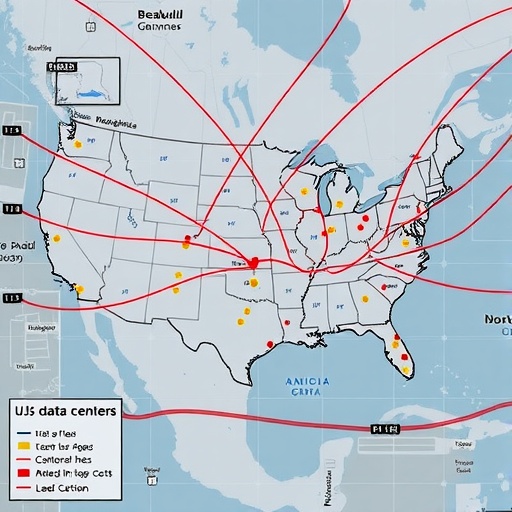
Data centers are often imagined as remote warehouses of servers, rising quietly in rural landscapes where land is cheap and electricity is abundant. A new study challenges that picture, finding that the infrastructure powering the digital economy is overwhelmingly urban. Across the United States, 97.5 percent of data centers are located within metropolitan or micropolitan statistical areas, tying the expansion of cloud computing, artificial intelligence and online services closely to existing population centers.
The findings, published in Nature Cities, reveal that data centers are not spreading randomly across the country. Instead, their locations reflect a combination of established urban infrastructure, regional electricity systems and the industrial history of the places where they are built. The research suggests that the next phase of digital growth may strengthen America’s existing urban hierarchy rather than distribute economic activity more evenly across rural regions.
At the center of the study is the relationship between data centers and electric power. Modern facilities are exceptionally energy-intensive because they operate thousands, and increasingly millions, of computer processors continuously. Their electricity demand is determined not only by the number of servers installed but also by cooling systems, networking equipment and redundancy requirements designed to prevent service interruptions. The researchers found that the nameplate capacity of nearby power plants—the maximum amount of electricity those plants are designed to generate—was the strongest factor associated with data center siting.
This connection places data centers within the geography of local power systems. A region with large generating facilities, transmission infrastructure and available electrical capacity can offer technology companies a faster and more reliable path to expansion. In practical terms, developers may prefer locations where the grid is already capable of handling enormous new loads, rather than building in areas where substations, transmission lines and generation capacity would need to be constructed from scratch.
Broadband quality also influenced where facilities appeared, although its role was smaller than that of power generation. Data centers require high-capacity, low-latency communications networks to move data rapidly between users, servers and other facilities. Their dependence on fiber-optic connections and network exchange points helps explain why they cluster around established urban areas. Cities already provide dense telecommunications infrastructure, large labor pools and access to corporate customers, making them attractive even when land and electricity costs are higher than in remote locations.
The study also identified links to retired coal plants, information technology employment and natural hazards. The association with former coal facilities points to the lasting influence of fossil-fuel infrastructure. Sites that once hosted coal generation may retain grid connections, industrial land, transmission corridors and technical expertise that can be repurposed for new forms of electricity demand. Yet this legacy also raises questions about whether the digital economy is truly breaking with the past or simply building a new layer of high-energy industry on top of older fossil-fuel landscapes.
Natural hazards added another dimension to the geography of data centers. Facilities must remain operational during extreme weather, flooding, heat, storms and other disruptions, although the precise effect of hazards can vary by region and technology. A data center may be engineered to withstand local risks, but companies also rely on geographic redundancy, distributing workloads among multiple facilities so that a failure in one location does not bring down an entire digital service. This strategy can reduce operational vulnerability while increasing the total physical footprint and energy demand of the industry.
Because power systems differ sharply from state to state, data center development may also deepen regional contrasts in environmental sustainability. Some states generate a larger share of electricity from renewable sources, while others remain heavily dependent on coal or natural gas. When data centers connect to local grids, their carbon emissions are shaped partly by the generation mix in that region, even if the facilities themselves purchase renewable-energy credits or sign contracts for clean power. Two data centers with identical computing equipment can therefore have very different climate impacts depending on where they operate and how their electricity is produced.
The researchers used population-based projections to examine what continued growth could mean for the American urban system. Their results indicate that new facilities are likely to follow existing patterns of population, infrastructure and economic concentration. Rather than triggering a broad decentralization of opportunity, the digital transition could reinforce the dominance of major metropolitan regions and selected smaller urban centers already connected to national power and communications networks.
That concentration has consequences beyond electricity consumption and carbon emissions. Data centers can compete with households, manufacturers and public services for grid capacity, while their construction can intensify pressure on land, water and transportation systems. Cooling technologies may require substantial water resources, and large facilities can alter local landscapes even when they employ relatively few people compared with their physical scale. As cities court data center investment, planners may face difficult choices about who benefits from the new infrastructure and who bears its costs.
The study’s broader message is that the cloud is not weightless. Digital services depend on concrete buildings, transmission lines, power plants, fiber networks and urban labor markets. The industry’s expansion is therefore path-dependent: choices made decades ago about where to build cities, power stations and industrial corridors continue to shape the geography of artificial intelligence and cloud computing today. If governments want a more sustainable and equitable digital future, the researchers suggest, they will need to address data centers not as invisible pieces of the internet but as major urban infrastructure whose energy and environmental consequences are embedded in the places that host them.
Subject of Research: US data center siting, urban infrastructure, energy systems and fossil fuel industrial legacy
Article Title: Urban infrastructure and fossil fuel industrial legacy drive US data center siting
Article References: Ancona, C., Lauber Bonomo, O., Rozhkov, A. et al. “Urban infrastructure and fossil fuel industrial legacy drive US data center siting.” Nature Cities (2026). https://doi.org/10.1038/s44284-026-00487-z
Image Credits: AI Generated
DOI: https://doi.org/10.1038/s44284-026-00487-z
Keywords: Data centers, urban infrastructure, artificial intelligence, electricity demand, power plants, broadband networks, fossil fuel legacy, coal plants, sustainability, US cities, energy geography, digital economy
Tags: energy consumption of data centers and cooling requirementsenvironmental implications of data center location choicesfossil fuel legacy influence on digital infrastructuregeographic distribution of data centers in the USimpact of fossil fuel legacy on urban digital infrastructureinfluence of metropolitan areas on cloud computing expansionrelationship between data centers and regional electricity systemsrole of industrial history in data center sitingspatial distribution of digital infrastructure in relation tourban hierarchy and digital economy growthurban infrastructure impact on data center placementUS data center locations