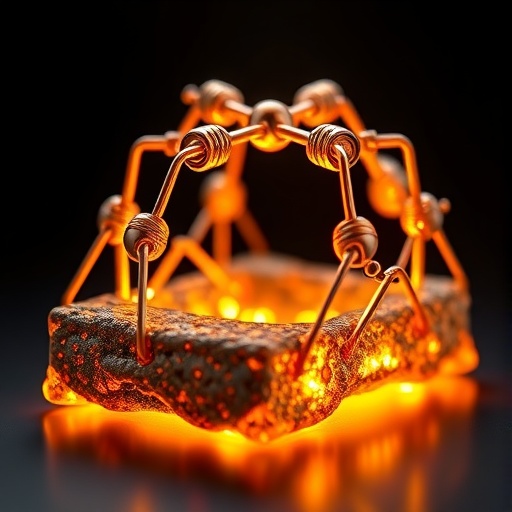

image: CuAu alloys with tailored compositions were integrated onto copper foam by a simple one-step electrodeposition method. The optimized Cu0.25Au0.75 catalyst exhibited rather excellent performance for the electrocatalytic oxidation of 5-hydroxymethylfurfural (HMF) via a one-electron dehydrogenation pathway. The improved catalytic activity could be attributed to the alloying-induced charge redistribution that modulates the d-band centers, thereby steering surface adsorption behaviors to balance HMF adsorption and HMFCA desorption, ensuring active site availability for the selective production of 5-hydroxymethyl-2-furancarboxylic acid (HMFCA) and simultaneous anodic hydrogen evolution.
view more
Credit: Chinese Journal of Catalysis
Combining renewable electricity with electrochemical water splitting offers a promising route for green hydrogen production, yet the sluggish oxygen evolution reaction (OER) at the anode severely limits energy efficiency and economic viability. Replacing OER with organic oxidation reactions, such as the electrooxidation of biomass-derived HMF, can drastically reduce the cell voltage while generating value-added chemicals at the anode. However, achieving selective partial oxidation of the aldehyde group in HMF to HMFCA via one-electron dehydrogenation remains challenging, as it requires precise control over the adsorption of reactants and desorption of products on the catalyst surface. Fortunately, alloying metals with different adsorption capacities can finely tune the electronic structure and optimize these surface processes, providing a distinct strategy for efficient low‑potential HMFOR.
Recently, a research team led by Prof. Shaohua Shen (Xi’an Jiaotong University) and Dr. Puyu Du (State Power Investment Corporation Central Research Institute) designed a series of CuAu alloy electrocatalysts supported on copper foam for selective HMF to HMFCA conversion coupled with anodic H2 production. The synthesized Cu0.25Au0.75 alloy catalysts significantly promote the one‑electron dehydrogenation pathway by achieving an optimal balance between reactant adsorption and product desorption on the surface. The results were published in Chinese Journal of Catalysis (DOI: 10.1016/S1872-2067(26)65019-X).
The Cu0.25Au0.75 catalyst could be readily prepared by electrodeposition at a constant current density in an acidic bath containing CuCl2 and HAuCl4 precursors. The alloy exhibited a nanoflower-like morphology with uniform distribution of Cu and Au. By optimizing the Cu molar ratios, a superior electrocatalytic performance for HMFOR via one-electron dehydrogenation could be observed over Cu0.25Au0.75, reaching a current density of 84.8 mA cm-2 at 0.4 V vs. RHE, with 94.5% HMFCA yield, 98.6% HMFCA FE and 94.6% H2 FE. Remarkably, when assembled in a membrane electrode assembly (MEA) electrolyzer with Pt/C as the cathode, the Cu0.25Au0.75 ‖ Pt/C system operated at an ultralow cell voltage of 0.45 V for simultaneous anodic HMFOR and cathodic HER, delivering 94.5% HMFCA FE and ~200% overall H2 FE.
Pure Cu exhibits a weak strength for HMF adsorption at surface, which would fail to efficiently activate reactants, thus limits its intrinsic activity for HMFOR. In comparison, Pure Au feature with strong HMF adsorption results in the difficult desorption of products from surface, which would occupy the surface active sites, impeding the initiation of cycled HMFOR and retarding the surface reactivity. By alloying Cu with Au, the obtained Cu0.25Au0.75 electrocatalyst with charge redistribution between Cu and Au could modulate the d-band centers, and then steer the HMF adsorption behaviors to balance the reactant adsorption and the product desorption at surface, ensuring the optimized active site availability to benefit the one-electron dehydrogenation HMFOR towards simultaneous HMFCA and H2 production.
About the journal
Chinese Journal of Catalysis is co-sponsored by Dalian Institute of Chemical Physics, Chinese Academy of Sciences and Chinese Chemical Society, and it is currently published by Elsevier group. This monthly journal publishes in English timely contributions of original and rigorously reviewed manuscripts covering all areas of catalysis. The journal publishes Reviews, Accounts, Communications, Articles, Highlights, Perspectives, and Viewpoints of highly scientific values that help understanding and defining of new concepts in both fundamental issues and practical applications of catalysis. Chinese Journal of Catalysis ranks among the top six journals in Applied Chemistry with a current SCI impact factor of 17.2.
At Elsevier
Manuscript submission
Journal
Chinese Journal of Catalysis
DOI
10.1016/S1872-2067(26)65019-X
Article Title
Steering adsorption behavior of 5-hydroxymethylfurfural at CuAu alloys for one-electron dehydrogenation electrocatalysis pairing anodic 5-hydroxymethyl-2-furancarboxylic acid and bipolar hydrogenproduction
Article Publication Date
5-Jun-2026
Media Contact
Yan Zhang
Dalian Institute of Chemical Physics, Chinese Academy Sciences
Journal
Chinese Journal of Catalysis
DOI
10.1016/S1872-2067(26)65019-X
Journal
Chinese Journal of Catalysis
DOI
10.1016/S1872-2067(26)65019-X
Article Title
Steering adsorption behavior of 5-hydroxymethylfurfural at CuAu alloys for one-electron dehydrogenation electrocatalysis pairing anodic 5-hydroxymethyl-2-furancarboxylic acid and bipolar hydrogenproduction
Article Publication Date
5-Jun-2026
Tags
/Applied sciences and engineering