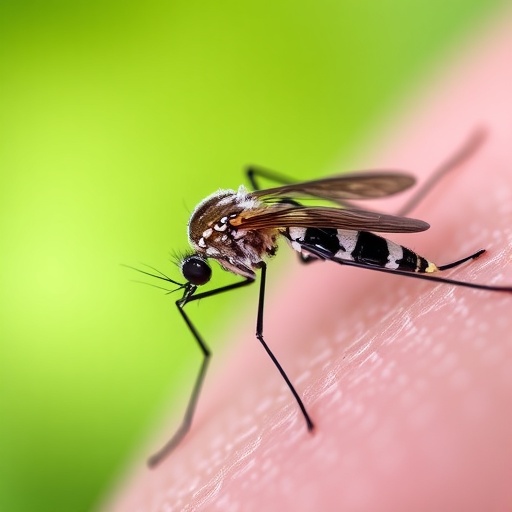
UNIVERSITY PARK, Pa. — Mosquito-borne pathogens, including zika, yellow fever and other illnesses have serious and worldwide impacts on human health. The World Health Organization warned that half of the global population is at risk of dengue, with 100 million to 400 million infections occurring each year. The Centers for Disease Control and Prevention estimated that 2023 saw more than 260 million cases of malaria and almost 600,000 deaths across 83 countries.
To improve scientific understanding of the pathogens involved and begin addressing these challenges, the National Institutes of Health’s Institute of Allergy and Infectious Disease recently awarded a pair of grants collectively worth more than $2.8 million to Jason Rasgon, professor of entomology and of disease epidemiology, and Huck Endowed Chair in Disease Epidemiology and Biotechnology at Penn State. If successful, Rasgon said, the projects could lower technical barriers for researchers studying mosquito genetics and eventually, enable new discoveries that could help inhibit the spread of dangerous pathogens.
“We hope to build tools to make genetic manipulation of mosquitoes — and potentially other arthropods — easy across laboratories,” Rasgon said. “Although the two projects take different approaches, both are rooted in the same idea: using modern genetic and synthetic biology tools to introduce desired traits into individual mosquitoes and, potentially, mosquito populations.”
The first grant will focus on developing a model system to better understand how bacteria establish symbiosis with mosquitoes, among other investigative questions. The grant builds on previous work performed in Rasgon’s lab that was supported by a Huck Innovative & Transformational Seed Fund grant and focused on better understanding the genetic interactions of symbiotic relationships.
The project is taking inspiration from Wolbachia, a type of symbiotic bacteria that lives in a host and offers antiviral protection. Currently, Rasgon said, Wolbachia is used to control vector-borne diseases such as dengue virus, because female mosquitoes infected with Wolbachia have reduced ability to transmit pathogens, and if a male carrying the bacteria mates with a female without it, that female’s eggs will not hatch.
“In some areas this seems to work, but in others it does not, primarily because the symbiotic relationship breaks down,” Rasgon said. “We have a poor understanding of the biological phenomena underpinning the evolution and maintenance of symbiosis, because Wolbachia cannot be manipulated or engineered. Thus, we are developing a model system where all aspects of the symbiotic relationship can be manipulated and altered at will to understand the forces driving these dynamics.”
In the new project, Rasgon and his collaborators will attempt to build an artificial symbiotic relationship that will be easier and more flexible for researchers to work with than naturally occurring endosymbionts — extremely specialized organisms that live inside the bodies or cells of other organisms and provide essential nutrients to the host.
“A model system, where we can manipulate and alter every aspect of the interaction, allows us to identify and test the factors underpinning the development of symbiosis,” Rasgon said.
Using techniques from synthetic biology, an interdisciplinary approach that applies engineering principles to develop new kinds of biological processes and structures, the researchers plan to first modify E. coli to display a small protein piece called a peptide on its surface. This peptide will act like a tag that enables developing mosquito eggs to recognize the bacteria and allow it entry. The team plans to then create a nutritional dependency between the mosquito and the bacteria by engineering mosquitoes that cannot produce sufficient vitamin B6 on their own and bacteria that can supply the missing nutrient.
If successful, Rasgon said, the work would establish a stable, inherited relationship between the insects and the engineered microbes. Such a system would provide scientists with a new model for studying the biology and evolution of symbiosis, offering insights into how beneficial microbial partnerships emerge and persist in nature. In the longer term, the platform could inform the development of novel disease control strategies.
In the second funded project, the team will use a virus that naturally infects insects but is harmless to humans and other vertebrates, to deliver into the mosquito a tiny payload capable of initiating genetic changes.
The Rasgon Lab previously developed and demonstrated the ReMOT Control technique, a method that enables gene editing through targeted delivery of CRISPR technology to mosquito ovaries. While ReMOT Control has proven extremely useful for deleting genes, Rasgon said, it has also proven challenging to use the technique to insert new genetic material. In this new project, will investigate whether the virus can enter mosquito tissues and deliver molecular “cargo” to modify the mosquito genome.
Rasgon’s lab aims to enable the virus to deliver gene-editing cargo carrying instructions for specific desired characteristics into mosquito ovaries. They will test whether the virus can create heritable genetic changes, meaning the mosquitoes’ offspring will manifest the desired genetic traits from birth without needing additional exposure to the virus. They will also test if the virus can be modified to induce similar genetic reproductive outcomes as Wolbachia with more precise control. If successful, Rasgon said, the result will be a tunable platform capable of helping researchers investigate and potentially manipulate the specific molecular interactions of mosquito pathogen transmission.
This work is supported by the National Institutes of Health’s Institute of Allergy and Infectious Disease under award numbers R21AI193463 and R01AI128201. The content is solely the responsibility of the authors and does not necessarily represent the official views of the National Institutes of Health.
Media Contact
Christine Yu
Penn State
Funder
NIH/National Institute of Allergy and Infectious Diseases
Tags
/Health and medicine/Epidemiology/Pathogens
/Health and medicine/Epidemiology/Pathogens/Viruses
/Applied sciences and engineering/Environmental sciences/Ecology/Ecological dynamics/Species interaction/Ecological interdependence/Symbiosis
/Applied sciences and engineering/Engineering/Bioengineering/Biotechnology/Synthetic biology
/Life sciences/Organismal biology/Animals/Invertebrates/Arthropods/Insects/Mosquitos
/Life sciences/Genetics
Tags: advancements in mosquito genetics researchdevelopment of genetic tools for mosquitoesdisease epidemiology and geneticsgenetic manipulation of mosquitoesglobal health impact of mosquito-borne illnessesinfectious disease research fundingmosquito-borne disease preventionmosquito-microbe interactionsNIH research grants for vector-biologysynthetic biology in vector researchvector control biotechnologyZika and yellow fever pathogen studies