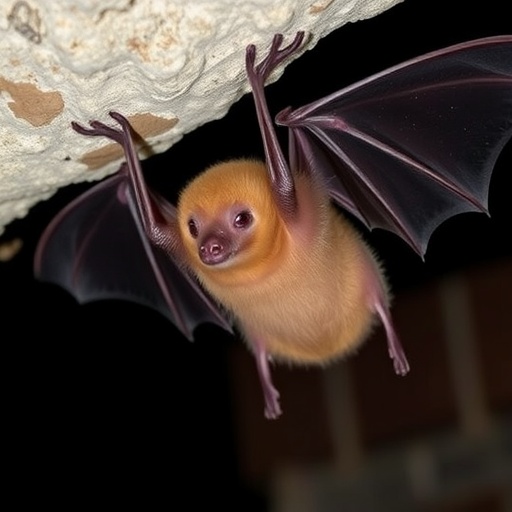

image: Hannah Frank, associate professor of ecology and evolutionary biology at Tulane University School of Science and Engineering, led a study that discovered a previously unknown antibody system in bats that could offer new clues about how they coexist with viruses without becoming seriously ill.
view more
Credit: Kenny Lass/Tulane University
It is a mystery that has puzzled scientists for years. How can the world’s only winged mammals carry viruses that cause severe disease while rarely becoming seriously ill themselves?
Now researchers at Tulane University, with collaborators at Stanford University and the Centers for Disease Control, may have found a reason.
In a study published in Science Advances, the research team found that the world’s largest family of bats has two distinct copies of the genes that produce antibodies, the specialized proteins that help the immune system recognize and fight infections. Every other known mammal has only one such set. The discovery opens new avenues for understanding the evolution of immunity and how animals respond to disease.
“We’ve never seen anything like this in a mammal before,” said Hannah Frank, associate professor of ecology and evolutionary biology at Tulane University School of Science and Engineering and corresponding author of the study. “This completely changes our understanding of how mammalian immune systems can be organized and raises exciting new questions about why bats have been so evolutionarily successful and how they respond to viruses.”
The discovery was made in vesper bats, which includes more than 500 species found on every continent except Antarctica. Their remarkable evolutionary success has long intrigued scientists, and this newly discovered antibody system may offer one explanation.
Antibodies are Y-shaped proteins made of two heavy protein chains and two light protein chains. In humans and every other known mammal, those heavy chains are built from a single set of genes. Frank and her collaborators discovered that vesper bats instead possess two separate heavy-chain gene systems, giving them an entirely new way to generate antibody diversity.
While researchers have traditionally focused on bats’ innate immune systems, Frank said this study highlights the importance of looking more closely at their adaptive immune system— the part responsible for producing antibodies.
“We think this discovery is an important piece of the puzzle,” Frank said. “It doesn’t fully explain why bats are such effective viral reservoirs, but it reveals a level of immune variety we didn’t know existed and gives us an entirely new direction to explore.”
Bats are critical pollinators, seed dispersers and natural pest controllers but also serve as natural hosts for many viruses, Frank said. Understanding how they coexist with those viruses without becoming ill may eventually help scientists better understand immune responses across species and improve strategies for preventing disease spillover.
“We’ve learned an enormous amount about immunity by studying humans and laboratory mice,” Frank said. “But the natural world is far more varied than that. Every time we study a species that has evolved differently, we have the opportunity to discover something entirely new.”
Journal
Science Advances
DOI
10.1126/sciadv.aeb6714
Article Title
Immunoglobulin Heavy Chain Locus Duplication in Bats
Article Publication Date
29-Jul-2026
Media Contact
Stacey Jenkins
Tulane University
Office: 504-247-1420
Journal
Science Advances
DOI
10.1126/sciadv.aeb6714
Journal
Science Advances
DOI
10.1126/sciadv.aeb6714
Article Title
Immunoglobulin Heavy Chain Locus Duplication in Bats
Article Publication Date
29-Jul-2026
Tags
/Life sciences/Immunology
/Life sciences/Immunology/Immune response
/Life sciences/Immunology/Immune system
/Life sciences/Immunology/Immunity
/Life sciences/Immunology/Immune cells
/Life sciences/Immunology/Antibodies
/Life sciences
/Life sciences/Developmental biology
/Life sciences/Evolutionary biology
/Life sciences/Microbiology/Microorganisms/Viruses
/Life sciences/Microbiology/Virology
/Life sciences/Microbiology/Microorganisms
/Life sciences/Microbiology
/Life sciences/Organismal biology/Animals
/Life sciences/Organismal biology/Animals/Vertebrates
/Life sciences/Organismal biology/Animals/Vertebrates/Mammals
/Life sciences/Organismal biology/Biological systematics
/Applied sciences and engineering/Agriculture
/Applied sciences and engineering/Agriculture/Pest control
/Life sciences/Plant sciences/Plant physiology/Plant reproduction/Pollination/Pollinators
/Life sciences/Plant sciences/Plant physiology/Plant reproduction/Pollination/Animal pollination
Tags: bat antibody discoverybat immune response mechanismsbat immune systembat-virus coexistencebats and emerging infectious diseasesbats and virusesimmune adaptations in batsimplications for human disease preventionnovel antibody systems in batsTulane University research on batsvirus tolerance in batszoonotic disease prevention