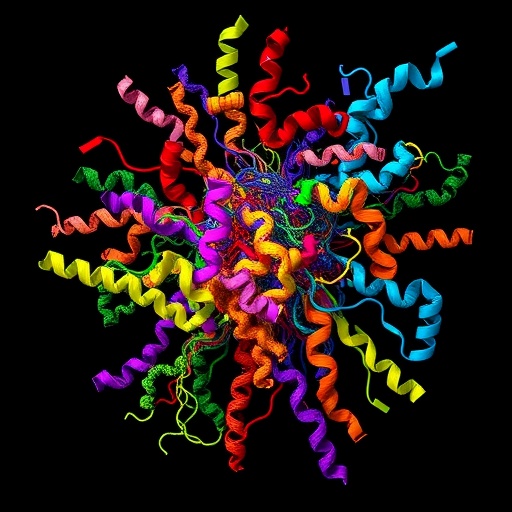
Kinase-driven phosphorylation is a central switch in cell signaling, yet most sites in the human proteome remain poorly characterized. Among the roughly 1.8 million serine, threonine, and tyrosine residues, only about 6% have experimental evidence for phosphorylation, and merely a fraction of those can be confidently assigned to a specific kinase. The gap reflects a longstanding bottleneck: predicting not just whether a residue is modifiable, but whether a kinase can actually “reach” and recognize it in the native-like three-dimensional context of a protein.
In a new study, Vanderwall, Huttlin, Mintseris, and colleagues unveil KinoPlex, an AI-enabled computational framework designed to decode kinase specificity at proteome scale. The approach fuses predicted protein structures with kinase recognition motifs to estimate phosphorylation potential for essentially all candidate residues, aiming to bridge the divide between sequence-based motif matching and structure-dependent accessibility.
KinoPlex builds on ~20,000 AlphaFold models. Using a positive-unlabeled transfer learning strategy, the authors infer which residues are structurally competent for phosphorylation even when direct phosphorylation labels are sparse. This yields an estimated set of about 567,000 residues that are “phospho-competent” based on their structural presentation.
Next, the pipeline intersects those candidates with kinase position-specific scoring matrices, quantifying how strongly each residue’s local sequence matches a kinase’s preferred motif. The result is a shortlist of roughly 250,000 high-confidence candidates that combine motif-compatible sequence features with optimal structural context for recognition.
The team goes beyond cataloging sites. By analyzing the resulting structural atlas, they identify organizing rules that govern how kinases engage substrates and how phosphorylation is dynamically enabled across different proteins. A key conceptual advance is “sequence–structure selective coupling,” in which specificity emerges not only from motif discrimination, but from the structural scarcity or accessibility of the preferred motif in a kinase’s substrate landscape.
Under this model, “negative-selecting” kinases become selective because their best motifs are structurally rare—limiting opportunities in the proteome. In contrast, “positive-selecting” kinases appear promiscuous when their preferred motifs are frequently structurally exposed, allowing phosphorylation even when sequences alone might look similar.
To test predictions, the authors perform deep phosphoproteomics in K562 cells. The experimental data support KinoPlex’s estimates of phosphorylation competence and demonstrate that predicted kinase-specific enrichment tracks with measured kinase-linked phosphorylation patterns. Together, the findings suggest that a structural atlas can meaningfully prioritize kinase-substrate relationships at scale.
By combining modern structure prediction with motif scoring and transfer learning, KinoPlex offers a new lens on the biology of phosphorylation. It points toward a future where kinase targeting can be inferred more reliably from structural context, helping transform large-scale phosphoproteomics from cataloging to mechanism-driven interpretation.
Tags: AI-driven phosphoproteome mappingAlphaFold protein structure modelscomputational kinase-substrate interactionhuman proteome phosphorylation analysiskinase accessibility and reachabilitykinase recognition motif analysiskinase substrate specificity predictionlarge-scale phosphorylation site annotationphosphorylation site predictionprotein kinase recognition motifstructural bioinformatics in cell signalingstructural proteomics