


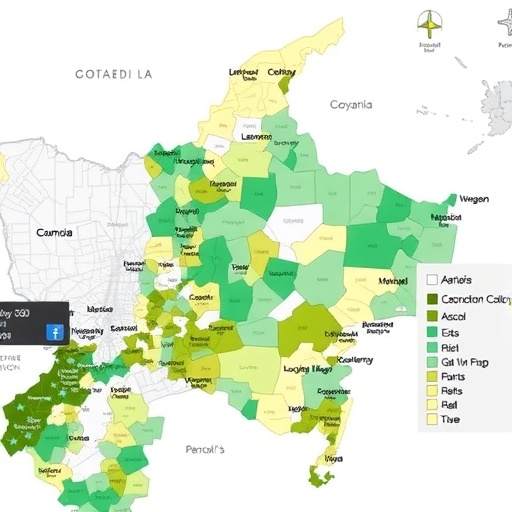
A new study in Colombia is using a sophisticated statistical lens to map how older adults perceive the age-friendliness of their cities and communities—and what those perceptions mean for lived experiences of ageism. Published in BMC Geriatrics, the work examines perceived environmental fit as a potential predictor of how often and how intensely older people encounter discriminatory attitudes or behaviors.
At the center of the research is “latent profile analysis,” a model-based technique that identifies hidden subgroups within a population based on patterns in observed responses. Instead of assuming that everyone evaluates their environment in the same way, the method estimates distinct profile classes that share similar perceptions of local age-friendliness.
The researchers focus on Colombia, where urban and community contexts vary widely in social design, accessibility, and everyday interactions. By capturing perceived age-friendliness—not just objective policy or infrastructure—the study links the social meaning of place to later-life outcomes.
Critically, the analysis also tests associations between these latent profiles and ageism experiences. This allows the team to evaluate whether certain perception-based profiles correspond to higher or lower likelihood of reporting ageist encounters, such as being treated as less competent, being excluded from social life, or facing disrespect in everyday settings.
From a technical standpoint, the study uses probabilistic classification: each participant is assigned a likelihood of belonging to each profile, reflecting uncertainty rather than forcing rigid categories. Model selection and fit evaluation guide how many distinct profiles are supported by the data, improving confidence in the subgroup structure.
The findings support a growing view that ageism is not only an interpersonal phenomenon, but also intertwined with the social environment. When communities are perceived as recognizing older residents, it may buffer against ageist experiences; when they are perceived as neglectful or limiting, the risk may increase.
In practical terms, the study suggests that interventions should target perceptions as well as services. Communication, community engagement, and age-inclusive everyday practices could shift how older adults interpret their surroundings—and potentially change the frequency of ageist experiences.
For policymakers and urban planners, the results provide an evidence-informed framework: designing age-friendly environments may require not only physical accessibility, but also the social signals that older people read in their day-to-day lives.
Subject of Research: Older adults’ perceived age-friendliness of cities and communities in Colombia; its relationship to ageism experiences in later life.
Article Title: Latent profiles of the perceived age-friendliness of cities and communities in Colombia: relations to ageism experiences in later life.
Article References: Li, X., Bustamante, M., Tamayo Gaviria, N.A. et al. Latent profiles of the perceived age-friendliness of cities and communities in Colombia: relations to ageism experiences in later life. BMC Geriatr (2026). https://doi.org/10.1186/s12877-026-07735-w
Image Credits: AI Generated
DOI: 10.1186/s12877-026-07735-w
Keywords: Not provided
Tags: age-friendly cities in Colombiacommunity accessibility for older adultsenvironmental predictors of ageismimpact of city environments on aginglatent profile analysis in aging researchlived experiences of older residentsmapping perceptions of age-friendly communitiesolder adults’ experiences of ageismperceived environmental fit and ageismsocial exclusion and age discriminationsocial perceptions of age-friendlinessstatistical modeling of aging perceptionsurban aging and community design


