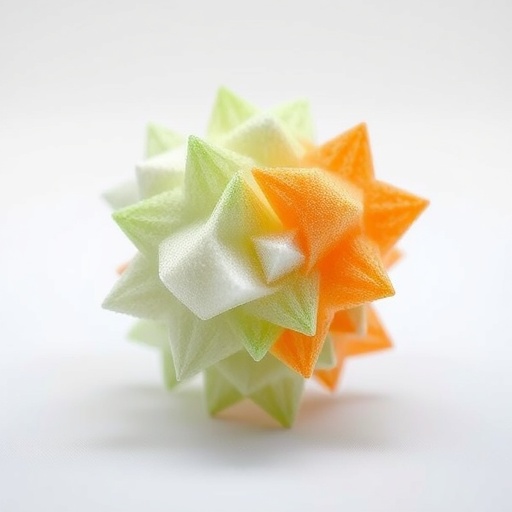
A team of researchers at The University of Texas at Austin has created a new 3D-printable material that behaves like living tissue’s built-in sorting system. Instead of passively acting as a barrier, the material can selectively allow certain molecules and ions to pass while restricting others—an ability that is central to how kidneys and intestines work.
Scaling the concept to practical sizes has been a major obstacle for earlier “tissue-like” constructs. The researchers report that conventional formation approaches were too slow and unstable to grow into dimensions suited for real-world applications, limiting how far lab prototypes could go.
Their solution is surprisingly straightforward: they jam billions of tiny water droplets into a tightly packed structure in a matter of minutes. Using basic mixing steps followed by centrifugation, the team forms large, tissue-like blocks from emulsions where each droplet is separated by a thin membrane.
Crucially, the membranes are not dead layers. As the droplets are interconnected during the jamming process, membrane domains link up to create an organized network. In effect, the internal architecture resembles the spatial organization of cells and intercellular interfaces found in biological tissues.
Because the resulting material can be fabricated with 3D printing using biocompatible components, it can be tuned to act like different tissue types. The team envisions it as a scaffold that supports the growth of new tissues and, eventually, functional organ-like structures.
The same responsive properties also point toward soft robotics. A gel-like material that can adapt while transporting signals or ions could enable robots for minimally invasive surgery, search-and-rescue operations, or hazardous environments where rigid machines struggle.
To push the idea further into bioelectronic territory, the researchers modified the material by adding specific proteins that enable ion-current conduction, similar to nerve tissue. That capability could support future computing concepts modeled after brain-like communication pathways.
In a parallel demonstration, they incorporated a protein that discriminates ammonium from other ions in wastewater. The filtration approach targets streams such as water produced during oil and gas extraction as well as municipal wastewater, aiming to recover valuable mineral ions and nutrients.
This research, published in Nature Materials, is part of a multi-year effort driven by graduate student Aida Fica. After facing years of slow and unstable fabrication, the team refined the method using emulsification of two oils with different solubilities, then applying centrifuge-driven jamming to lock the structure in place.
Subject of Research: 3D-printable tissue-mimicking emulsions for selective ion/molecule transport and filtration
Article Title: Jammed interconnected bilayer emulsions as 3D-printable biological tissue mimics
News Publication Date: Not provided
Web References: https://www.nature.com/articles/s41563-026-02679-3
References: 10.1038/s41563-026-02679-3
Image Credits: Not provided
Keywords: 3D printing, tissue mimics, emulsions, ion transport, ion selectivity, wastewater filtration, soft robotics, biocompatible materials, bioelectronics, centrifugation