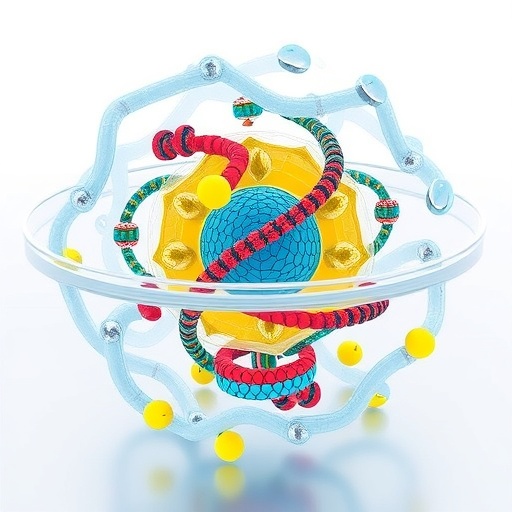
International quantum simulations are giving a rare, full-resolution view of how a hydrated proton moves through water. Led by researchers at Heidelberg University’s Institute for Physical Chemistry, the study tracks proton “hopping” not as a simple drift, but as a rapid transfer between neighboring water molecules. The team’s approach targets one of the hardest problems in molecular science: the coupled, ultrafast dynamics that define proton transport in liquid water.
When an acid dissolves, the proton does not stay attached to just one water molecule. Instead, it shuttles through a hydrogen-bond network, a process historically known as the Grotthuss mechanism. This behavior underlies key properties such as water’s acidity and also influences technologies ranging from battery energy storage to signal transmission in biology.
For decades, scientists have relied on two idealized pictures of hydrated protons: the Zundel and Eigen cations. In the Zundel description, the excess proton is shared between two water molecules; in the Eigen picture, it forms a hydronium-like core bonded to additional waters. But infrared spectroscopy hints at a more complex intermediate state—more dynamic than either idealization.
To resolve that missing middle, the researchers simulated an extended Zundel complex containing six water molecules. They systematically removed molecules to drive the system from a symmetric Zundel configuration toward an asymmetric Eigen-like structure. Throughout this transition, the study follows the proton’s quantum motion together with the surrounding waters in detail.
A central advance is the computation of the full infrared spectrum. The team identifies 51 interlocking vibrational modes that collectively shape the proton’s characteristic infrared “fingerprint.” By propagating all these degrees of freedom at once, the simulations reproduce experimental measurements across the entire spectral range.
Accuracy in the underlying atomic forces proved decisive. Rather than using common approximations, the researchers employed an artificial neural network trained on high-level quantum-chemical data in Bochum. The resulting machine-learning potential enables parameter-free quantum dynamics, capturing subtle interactions that strongly affect proton transfer pathways.
The findings emphasize a unifying principle: the local geometry—and particularly local asymmetries—of the surrounding water controls the proton’s hopping signatures. In other words, the infrared response is not only a property of the proton, but a readout of how nearby waters choreograph the transfer process.
The project involved collaborators from Cambridge (UK) and Université Bourgogne Europe in Dijon (France). Funding was provided by the German Research Foundation and the Royal Society. The results appear in Nature Chemistry, marking a step toward predictive, molecule-level understanding of proton transport in aqueous environments.
Subject of Research: Hydrated proton dynamics in water (proton hopping and infrared spectrum)
Article Title: Deciphering the infrared spectrum of the hydrated proton using full-dimensional quantum dynamics
News Publication Date: 27-Jul-2026
Web References: http://dx.doi.org/10.1038/s41557-026-02209-3
References: Nature Chemistry (published article)
Image Credits: © David Mendive-Tapia
Keywords
Proton transport; Grotthuss mechanism; hydrated proton; quantum dynamics; infrared spectroscopy; Zundel and Eigen; machine-learning potential; vibrational spectrum; neural network; water asymmetry
Tags: advanced water simulation techniquesGrotthuss mechanismhydrated proton dynamicshydrogen bond network in watermolecular-level water acidityproton conduction in biological systemsProton transport in waterquantum molecular simulationssimulations of proton transfer pathwaysultrafast proton transferwater proton hoppingZundel and Eigen cations