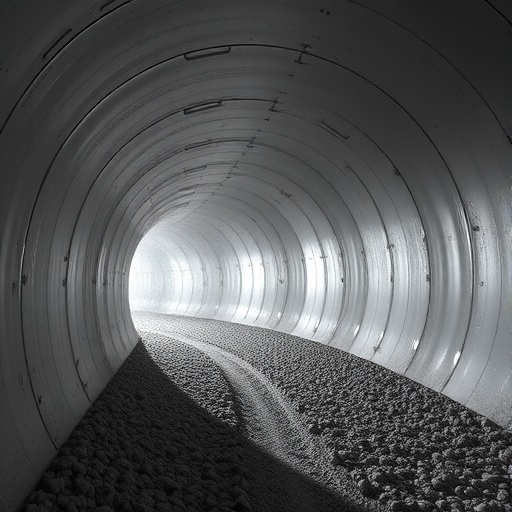
Mountain tunnels built in weak ground can experience severe inward convergence, known as squeezing ground. As the surrounding rock deforms, conventional tunnel supports may crack or lose capacity, threatening long-term stability. Deformation-accommodating support systems aim to manage this risk by allowing controlled, recoverable-to-nonlinear deformation within the support lining itself, rather than letting the ground displacement fully transfer into brittle failure modes.
A key strategy in these systems is the inclusion of “yielding elements” embedded within a shotcrete layer. Unlike rigid reinforcement that primarily resists deformation, yielding elements are designed to deform in a ductile manner, absorbing a portion of the ground-driven displacement through compression and progressive yielding. Yet, while yielding elements have been studied individually through material tests and numerical models, the structural response of an entire tunnel support system—and how it depends on where yielding elements are installed—has remained insufficiently validated experimentally.
To address this gap, researchers led by Associate Professor Yota Togashi at Saitama University, in collaboration with Taisei Corporation, carried out laboratory loading tests using 1/20-scale tunnel support models. The shotcrete-like matrix was simulated with young-aged mortar, and model yielding elements were made using ordinary styrofoam. The experiments reproduced squeezing-ground conditions by applying isotropic compressive stress using nine independently controlled screw jacks.
By comparing configurations with different yielding-element installation positions, the team showed that these elements absorb displacement mainly through compression along the tunnel circumferential direction. As the yielding elements entered a strain regime where compressive deformation accelerated rapidly, the deformation of the entire support system increased sharply, highlighting a strong coupling between local yielding and global tunnel response.
The study also found that structural failure occurred after the yielding elements became nearly fully compressed. Notably, the maximum load at failure was comparable to that of a mortar-only reference support, indicating that yielding elements primarily alter the deformation pathway rather than dramatically increasing ultimate load.
Different installation angles produced distinct deformation patterns. A nearly vertical arrangement promoted predominantly vertical displacement, whereas an inclined arrangement enabled significant horizontal movement as well. This demonstrates that geometry can steer how compressive accommodation propagates through the lining.
To interpret the observed behavior, the researchers used a simplified beam–spring model that reproduced the main deformation trends. However, they emphasized that further refinement is needed to predict stress distributions with higher accuracy, particularly for capturing the complex interaction between yielding elements and the shotcrete-like matrix under large strains.
“This study is significant because it experimentally shows how yielding elements function not merely as individual materials, but as part of an entire tunnel support system,” said Togashi. The results are expected to support safer, more rational design of deformation-accommodating supports for tunnels exposed to strong ground squeezing, where resilience against progressive deformation is essential. Future work will move toward laboratory experiments using commercially relevant yielding elements and will connect experimental insights to design methods applicable to construction sites.
Keywords
Deformation-accommodating tunnel support; yielding elements; squeezing ground; isotropic compression; structural loading tests; ductile lining behavior
Subject of Research: Deformation-accommodating (ductile) tunnel support systems under isotropic squeezing-ground stress
Article Title: Laboratory loading tests of ductile support systems under isotropic stress considering the effect of the installation position of yielding elements
News Publication Date: 4-Jun-2026
Web References: http://dx.doi.org/10.1016/j.tust.2026.107841
References: Y. Togashi et al., Tunnelling and Underground Space Technology (2026), DOI: 10.1016/j.tust.2026.107841
Image Credits: Image adapted from Y. Togashi et al., Tunn. Undergr. Space Tech. 2026, DOI: 10.1016/j.tust.2026.107841. Used under CC-BY-NC-ND.
Tags: deformation-accommodating tunnel supportsductile tunnel support designground pressure-induced tunnel deformationinnovative tunnel support validationlaboratory testing of tunnel supportslong-term tunnel stability under squeezing conditionsscale model tunnel experimentsshotcrete support with yielding componentssimulated squeezing ground pressuretunnel support system testingweak ground tunnel stabilityyielding elements in tunnel reinforcement