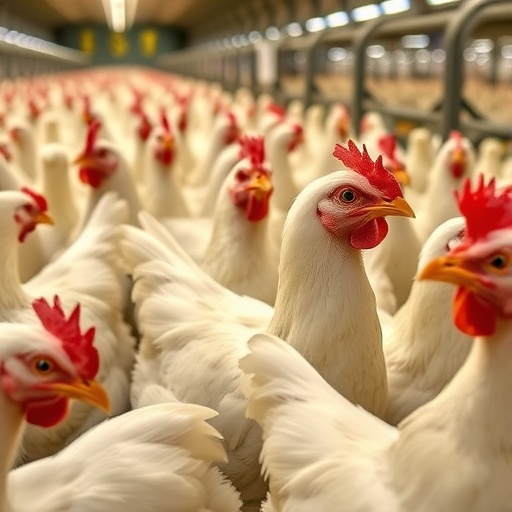
A new genomic study from the Ineos Oxford Institute for antimicrobial research and the University of Oxford argues that industrial poultry farming has turbocharged the spread of Campylobacter—a leading cause of bacterial gastroenteritis worldwide.
The researchers report a more than 100-fold increase in the movement of Campylobacter between hosts, enabling strains historically circulating mainly in wild birds to mix extensively within commercial flocks. This shift matters because Campylobacter is already the most common worldwide bacterial cause of diarrhoea, and rising antimicrobial resistance (AMR) is making infections harder to treat.
To reach their conclusions, the team analysed nearly 2,800 bacterial genomes collected from chickens and wild birds across 30 countries over a multi-decade period spanning 1979 to 2024. The data allowed them to reconstruct how lineages moved, diversified, and adapted as global poultry numbers surged.
Since the 1960s, global chicken populations have expanded roughly seven-fold to about 31 billion birds, with chickens now representing around 70% of total bird biomass on Earth. In evolutionary terms, that scale creates an ecosystem where microbes can encounter new opportunities for transmission, selection, and genetic exchange.
Using comparative genomics, the study identifies changes associated with adaptation to the chicken environment. These include genes linked to antimicrobial resistance, oxidative stress tolerance, metal acquisition, and motility—traits that can improve survival under the stresses of modern poultry production.
The authors also suggest that densely populated flocks may function as ecological “pathogen sponges,” absorbing strains from multiple sources and amplifying them. Mathematical modelling indicates that once chicken populations reach a critical size, incoming strains may persist and spread even if they are not perfectly adapted to the host.
The work reinforces earlier findings from the institute that a large fraction of human Campylobacter infections in Oxfordshire are associated with poultry meat and that many show antibiotic resistance. Together, the studies highlight how farming practices can drive microbial evolution with direct public health consequences.
The team emphasizes that anticipating these evolutionary trajectories is essential for reducing future risks from zoonotic disease and AMR. In a world where food systems shape microbial ecology, genomic surveillance and targeted intervention may be key to slowing the next wave.
Subject of Research: Campylobacter transmission and antimicrobial resistance evolution in poultry farming
Article Title: Accelerating Campylobacter zoonosis in the Anthropocene
News Publication Date: 27-Jul-2026
Web References: https://www.ineosoxford.ox.ac.uk/
References: Proceedings of the National Academy of Sciences (PNAS); DOI: 10.1073/pnas.2609969123
Image Credits: Ineos Oxford Institute for antimicrobial research (IOI).
Keywords: Campylobacter; zoonosis; poultry farming; antimicrobial resistance; AMR; genomics; pathogen transmission; evolutionary adaptation; PNAS
Tags: antimicrobial resistance gene transfer in poultry environmentsantimicrobial resistance in foodborne bacteriabacterial adaptation to poultry farming conditionsCampylobacter transmission in industrial poultry farmingchallenges of antimicrobial-resistant infections from poultryeffects of intensive farming on microbial diversityfood safety risks from industrial poultry farminggenomic analysis of bacterial evolution in chickensglobal expansion of chicken populations and pathogen spreadimpact of large-scale poultry production on bacterial spreadrole of wild birds in bacterial gene flowspread of foodborne pathogens across countries