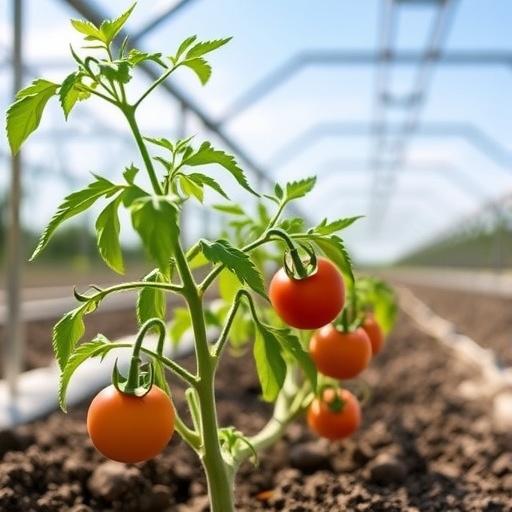
A low-dose leaf spray may help tomato plants thrive on farmland made unproductive by salt, according to a new study led by the University of Texas at El Paso (UTEP). The work targets a growing agricultural problem: salinity that disrupts how roots take up water and nutrients, ultimately suppressing growth and yield.
When soils become salty, plants often experience both water stress and ion toxicity. That combination reduces photosynthesis efficiency and can trigger nutrient imbalances, leaving crops weaker and less productive—especially in arid and semi-arid regions where saline irrigation is common.
The researchers focused on tomatoes because the crop is globally important, with production reaching roughly 192 million tons in 2023. Even modest improvements in salt tolerance could therefore protect a substantial portion of the vegetable food supply.
Their treatment pairs manganese oxide nanoparticles with chitosan, a biopolymer derived from crustacean shells. Instead of amending soil, the team applied the formulation directly to leaves, aiming to deliver protective effects through accessible plant surfaces at small doses.
Greenhouse experiments tested plants under moderate and severe salt stress. Compared with untreated stressed tomato plants, the combined spray substantially improved performance, indicating that the approach can counter key physiological disruptions caused by salinity.
Under the harshest conditions, the treatment doubled shoot weight and increased root weight by more than 55%. These growth gains suggest the plants maintained better internal balance during stress exposure.
The study also reports restored photosynthetic pigments, including a sharp increase in carotenoids—up roughly 91% in treated plants. At the same time, chemical indicators associated with cellular damage were markedly reduced, supporting the idea that the formulation helps limit stress injury.
Beyond pigment recovery, the researchers found antioxidant defenses were boosted. Antioxidant enzyme activity rose up to 300%, consistent with a stress-response mechanism that enables plants to neutralize harmful oxidative effects rather than deteriorate under salty conditions.
While the authors emphasize that results come from controlled greenhouse settings, they describe the strategy as a practical, environmentally friendlier route toward more resilient crops. They call for field trials to confirm performance at scale and to evaluate longer-term environmental and soil impacts.
Subject of Research: Tomato salinity stress alleviation using manganese oxide nanoparticles and chitosan foliar spray.
Article Title: Synergistic alleviation of salinity stress in tomato: unraveling the physiological, biochemical, and antioxidant mechanisms modulated by manganese nanoparticles and chitosan
News Publication Date: July 27, 2026
Web References: https://www.tandfonline.com/doi/full/10.1080/15226514.2026.2669640
References: 10.1080/15226514.2026.2669640
Image Credits: The University of Texas at El Paso.
Keywords: salinity stress, tomato, manganese oxide nanoparticles, chitosan, foliar spray, phytoremediation, antioxidant enzymes, photosynthesis, nanoparticles in agriculture, sustainable crop protection
Tags: arid region agriculture solutionsbiopolymer applications in farmingchitosan-based plant protectiondrought and salinity stress managementimproving crop yields in saline environmentsleaf spray treatment for salt tolerancelow-cost foliar spray for saline soilsmanganese oxide nanoparticles in agriculturenanoparticle use in crop resiliencesaline soil crop productivity enhancementsustainable tomato cultivation techniquesTomato plant salt stress mitigation