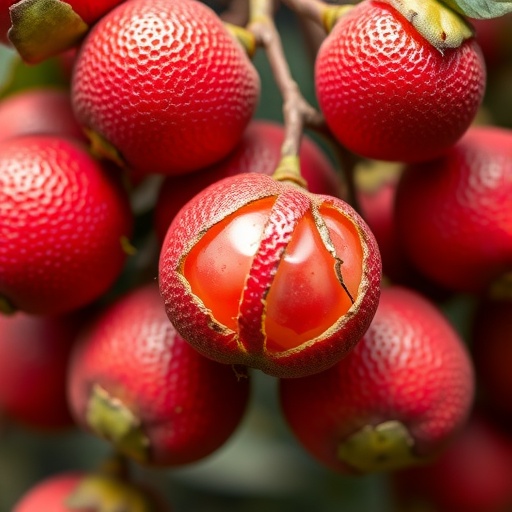
Litchi fruit can deteriorate within days after harvest, with rapid spoilage driven largely by fungal infection and peel browning. Traditional chemical preservatives can extend shelf life, but they also raise food-safety concerns and sustainability questions. A new study from China now proposes a microbiome-centered alternative: using the dynamics of naturally occurring bacteria on the fruit surface to both predict freshness and suppress pathogens.
Researchers led by Prof. Yong‑Xin Liu (Chinese Academy of Agricultural Sciences) monitored bacterial communities on the peels of two litchi varieties—“Huaizhi” (storage tolerant) and “Nuomici” (sensitive)—over a nine-day period. Experiments included both natural storage conditions and fungicide-treated groups, enabling the team to separate microbial succession signals from treatment effects.
To characterize the peel microbiome, the study applied amplicon sequencing to capture temporal community shifts. Time-series analysis identified genera exhibiting consistent freshness-linked patterns, including Methylobacterium, Sphingomonas, and Gluconobacter. In parallel, a machine-learning approach was used to evaluate whether these microbial signatures could forecast quality without relying on chemical indicators.
Using a random forest model trained on microbial biomarkers, the team achieved accurate prediction of fruit freshness, reporting a coefficient of determination greater than 0.90. The authors describe the peel microbiome as a “freshness clock,” reflecting how specific bacterial populations rise or decline in step with storage time and quality loss.
A key step toward application involved culturing bacteria from the peel. From 80 culturable isolates, the researchers tested biocontrol potential against two major postharvest pathogens: Peronophythora litchii (downy blight) and Colletotrichum gloeosporioides (anthracnose). One strain, Gluconobacter sp. Lc45, showed strong inhibitory activity.
In vitro assays demonstrated that Gluconobacter sp. Lc45 suppressed pathogen growth by more than 63%. More importantly, the strain also reduced disease development in living fruit, indicating functional biocontrol performance under realistic postharvest conditions.
Mechanistically, the protective effect was linked to nutrient competition and the secretion of antimicrobial metabolites. Because these actions do not depend on synthetic fungicides, the approach offers a potentially safer and more sustainable option for shelf-life extension.
Beyond individual strains, the study clarified the ecological driver of microbial community change: storage time, rather than cultivar identity or fungicide treatment, was the primary force shaping succession on the fruit surface. As decay progressed, communities shifted from plant-beneficial bacteria toward decomposer-associated taxa, explaining why some genera correlate positively with freshness early and negatively later.
By integrating high-throughput sequencing, culturomics, and predictive modeling, the work delivers both a diagnostic framework for postharvest management and a candidate biocontrol agent. The authors have filed a patent (No. 202610311174.2) based on the results, supporting translation toward real-world applications.
Subject of Research: Postharvest spoilage microbiome; bacterial freshness biomarkers; biocontrol using Gluconobacter
Article Title: Postharvest bacterial dynamics in litchi
Web References: http://dx.doi.org/10.1007/s11427-025-3302-x
Image Credits: ©Science China Press
Keywords: litchi; postharvest; microbiome; freshness biomarkers; time-series analysis; random forest; biocontrol; Gluconobacter; pathogen suppression
Tags: amplicon sequencing for microbiome profilingfruit microbiome analysisfungal infection preventionLitchi shelf life extensionmachine learning in fruit quality predictionmicrobial succession in fruit spoilagemicrobiome-centered food preservationnatural bacterial indicators of freshnesspeel bacterial communitiespost-harvest fruit spoilage controlrandom forest models for freshness forecastingsustainable alternatives to chemical preservatives