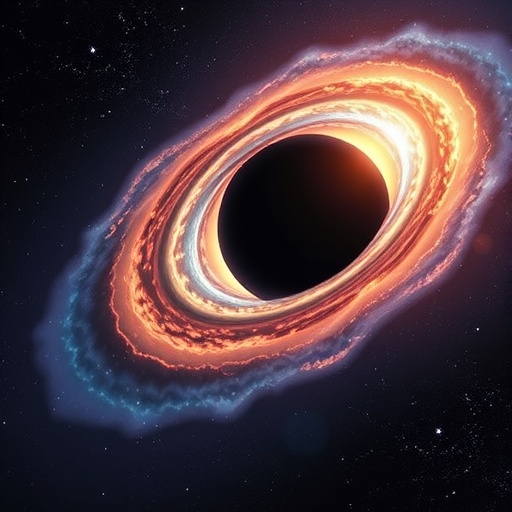
A team at the University of North Carolina at Chapel Hill has reported the observation of an exceptionally rare “wandering” black hole—detected far from its galaxy’s center, at an offset of roughly 30,000 light-years. The culprit is a tidal disruption event (TDE), a flare that ignites when a star passes too close to a supermassive black hole and is torn apart by extreme tidal forces.
TDEs are already uncommon in the cosmic neighborhood: on average, they occur only about once every 100,000 years in a given galaxy. Yet the majority of known TDEs have been seen at galactic centers, where astronomers expect the largest black holes to reside. This new event, labeled TDE 2025abcr, breaks that pattern—suggesting the black hole is moving through the galaxy rather than anchored at the nucleus.
The estimated mass of the responsible black hole is about one million times the Sun. Researchers propose two possible origins: it may be a remnant left behind after a past galaxy merger, or it could have been propelled outward by gravitational interactions involving other massive black holes in the crowded central region.
Because black holes do not emit light on their own, astronomers rely on the brief brilliance of TDEs as indirect “signposts.” In this case, the flare acts like a cosmic billboard, illuminating the presence of an otherwise invisible object and allowing scientists to probe how black holes consume stellar debris.
Crucially, the detection depended on an artificial intelligence classifier called tdescore. The team adapted the tool to search for TDEs even when they occur away from galaxy centers—removing a key assumption that had likely excluded similar candidates.
After the AI flagged TDE 2025abcr, the researchers confirmed the event using the 4.1-meter Southern Astrophysical Research (SOAR) Telescope in Chile, a facility UNC helps build and continues to operate as part of an international consortium. This rapid follow-up enabled them to validate the transient’s nature.
The researchers say the observation provides strong evidence that wandering black holes can be reliably discovered with visible-light ground-based telescopes. With next-generation observatories such as the Rubin Observatory and UNC’s Argus Array, the field could shift from finding tens of TDEs per year to discovering hundreds—or thousands—at much greater distances.
Beyond black hole dynamics, TDEs offer insight into stellar death and extreme physics under conditions unreachable on Earth. Each flare provides a laboratory for testing how matter behaves under intense gravity and how black holes grow by accreting disrupted material.
The study is published in The Astrophysical Journal Letters and may open a new observational chapter on how massive black holes form, migrate, and reshape their host galaxies over cosmic time.
Subject of Research: Tidal disruption events (TDEs) and wandering supermassive black holes
Article Title: TDE 2025abcr: A Tidal Disruption Event in the Outskirts of a Massive Galaxy
News Publication Date: 27-Jul-2026
Web References: https://iopscience.iop.org/article/10.3847/2041-8213/ae77f3
References: https://iopscience.iop.org/article/10.3847/2041-8213/ae77f3 (DOI: 10.3847/2041-8213/ae77f3)
Image Credits: NRAO/AUI/NSF/NASA
Keywords
Black holes, Artificial intelligence, Astronomy, Tidal disruption events
Tags: black hole movement outside galactic centersblack hole origins and dynamicsgalaxy merger remnantsgravitational interactions with black holeshigh-mass black holes in galaxy outskirtsobservational astronomy of black holesoff-center supermassive black holesrare black hole eventsTDE 2025abcr discoverytidal disruption events in galaxiestransient astronomical phenomenawandering black hole detection