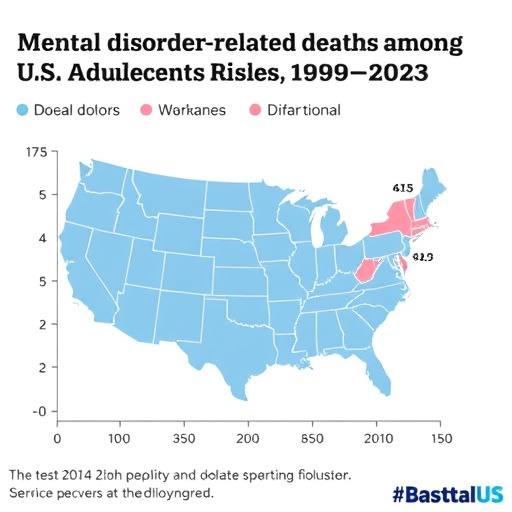
Mental health conditions are a persistent source of adolescent illness and early death, but national-scale, long-term mortality patterns have remained unclear. Now, a new analysis tracking trends across more than two decades offers a clearer picture of how mental and behavioral disorders have shaped death rates for US youth aged 15–24.
Using CDC WONDER (Wide-ranging Online Data for Epidemiologic Research), researchers examined deaths from 1999 through 2023. They defined “mental and behavioral disorder-related mortality” by identifying ICD-10 codes F01–F99 listed as a contributing cause of death, rather than as the single underlying diagnosis. This approach captures mortality where mental health conditions may have influenced risk alongside other factors.
Across the 25-year period, the study recorded 67,984 deaths, corresponding to an overall rate of 6.37 per 100,000 population. The team assessed how death rates evolved over time, how they differed across demographic groups, and how they varied by place of residence.
Sex differences emerged: males experienced higher mortality than females. Age stratification also showed elevated rates among those aged 20–24 compared with the younger 15–19 group, suggesting that risk accumulates as adolescents transition toward young adulthood.
Racial and ethnic inequities were evident throughout the study window. American Indian or Alaska Native adolescents showed the highest burden, highlighting structural and access-related challenges that may intensify the impact of mental health and substance-use vulnerabilities.
Geography mattered as well. Counties and states in the South reported the highest mortality rates, pointing to regional differences in care availability, prevention infrastructure, and social determinants of health.
To quantify trend shifts, the researchers applied joinpoint regression, a statistical method designed to detect changes in slope across time. Two distinct periods of increasing mortality were identified: 1999–2006 and 2009–2021. Despite these rises, the overall direction of rates across the full 1999–2023 span remained largely stable.
The authors interpret the findings as evidence of both persistent disparities and recurring periods where risks intensified. They argue that improvements will likely require more than broad awareness—targeted, equity-focused interventions that strengthen mental health services, substance use prevention, and linkage to evidence-based care for adolescents at highest risk.
Finally, the study underscores the importance of continued surveillance using routinely collected mortality data, especially when mental and behavioral disorders operate as contributing causes that may otherwise be overlooked in conventional reporting.
Subject of Research: Adolescent mental and behavioral disorder-related mortality in the United States (1999–2023)
Article Title: Mental and behavioral disorder-related mortality among US adolescents, 1999–2023.
Article References: Ding, G., Qu, W., Wen, C. et al. Pediatr Res (2026). https://doi.org/10.1038/s41390-026-05343-3
Image Credits: AI Generated
DOI: https://doi.org/10.1038/s41390-026-05343-3
Keywords:
Tags: age-related patterns in youth mental health mortalityanalysisCDC WONDER data on youth mental health deathsepidemiology of mental health conditions among US adolescentsgender differences in adolescent mental health-related deathsgeographic variation in adolescent mental health deathsICD-10 coding for mental health-related mortalityimpact of behavioral disorders on youth mortality ratesinfluence of mental disorders on overall youth mortalitylong-term trends in adolescent mental disorder mortalitymental health-related adolescent mortalityracial and ethnic disparities in adolescent mental health deaths