A new imaging approach is turning freehand scanning into a practical route for high-resolution 3D vascular views. In a study published in Light: Science & Applications, researchers report a “robust hybrid feature-driven on-the-fly mapping” method that enables freehand 3D panoramic photoacoustic angiography, aiming to make detailed blood-vessel imaging more accessible outside tightly controlled setups.
Photoacoustic imaging combines light and ultrasound: targeted laser pulses generate acoustic waves from tissue structures, and detectors reconstruct internal images from the returning signals. While this can reveal functional information such as hemoglobin contrast, producing wide, three-dimensional maps—especially when the probe is moved by hand—has been a persistent technical challenge.
The team’s core advance is a mapping strategy that works in real time as the scanner moves. Instead of relying solely on a single type of feature or a calibration-heavy workflow, the method blends complementary visual/feature cues to estimate the probe’s trajectory during acquisition. This “hybrid” design helps maintain alignment between frames, even when motion is imperfect or tissue appearance changes.
To keep reconstructions stable, the approach emphasizes on-the-fly correction of mapping errors. That matters because small pose or drift inaccuracies can accumulate quickly during panoramic scans, distorting vessel geometry and reducing quantitative reliability. By continuously updating the spatial relationship between successive photoacoustic measurements, the system aims to deliver a coherent 3D volume rather than a stitched but misregistered result.
The study describes how the strategy supports freehand operation while preserving the structural information needed for angiography. The reported capability enables panoramic coverage—capturing a larger field of view than typical fixed scanning—while still reconstructing 3D vascular patterns. Such coverage is particularly relevant for tracking anatomically complex microvasculature.
Beyond producing appealing images, robust mapping can also improve the reproducibility of photoacoustic angiography. More consistent 3D registration reduces operator-dependent variability, which is crucial for translating imaging methods into longitudinal studies and eventual clinical evaluation.
If validated further across different tissue types and experimental conditions, this technique could lower barriers to photoacoustic vascular imaging. By turning hand movement from a liability into an asset—through real-time, hybrid mapping—the method points toward faster, more flexible imaging systems.
In short, the work addresses a key bottleneck in freehand 3D photoacoustics: how to maintain geometric accuracy while moving. With its real-time hybrid feature-driven mapping, the platform offers a promising blueprint for more robust, panoramic angiography using photoacoustic contrast.
Subject of Research: Photoacoustic angiography and 3D real-time mapping
Article Title: Robust hybrid feature-driven on-the-fly mapping enables freehand 3D panoramic photoacoustic angiography.
Article References: Xin, H., Wang, E., Ma, R. et al. Robust hybrid feature-driven on-the-fly mapping enables freehand 3D panoramic photoacoustic angiography. Light Sci Appl 15, 328 (2026). https://doi.org/10.1038/s41377-026-02401-7
DOI: https://doi.org/10.1038/s41377-026-02401-7
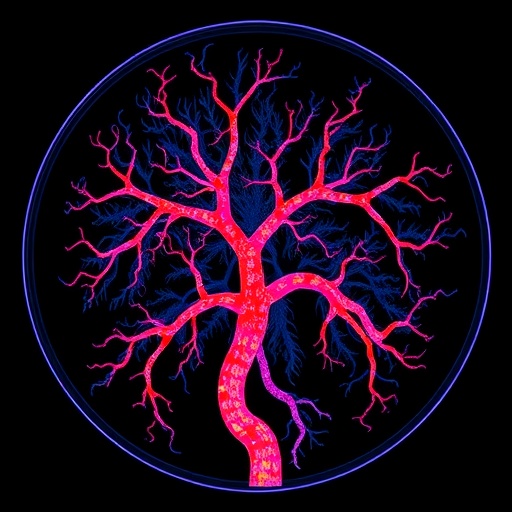
Image Credits: AI Generated
Tags: advanced biomedical imaging technologydynamic vascular structure visualizationFreehand 3D photoacoustic angiographyhandheld photoacoustic scannerhigh-resolution 3D vascular mappinghybrid feature-driven mappinghybrid imaging techniquesmotion correction in photoacoustic imagingpanoramic blood vessel imagingreal-time image reconstructionreal-time vascular imagingtissue imaging with light and ultrasound