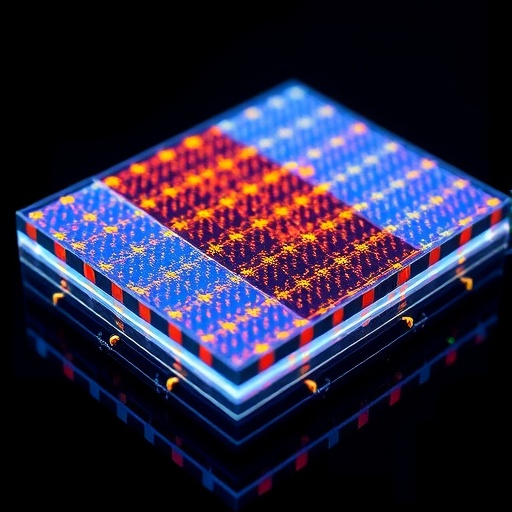
Monolithic perovskite/silicon tandem solar cells are widely viewed as a route to eclipse the efficiency ceilings of single-junction photovoltaics. Yet turning laboratory breakthroughs into durable, scalable modules hinges on a single thin layer: the recombination interconnect between the subcells. This layer must simultaneously promote rapid charge recombination, remain optically transparent for incoming light, and form a chemically robust interface that resists degradation over time.
A persistent challenge is that many high-performing indium-containing transparent conductive oxides (TCOs) raise cost and sustainability concerns, while silicon-based tunnel junctions can introduce parasitic optical losses. In a new study in Nature Energy, researchers report an alternative strategy built on titanium oxynitride, TiOxNy, designed to unify electrical, optical, and chemical functions in one material.
The key idea is to use conductive TiOxNy as a multifunctional recombination layer that improves charge transport in the vertical direction while suppressing unwanted lateral leakage. This matters for tandem stability because incomplete or inefficient recombination can increase carrier accumulation, degrade interfaces, and accelerate performance loss under continuous operation.
Beyond conductivity, the team emphasizes interfacial chemistry. TiOxNy provides anchoring sites for self-assembled monolayers (SAMs), achieved through a tridentate binding configuration. Those SAMs help engineer the energy landscape at the interface, strengthening contact selectivity and reducing recombination pathways that would otherwise waste photogenerated carriers.
Optically, the approach is engineered to keep the interconnect sufficiently transparent so that the perovskite and silicon subcells can harvest light efficiently. By balancing electrical recombination with optical clarity, the recombination layer avoids the trade-offs that typically force designers to choose between performance and manufacturability.
The results are striking. The researchers achieved power conversion efficiencies (PCEs) of 33.3% in 1.0-cm² perovskite/silicon tandem devices. More importantly for industrial translation, they scaled to an area of 207.87 cm² and still reached 30.6% PCE, indicating that the recombination layer concept tolerates the structural and processing complexity of large-area fabrication.
Operational durability also improved, supporting the claim that TiOxNy not only performs electrically but also stabilizes interfacial chemistry against the stresses that degrade tandem stacks. In practical terms, this suggests a path toward longer-lived, high-yield manufacturing rather than fragile, lab-only prototypes.
With indium-free materials and minimal optical penalty, TiOxNy could become a scalable interconnection choice for next-generation tandem photovoltaics. If further validated across manufacturing lines, it may help accelerate the move from record efficiencies toward technology that can be deployed widely.
Subject of Research: Perovskite/silicon tandem solar cells; recombination layers
Article Title: High-performance perovskite/silicon tandem solar cells enabled by multifunctional titanium oxynitride recombination layers.
Article References: Cao, F., Li, Y., Wang, S. et al. Nat Energy (2026). https://doi.org/10.1038/s41560-026-02116-4
DOI: https://doi.org/10.1038/s41560-026-02116-4
Keywords: titanium oxynitride; TiOxNy; perovskite/silicon tandem; recombination layer; indium-free interconnect; self-assembled monolayers; SAM anchoring; operational stability
Tags: charge recombination optimization in tandem solar cellschemical stability of recombination layersdurability and degradation resistance in tandem moduleshigh-performance perovskite-silicon solarinterfacial engineering with self-assembled monolayersmultifunctional conductive coatings for photovoltaicsperovskite silicon tandem solar cellsscalable perovskite-silicon tandem module fabricationsuppression of lateral leakage in photovoltaic devicestitanium oxynitride recombination layertransparent conductive oxides alternatives