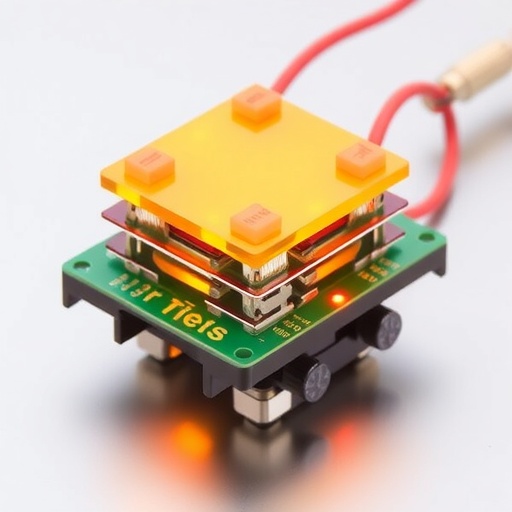
A new study in npj Flexible Electronics reports an electromechanical way to “snap” thin-film robotic and electronic modules together—and to separate them again—without relying on bulky connectors or manual alignment. The work, led by Uchima and colleagues, targets a key bottleneck for modular flexible technology: how to achieve reliable electrical contact while keeping devices thin, lightweight, and easy to reconfigure.
At the heart of the approach is a docking and undocking mechanism built around “kinetic electronics,” a concept that uses motion and mechanical coupling as functional elements. Instead of treating connection hardware as passive infrastructure, the researchers design interfaces whose physical action directly supports electrical engagement. This enables modules to align and establish pathways for current in a controlled, repeatable manner.
The authors emphasize electromechanical control, meaning the docking process is not just mechanical fitting but also includes coordinated electrical behavior. During docking, mechanical features guide the thin films into a precise position, while the system simultaneously brings conductive elements into contact. Undocking reverses the sequence, allowing modules to separate while reducing the risk of damage that often plagues fragile, flexible components.
Such a strategy could be especially useful for distributed sensing platforms, wearable electronics, and reconfigurable robotic skins. In these settings, a modular architecture is attractive because it allows new functions to be added, swapped, or removed as needs change. However, modularity is only practical if connections remain dependable after repeated cycles.
The study also points to the broader promise of kinetic electronics: converting movement into useful electronic operations. In effect, the mechanical act of joining becomes part of the circuitry’s lifecycle, potentially improving durability and reducing the complexity of external wiring.
If the mechanism scales, thin-film modules could be rapidly assembled on demand, supporting “living” electronics that adapt to new tasks. Equally important, the ability to undock cleanly could enable maintenance, recycling, or upgrades without discarding entire systems.
Beyond convenience, the reliability of docking under realistic conditions—where alignment errors, repeated contact, and flexibility-induced stresses are unavoidable—could determine whether such technologies move from laboratory prototypes to real-world products. This work offers a concrete pathway toward that goal.
Still, widespread adoption will depend on long-term cycling performance and manufacturability of the thin-film interfaces. Even so, the demonstrated concept is a compelling step toward flexible, modular devices that connect and disconnect like components of a dynamic machine rather than static gadgets.
Subject of Research: Thin-film modular robotics and electronic interfacing
Article Title: Electromechanical docking and undocking mechanisms for thin-film robotic and electronic modules based on kinetic electronics
Article References: Uchima, S., Cai, J., Hayashi, K. et al. Electromechanical docking and undocking mechanisms for thin-film robotic and electronic modules based on kinetic electronics. npj Flex Electron 10, 87 (2026). https://doi.org/10.1038/s41528-026-00606-9
Image Credits: AI Generated
DOI: https://doi.org/10.1038/s41528-026-00606-9
Tags: distributed sensing platform integrationelectrical contact reliability in flexible deviceselectromechanical docking systemsflexible device reconfiguration methodsflexible electronics modularitykinetic electronics docking mechanismlightweight electronic module connectionnon-bulky electronic connectorsreconfigurable wearable sensorsreversible module separation technologyrobotic skin modular assemblythin-film robotic module transfer