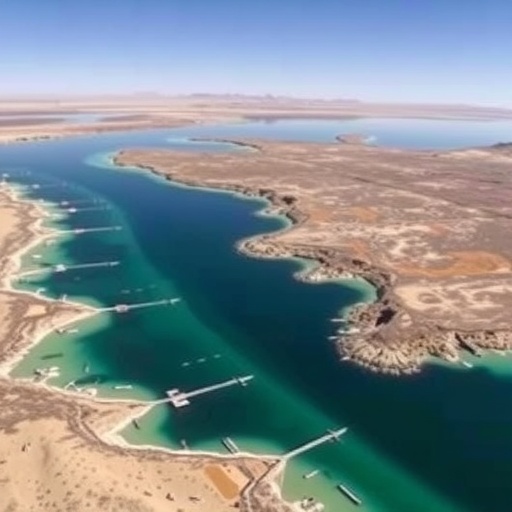
Drying of the Aral Sea has released more than 200 teragrams of carbon from exposed lake-bed sediments, turning a once-stable carbon reservoir into an active source of greenhouse gases, according to a new study in Science. The work highlights a growing blind spot in climate accounting: when lakes shrink or disappear, the fate of buried organic carbon must be tracked alongside emissions from land and industry.
Lakes are powerful climate regulators. Their sediments store large quantities of organic carbon, while the water and sediments can also emit carbon dioxide and methane. But when lakebeds dry, sediments that were previously sealed from the atmosphere are exposed to air, enabling buried organic matter to decompose and return carbon to the atmosphere—potentially reversing long-term natural sink behavior.
How this transformation scales across space and time has remained difficult to quantify, largely because emissions occur over decades and across changing environmental conditions. The Aral Sea, situated between Kazakhstan and Uzbekistan and once the world’s fourth-largest inland lake, provides an unusually clear natural experiment. After feeder rivers were diverted for irrigation, the basin became the world’s largest exposed dry lake bed.
To measure carbon losses, Rafael Marcé and colleagues used a space-for-time substitution strategy that integrates sediment-core records, in situ measurements of CO₂ flux, and remote sensing. By combining these approaches, the team reconstructed how much carbon the exposed lakebed released between 1960 and 2022, capturing both natural variability and human-driven drying.
The authors estimate that desiccated sediments emitted an average of about 204 ± 53 teragrams of carbon since 1960. Importantly, newly growing vegetation on the former lakebed has compensated for less than 1% of these emissions, suggesting that recovery processes have not kept pace with carbon release.
As a result, the Aral Sea basin’s carbon balance has flipped over roughly the last 50 years, shifting from net sink to significant source. The implication is broader than one region: similar lake desiccation events could materially reshape regional and global carbon inventories.
The study argues that reflooding the lake could deliver dual benefits—improving socioeconomic conditions while also slowing or halting continued carbon loss from the sediment. Beyond climate mitigation, the authors propose that avoided emissions and renewed carbon storage could be monetized through high-integrity carbon credits in voluntary markets.
If accurate accounting frameworks incorporate drying lakes as emission sources, Science reports that restoration could become a practical tool for limiting future greenhouse gas growth—turning a climate warning into a measurable climate intervention.
Subject of Research: Drying of the Aral Sea and its impact on regional carbon storage and greenhouse gas emissions
Article Title: Drying of the Aral Sea reshapes the anthropogenic carbon inventory of Central Asia
News Publication Date: 16-Jul-2026
Web References: http://dx.doi.org/10.1126/science.aeb2344
References: 10.1126/science.aeb2344
Image Credits: Not provided
Keywords: Aral Sea, lake drying, carbon emissions, sediment cores, CO₂ flux, remote sensing, carbon inventory, carbon credits, climate mitigation
Tags: Aral Sea environmental degradationclimate change and lake desiccationecological consequences of lake lossgreenhouse gas emissions from dried lake bedsimpact of shrinking lakes on carbon cyclelake sediment carbon storage and releaselong-term climate accounting challengesmethane and carbon dioxide emissions from drying lakesnatural carbon sinks turning into sourcesorganic carbon release from exposed sedimentsremote sensing of drying lakessatellite-based measurement of lakebed emissions