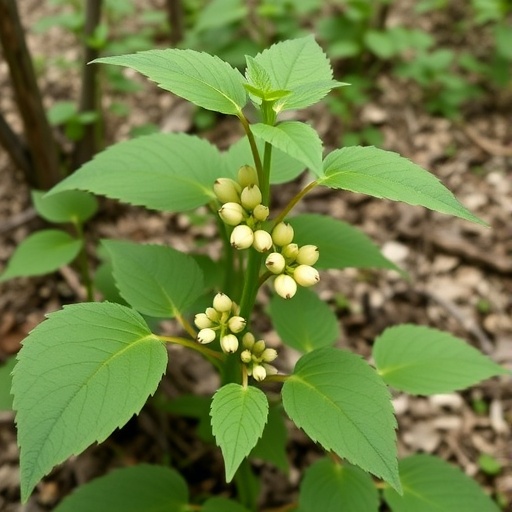
Wild American ginseng has long been regulated by rules that rely on plant age and leaf count, but a new study led by Yale researchers suggests those benchmarks can miss what conservation managers actually need. The work, published in Environmental Research Letters, examines how well the current federal criteria predict biological traits tied to survival and regeneration in natural populations.
Under current rules, ginseng can be harvested only after it reaches at least five years of age and forms three leaves. While such thresholds are intended to ensure individuals have enough time to grow, the study found that age and leaf number often fail to track root development and reproductive potential—the traits most directly linked to conservation outcomes.
To test these assumptions, the authors measured hundreds of plants across wild and working landscapes, comparing field- and biology-relevant characteristics. The results indicate that two plants meeting the same age/leaf requirement may still differ substantially in root size and the ability to produce seeds. In other words, the legal proxy (age and leaf count) did not reliably translate into the biological maturity that matters for population persistence.
A central implication is that conservation policy may be improving the odds of harvest compliance without guaranteeing protection of the most ecologically valuable individuals. When harvest pressure removes plants whose roots are still small or whose seed production capacity is limited, recovery dynamics can shift in ways that regulations based on time-based proxies are less likely to prevent.
The researchers argue for transitioning toward size-based harvest criteria, such as thresholds anchored to measurable plant dimensions that better correspond to root growth and reproductive output. Size metrics, they note, can align regulations with the biology that determines how quickly populations can replace harvested plants.
Beyond conservation, the team emphasizes practicality: criteria tied to observable size may be easier for harvesters and forest farmers to apply consistently in the field. That could reduce inadvertent violations and improve enforcement by making compliance more transparent and less dependent on estimating plant age.
The paper is led by Karam C. Sheban ’26 PhD, with co-authors Mark Bradford and Marlyse C. Duguid. Together, they present a framework for updating harvest regulation to better protect both wild populations and sustainable, long-term “working landscape” production.
Subject of Research: American ginseng conservation; harvest regulation criteria
Article Title: Protecting wild populations and working landscapes: the case for transitioning to size-based criteria for federal regulation of American ginseng
News Publication Date: 14-Jul-2026
Web References: https://iopscience.iop.org/article/10.1088/1748-9326/ae867c ; https://doi.org/10.1088/1748-9326/ae867c
References: 10.1088/1748-9326/ae867c
Image Credits: Not provided
Keywords
American ginseng
Harvest regulation
Conservation policy
Size-based criteria
Plant reproductive potential
Root growth
Tags: American ginseng conservationbiological traits linked to ginseng survivaleffectiveness of current ginseng harvesting policiesfederal ginseng harvesting regulationsginseng root development indicatorsginseng seed production and regenerationimplications of ginseng harvest rules on conservationlimitations of age-based plant regulationsplant age and leaf count in ginsengplant maturity assessment in conservationreproductive potential of wild ginsengwild ginseng population sustainability