

• HOME
  • NEWS
  • EXPLORE
    • CAREER
      • Companies
      • Jobs
    • EVENTS
    • iGEM
      • News
      • Team
    • PHOTOS
    • VIDEO
    • WIKI
  • BLOG
  • COMMUNITY
    • FACEBOOK
    • INSTAGRAM
    • TWITTER
Tuesday, September 1, 2026
BIOENGINEER.ORG
No Result
View All Result
  • Login
  • HOME
  • NEWS
  • EXPLORE
    • CAREER
      • Companies
      • Jobs
        • Lecturer
        • PhD Studentship
        • Postdoc
        • Research Assistant
    • EVENTS
    • iGEM
      • News
      • Team
    • PHOTOS
    • VIDEO
    • WIKI
  • BLOG
  • COMMUNITY
    • FACEBOOK
    • INSTAGRAM
    • TWITTER
  • HOME
  • NEWS
  • EXPLORE
    • CAREER
      • Companies
      • Jobs
        • Lecturer
        • PhD Studentship
        • Postdoc
        • Research Assistant
    • EVENTS
    • iGEM
      • News
      • Team
    • PHOTOS
    • VIDEO
    • WIKI
  • BLOG
  • COMMUNITY
    • FACEBOOK
    • INSTAGRAM
    • TWITTER
No Result
View All Result
Bioengineer.org
No Result
View All Result
Home NEWS Science News Chemistry

Cold Radioactive Molecules Prepared for Next Physics Breakthroughs

Bioengineer by Bioengineer
July 16, 2026
in Chemistry
Reading Time: 2 mins read
0
Cold Radioactive Molecules Prepared for Next Physics Breakthroughs
Share on FacebookShare on TwitterShare on LinkedinShare on RedditShare on Telegram

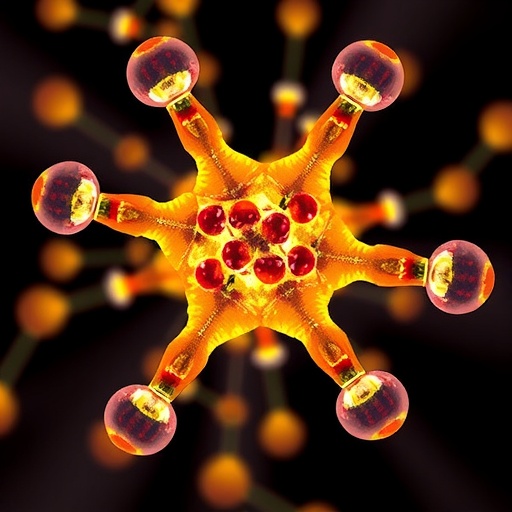
For the first time, researchers have produced radium-containing molecules in a cold, laser-ready state, enabling high-precision tabletop measurements. The work opens a new experimental route for probing how the universe became dominated by matter rather than antimatter.

In the early universe, matter and antimatter were expected to form in nearly equal amounts. Yet when an electron meets its antimatter counterpart, the positron, both annihilate into energy—so the persistence of ordinary matter today hints at an unknown asymmetry generated during the cosmos’s earliest moments.

To explore that asymmetry, a team led by Nick Hutzler at Caltech turned to radium. Its nucleus has a rare “pear-shaped” deformation, which amplifies subtle signals that could arise from previously unseen particles or forces. When such nuclei are embedded within molecules, laser spectroscopy can reveal tiny energy shifts tied to fundamental physics.

Radium is notoriously difficult to work with: it is radioactive, chemically reactive, and available only in minute quantities. The central challenge was therefore not only forming radium-bearing molecules, but doing so in a controlled way that preserves the atoms long enough to study them precisely.

The researchers designed a strategy that begins by stabilizing radium in a viscous medium produced through a process inspired by candy-making. Instead of sugar, they optimized conditions using xylitol to avoid problematic caramelization while creating a workable “goo” that can be handled safely and reproducibly.

Once prepared, the material was placed onto a gold foil inside a compact cryogenic apparatus. The chamber was cooled to roughly minus 450°F using helium gas. Radium atoms were then excited by lasers into a reactive state so they could form the target molecular species.

Finally, additional laser systems were used to detect and characterize the newly created molecules at quantum-relevant energies. The result is a method that yields cold radioactive molecules suitable for precision experiments, and it can be extended to other heavy atoms with similarly favorable nuclear structure.

Hutzler’s group is already pursuing next-generation measurement concepts, including “engineered molecular clocks,” designed to reduce sensitivity to noise and decoherence. In future experiments, these tools will be applied to the radium nucleus as the collaboration searches for evidence of new symmetry-violating physics.

Subject of Research: Matter–antimatter asymmetry via cold radium molecular spectroscopy
Article Title: Production and spectroscopy of cold radioactive molecules
News Publication Date: 16-Jul-2026
Web References: http://dx.doi.org/10.1126/science.aea9413 ; https://arxiv.org/abs/2508.06787
References: 10.1126/science.aea9413
Image Credits: Ella Maru Studio

Keywords

Antimatter, Quantum mechanics, Atomic physics, Nuclear physics, Subatomic particles

Tags: antimatter researchcosmology and particle physicsearly universe physicsfundamental particle searcheslaser spectroscopymatter-antimatter asymmetryprecision measurement techniquesquantum measurement methodsradioactive molecule productionRadioactive moleculesradium nuclear deformationradium-containing molecules


Share12Tweet7Share2ShareShareShare1

Related Posts

β-Sitosterol from Ipomoea carnea Jacq. As a promising anti-inflammatory agent: Evidence from in silico modeling and in vitro validation

β-Sitosterol from Ipomoea carnea Jacq. As a promising anti-inflammatory agent: Evidence from in silico modeling and in vitro validation

August 31, 2026
Graded membranes point to a sustainable route for refining complex petroleum

Graded membranes point to a sustainable route for refining complex petroleum

August 31, 2026

Round-robin tests quantify catalyst activity and deactivation in CO2 hydrogenation modelling

August 30, 2026

Researchers reveal guiding principles for electrochemical synthesis of multimetallic nanocrystals

August 30, 2026

POPULAR NEWS

  • β-Sitosterol from Ipomoea carnea Jacq. As a promising anti-inflammatory agent: Evidence from in silico modeling and in vitro validation

    29 shares
    Share 12 Tweet 7
  • Design, fabrication and characterization of a wearable Fiber Bragg grating sensor for cardiorespiratory monitoring using finger plethysmography

    29 shares
    Share 12 Tweet 7
  • KAIST opens the era of industrial-scale microbial foods, proposing growth strategies for the next-generation protein market

    29 shares
    Share 12 Tweet 7
  • Virologist awarded $2 million NIH grant to investigate how virus-infected cells live and die

    29 shares
    Share 12 Tweet 7

About

We bring you the latest biotechnology news from best research centers and universities around the world. Check our website.

Follow us

Recent News

β-Sitosterol from Ipomoea carnea Jacq. As a promising anti-inflammatory agent: Evidence from in silico modeling and in vitro validation

Design, fabrication and characterization of a wearable Fiber Bragg grating sensor for cardiorespiratory monitoring using finger plethysmography

KAIST opens the era of industrial-scale microbial foods, proposing growth strategies for the next-generation protein market

Subscribe to Blog via Email

Enter your email address to subscribe to this blog and receive notifications of new posts by email.

Join 85 other subscribers
  • Contact Us

Bioengineer.org © Copyright 2023 All Rights Reserved.

Welcome Back!

Login to your account below

Forgotten Password?

Retrieve your password

Please enter your username or email address to reset your password.

Log In
No Result
View All Result
  • Homepages
    • Home Page 1
    • Home Page 2
  • News
  • National
  • Business
  • Health
  • Lifestyle
  • Science

Bioengineer.org © Copyright 2023 All Rights Reserved.
