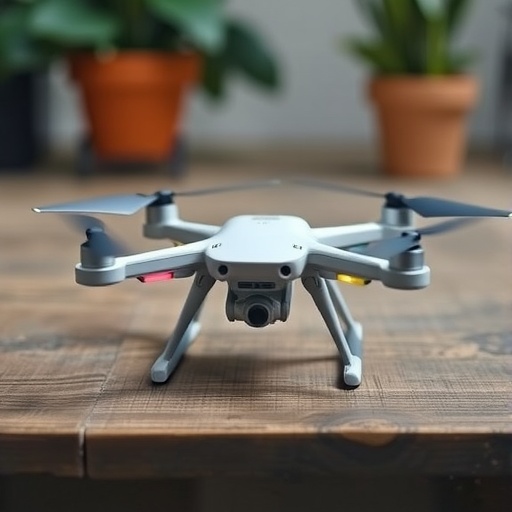
By exploiting a quirk of human vision, engineers at Northwestern University have built a drone that nearly disappears—right when you’re trying to look at it.
Instead of relying on classic camouflage, transparency, or light-bending optics, the team leaned on motion blur, the same visual effect that makes fast-spinning propellers and fan blades seem to fade into the background. Their approach targets perception itself: how long the visual system integrates information, and what happens when a moving object can’t be resolved into a stable shape.
The drone, nicknamed “Phantom Twist,” spins up to 25 times per second. That rapid rotation exceeds the clarity limits of the human eye, turning the vehicle from a distinct form into a ghostly smear that blends with whatever lies behind it.
A key design choice underpins this effect. Unlike a typical quadcopter with four separate rotors, Phantom Twist uses a single motor and a single propeller, arranged so the entire body rotates in the opposite direction to the propeller’s motion. As Rubenstein explains, this removes stationary parts that would otherwise remain visible.
Designing the geometry required computation at scale. The researchers first generated roughly 20,000 stable-flight configurations, then used AI-driven optimization to rearrange major components—motor, propeller, circuit board, counterweight, and batteries—while minimizing visibility from many viewing angles.
After narrowing candidates, they simulated each design spinning through flight and overlaid the rendered motion on 100 real background scenes. A human-vision-like perception model produced a visibility score, and the best performers were selected and refined again through repeated optimization.
The resulting system distributes components across different heights and angles with deliberate spacing, reducing visual overlap during rotation. When the parts blur together, the drone appears less like an object and more like a faint haze.
According to the team’s visibility metric, Phantom Twist is about 10 times less visually perceptible than a conventional quadcopter. Remaining limitations include audible noise from the propeller and partial visibility of wires and support rods, motivating future iterations with more transparent materials or quieter propulsion.
The work will be presented at Robotics: Science and Systems 2026 in Sydney, Australia, in a talk titled “Computational Design of a Low-Visibility UAV Using Human-Aligned Perceptual Metric.”
Subject of Research: Low-visibility UAVs using human-aligned perceptual metrics (motion-blur-based design)
Article Title: Computational Design of a Low-Visibility UAV Using Human-Aligned Perceptual Metric
News Publication Date: Thursday, July 16, 2026 (local presentation context stated; AEST/EDT given)
Web References: https://roboticsconference.org/ ; https://roboticsconference.org/program/papers/196/
References: Northwestern University (Michael Rubenstein and coauthors); National Science Foundation support
Image Credits: Northwestern University
Keywords
Low-visibility drones, motion blur, human perception, UAV design, robotics, computational optimization, computer vision
Tags: AI-optimized drone designblending with backgroundfast rotation effectsghostly drone illusionhuman vision perceptioninnovative drone stealth methodsmotion blur camouflagerapid spinning dronesingle motor quadcopterstealth dronetransparent appearancevisual masking technology