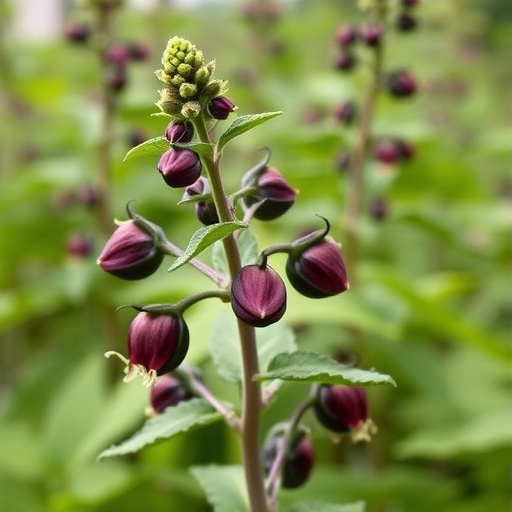
Traffic lights aren’t the only things that can shift from red to green. A team at Hiroshima University reports that the color of perilla can be reprogrammed using CRISPR-Cas9—while also rewiring the plant’s underlying chemical machinery. The result is a striking conversion of red perilla into a green phenotype that visually resembles conventional green varieties.
Perilla (a mint-family crop known as shiso in Japan, kkaennip in Korea, and tía tô in Vietnam) is widely valued for both culinary identity and market appeal. Its leaf color is more than cosmetic: red and green types differ in how they’re used and in what they contribute to flavor profiles. Beyond taste, perilla is chemically rich, containing hundreds of bioactive molecules linked to antioxidant, anti-inflammatory, and antibacterial potential.
The researchers focused on a pivotal gene in flavonoid biosynthesis, flavanone 3-hydroxylase (F3H). In flowering plants, F3H acts as a branching point that influences whether metabolic flux proceeds toward pigment-producing pathways. To test whether manipulating this control node could reshape both color and chemistry, the team disrupted the F3H gene in red perilla using CRISPR-Cas9.
Edited plants rapidly lost their characteristic red pigmentation and produced green leaves that were essentially indistinguishable from typical green perilla in appearance. This immediate phenotypic shift suggested that the genetic change had altered pigment accumulation and redirected metabolic flow.
Chemical profiling confirmed a major metabolic transition. Anthocyanins—the pigments responsible for red coloration—were dramatically reduced. At the same time, flavones increased substantially, including a reported ~sixfold rise in luteolin, a flavone associated with antioxidant and anti-inflammatory activity.
The study also detected elevated rosmarinic acid, another phenylpropanoid-linked metabolite. This pattern implies that targeting F3H affects not only flavonoid production but broader phenylpropanoid metabolism, expanding the scope of potential health-relevant compounds.
A key practical advance is that the team generated stable edited lines lacking foreign DNA from the genome-editing process, supporting the feasibility of non-transgenic perilla varieties with tailored metabolite profiles. In other words, the plants can carry the desired edits without remaining traces of introduced genetic material.
The authors propose that this single-enzyme intervention provides a strategic route for producing high-value perilla for food and pharmaceutical applications. Future work will use the new lines to probe how perilla’s diverse metabolite network is regulated, with the goal of enabling next-generation functional foods enriched with beneficial compounds.
Subject of Research: Perilla metabolic engineering using CRISPR-Cas9 (F3H disruption) to shift phenotype and enhance flavone/phenylpropanoid compounds
Article Title: CRISPR-Cas9 disruption of flavanone 3-hydroxylase produces a green phenotype and alters flavone metabolites in allotetraploid perilla
News Publication Date: 15-Jun-2026
Web References: https://www.frontiersin.org/journals/plant-science/articles/10.3389/fpls.2026.1877946/full
References: 10.3389/fpls.2026.1877946
Image Credits: Matsushita et al. / Hiroshima Prefectural Technology Research Institute
Keywords
CRISPR-Cas9, perilla, flavanone 3-hydroxylase (F3H), anthocyanins, flavones, luteolin, rosmarinic acid, genome editing, plant metabolism, functional foods
Tags: bioactive compound enhancement in perillaCRISPR applications in herbal crop developmentCRISPR-Cas9 gene editing in perillaculinary and medicinal herb improvementflavonoid biosynthesis manipulationgenetic modification of edible herbsperilla leaf color and chemistry changeplant metabolic pathway reprogrammingplant phenotypic trait editingred to green leaf color transformation in herbstargeted gene disruption in plantstraditional herb genetic engineering